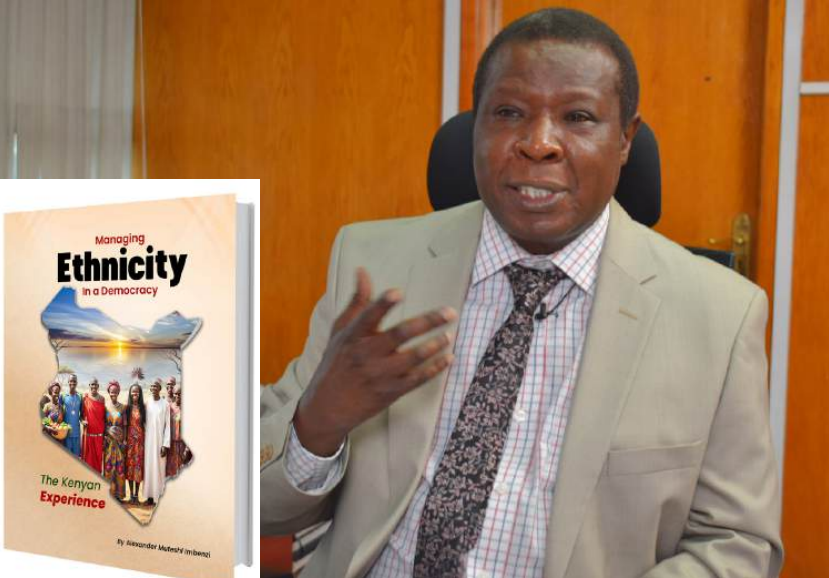
 Author Alexander Muteshi during an interview /CHARLENE MALWA
Will Kenya ever slay the dragon of ethnicity, which rears its ugly head during general elections? Can a more entrenched democracy serve as the antidote to overcoming ethnic tensions that often lead to violence?
These questions form the overall thesis of Alexander Imbenzi’s book, Managing Ethnicity in a Democracy: The Kenyan Experience.
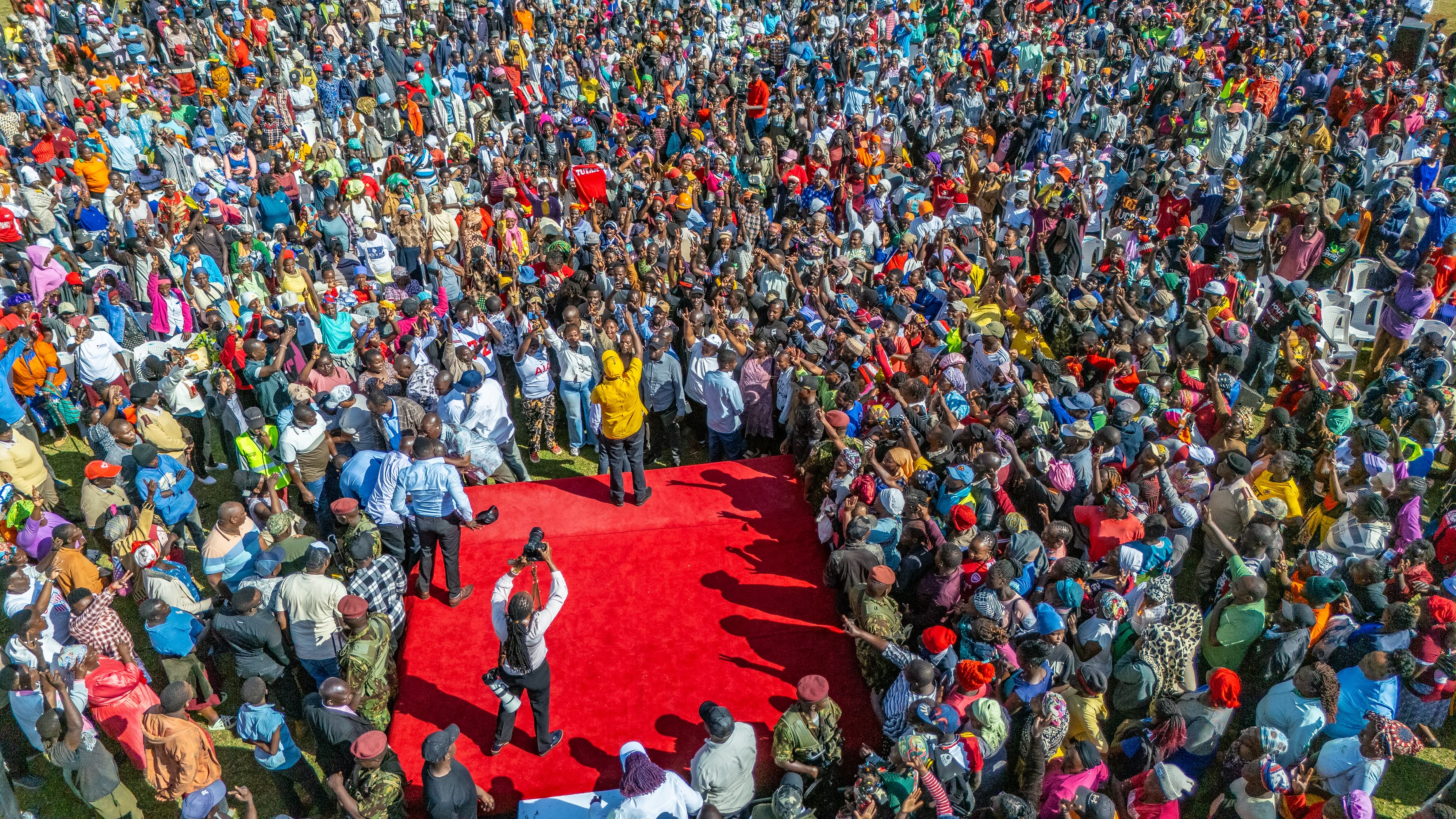
As Kenyans prepare for the 2027 general elections, there’s already palpable fear among some citizens that institutions paid for by taxpayers may not live up to expectations. Police killings of innocent civilians have become a permanent fixture of daily news, and political rallies are now hotbeds of violence.
Meanwhile, social media platforms have become havens for drumming the echoes of war. Economic stagnation and rampant corruption are breeding a culture of cynicism and despondency among youth, especially Gen Z. Things are falling apart, but the elites are either in denial or are afraid to confront the crisis.
Interestingly, according to Imbenzi, the various political, social, cultural and economic crises afflicting the country today have their foundations in Kenya’s adoption of a multiparty democracy.
In his argument, the repeal of Section 2a of the Independence Constitution in 1991 created a fertile ground for ethnicity to become the organising principle of distributing national resources.
“Elections have become a matter of life and death as Kenyans vote along ethnic lines and communities who win elections monopolise state resources while those on the losing side are marginalised,” Imbenzi writes.
“This has resulted in ethnic tensions, which have at times led to serious clashes and insecurity.”
He makes a plausible argument when viewed in the context of what Kenyan elections have become, especially after the promulgation of the 2010 Constitution.
For the record, all the elections since 2013 have been bitterly contested in the Supreme Court. During the charged petitions, the country nearly comes to a standstill and the economy suffers for it.
Imbenzi’s running argument throughout the book (the more reason it should be read by politicians and citizens alike) is that Kenya needs to bring to the fore such values as “integrity, accountability, equity and transparency” to forge a national consciousness. A tall order!
He believes these values have the potential to help Kenyans overcome the challenges of ethnicity and, more importantly, the dangers of a multiparty democracy.
Like Tom Mboya’s The Challenges of Nationhood: A Collection of Speeches and Writings, where the former Economic Planning Minister set out on an intellectual journey of finding out what was ailing the new African states, Imbenzi’s historical canvas is the post-Cold War era.
The Soviet Union has collapsed under the weight of its own contradictions. The structural adjustment programmes are making their way to African countries such as Kenya and they come with conditions of privatisation of state institutions and the broadening of the democratic space.
This essentially means more liberties: freedom of speech, freedom of assembly, freedom of the press and a strong and vibrant civil society that can keep the government in check. All this wind of change sweeps the continent much to the chagrin of its dictators.
Imbenzi’s central focus at this critical historical juncture is the creation of more political parties even as the liberalisation craze takes hold in African countries.
Unlike the political parties of the Independence period that prided themselves on their multiethnic composition, those that came after assumed a more singular ethnic face, meaning leaders and their members more often than not came from a particular region.
“This led to the formation of innumerable overtly and covertly ethnic political parties, with voting trends assuming ethnic dimensions,” he argues.
He adds: “Unfortunately, despite all these ethnic manifestations and apparent contradictions, the political elites have not made any effort to contain the polarisation and the impact it has on the democratisation process.”
For Imbenzi, Kenya can only fully achieve its democratic objectives if leaders and Kenyans alike come to terms with the negative consequences of ethnicity.
He extends that thread of argument to the politics of inclusion and exclusion. And a clear manifestation of that debate would be the doomed fate of the Building Bridges Initiative, the creation of the National Dialogue Committee (Nadco) and now the broad-based government.
Imbenzi argues that for any liberal democracy worth its name, access to state privileges and power depends on whether you belong or not. Yet, this imperfect system of governance (a relic of the colonial state) has continued throughout the post-colonial state to date.
He provides the example of the aftermath of the 1992 general election whereby “communities that largely identified with the opposition found themselves locked out of cabinet and government appointments.”
The events of 1992 would repeat themselves in 1997 and, surprisingly, even in 2003, when those who opposed Moi ascended to power and started ‘eating’ in earnest.
The same case with the Kenya Kwanza government when it promised to serve all Kenyans equally after it won elections in August 2022, but even before the dust settled, ‘shareholder politics’ erupted like a storm.
This worrying political pattern of including and excluding citizens based on their voting patterns cannot allow the country to attain its ambitions, more so the ‘Singapore Dream’ now being promoted by President William Ruto. Instead, a new reset is needed that will see the hypocrisy of ethnicity in entrenching democracy in a young state such as Kenya.
Tomorrow: What Kenya can do to overcome the challenges of ethnicity in the 21st century