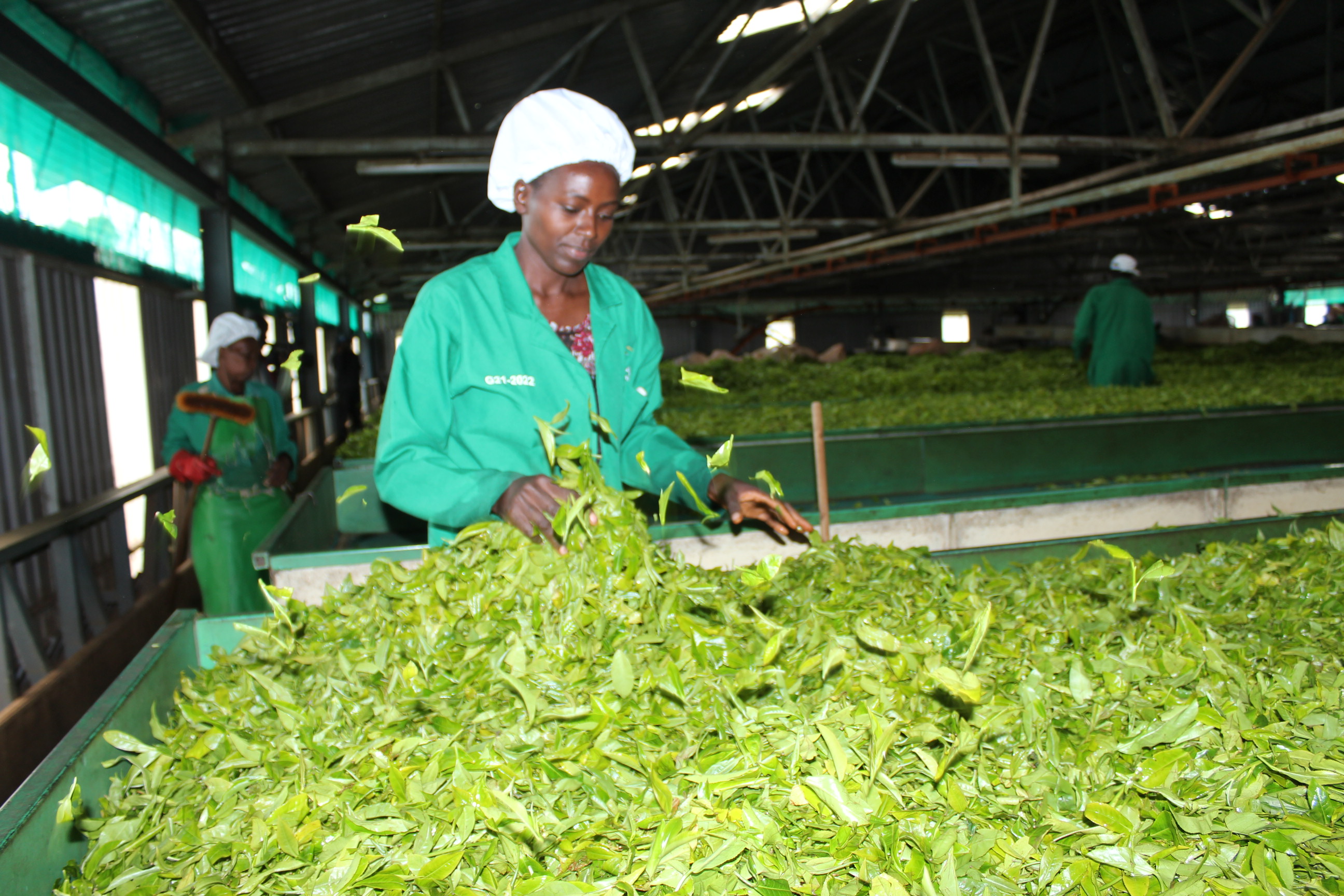
 A worker preparing tea for processing at Ngere tea factory in Gatanga, Murang'a./ ALICE WAITHERA
Tea farmers have earned $76.37 million (about Sh9.9 billion) since the beginning of the year after selling 35,031,737 kilos at the Mombasa auction.
Data from the East Africa Tea Trade Association shows tea traded at a cumulative average price of $2.18 (Sh281) per kilo in six auction sales.
This represents an improvement from the $2.14 (Sh276) per kilo recorded over the same period last year. However, traded volumes declined by 5.9 million kilos from 40.95 million kilos in 2025to35,031,737 kilos.
The figures point to a market that has remained increasingly quality-driven, with improved prices cushioning farmers against lower supply volumes.
Last year, tea production dropped by 13.55 per cent in the first two months of the year, with Tea Board of Kenya CEO Willy Mutai attributing the decline to unusually dry conditions.
“The dry weather had a significant impact on tea production in this period with output falling by 21 per cent in east of Rift and 18.6 per cent in west,” he said.
Absorption levels remained steady with the first sale in the first week of January this year recording a 79.6 per cent clearance rate, followed by 84.8 per cent in the second and 86.9 per cent in the third sale.
Demand strengthened further in the subsequent auctions, with sales four and five each posting 91 per cent absorption rates, while the sixth sale rose to 93 per cent, indicating consistent buyer participation and stable market fundamentals.
A defining feature of the period has been the strong performance of orthodox teas. Although black CTC (crush, tear, curl) teas continued to account for the majority of traded volumes, orthodox varieties consistently commanded a premium and played a central role in lifting overall earnings.
Across sales four, five and six, orthodox teas totalled 3,616,233 kilos and maintained a premium of between $40 cents (Sh52) and $50 cents (Sh65) per kilo on top of black CTC teas.
In the fourth sale, orthodox teas averaged $3.62 (Sh467) per kilo compared to $3.17 (Sh409) for CTC teas.
In sale five, orthodox teas earned $3.54 (Sh457) against $3.14 (Sh405) for CTC varieties and by the sixth sale, the premium widened further, with orthodox teas averaging $3.71(Sh479) per kilo compared to $3.21(Sh414) for CTC teas.
The consistent premium underscores a clear buyer preference for better liquoring teas and has significantly supported the overall cumulative average of $2.18 (Sh281) per kilo.
Kenya retained its dominance in both volumes and value while Rwanda continued to command premium prices despite lower volumes. The country sold 2,671,984 kilos at an average of $3.08 (Sh397) per kilo, slightly above last year’s comparable performance.
The majority of the teas were main grades, which drew robust international interest, supporting Rwanda’s status as a high-value, low-volume origin in the East African tea market.
Uganda traded 5,767,964 kilos across the six sales, averaging $1.11 (Sh143) per kilo, with the tea attracting buyers particularly for blending purposes in international markets.
Other East African countries had limited market participation in the first six sales. Tanzania sold 212,049 kilos cumulatively at an average of $1.36 (Sh175) per kilo while Burundi moved 120,598 kilos at an average of $1.49 (Sh192) per kilo.
Sales from Zambia, Malawi, Mozambique, Madagascar, Zimbabwe, DR Congo and Ethiopia were negligible or absent in the six weeks.
The main grades held relatively firm, with PF1, BP1, PD and D1 categories maintaining stronger price levels compared to secondary grades such as PF2 and D2.
Global Tea and Commodities Kenya Ltd emerged as the largest buyer with about 14 per cent followed by Chai Trading Company Ltd with eight per cent. James Finlay Mombasa Limited accounted for 7.65 per cent while LAB International Kenya and Mombasa Coffee Ltd completed the top five buyers.
Kenya hosts the largest CTC teas auction globally where sales are made weekly. Last September, the government opened the orthodox teas auction with the aim of expanding the produce’s market and moving the country away from low priced CTC teas.
The government aims to increase orthodox tea production from 15 million kilos in 2024 to 200 million kilos by 2030.
Regionally, other auction centres reported varied trends. Colombo recorded fair demand with selective gains for quality teas, while Guwahati saw good demand for better liquoring CTC teas. Chittagong registered firm interest in well-made broken and dust grades.
Overall, the first six sales of 2026 signal a stable start to the year for tea farmers. While volumes have declined compared to 2025, improved average prices, largely supported by orthodox tea premiums and steady demand for quality main grades, have strengthened cumulative earnings.
Farmer John Mwangi from Kinyona in Kigumo, Murang’a, said, “This year’s prices are encouraging and even though volumes are slightly down, the higher average price helps cushion the impact and motivates us to focus more on quality.”