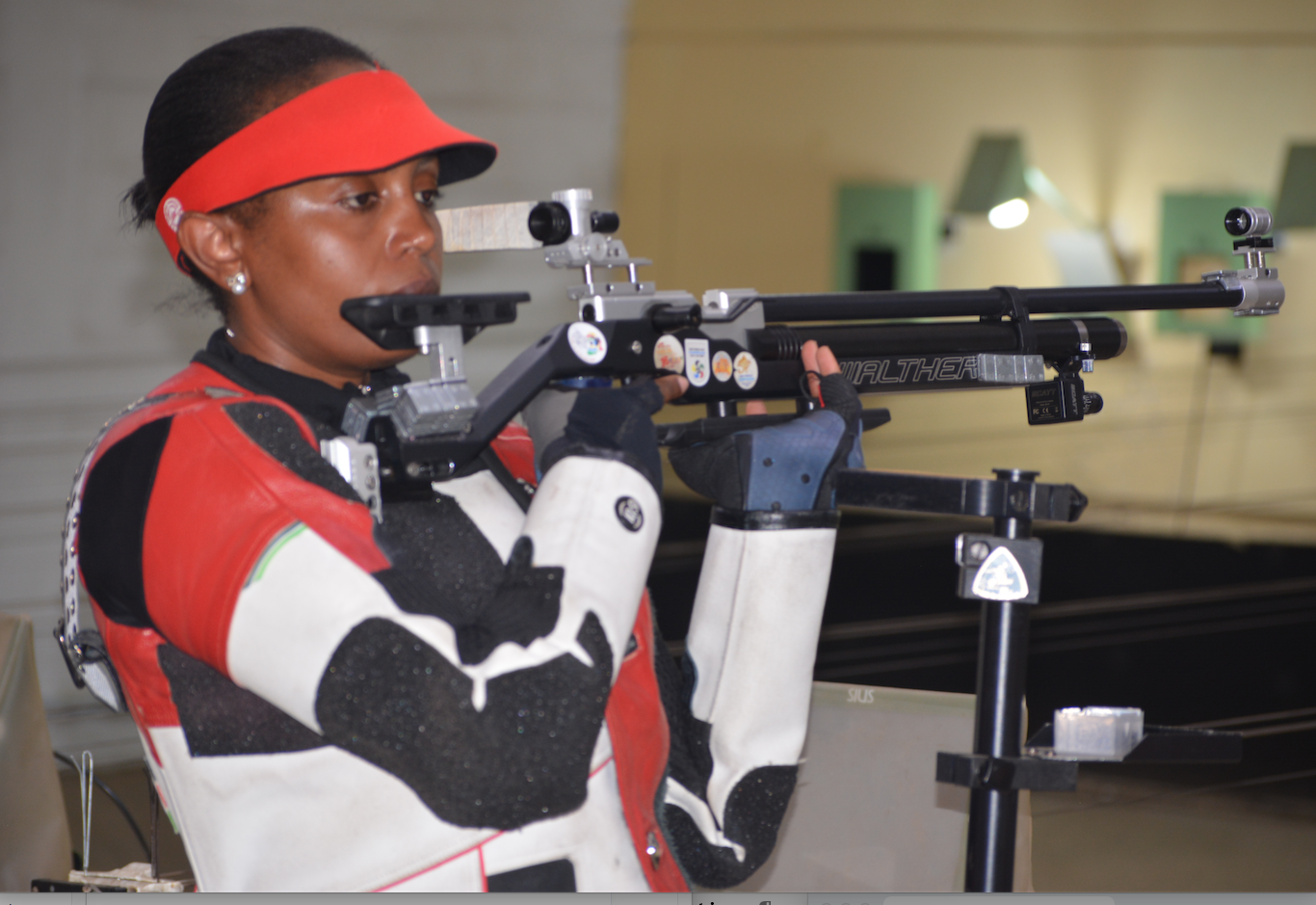
Kenyan air rifle shooter Priscilla Mburu’s rise to the top is anything but accidental. Her journey did not begin in a stadium or on a school playground, but inside a police training range — in uniform, rifle in hand, discovering a talent she never knew she had. Mburu did not grow up dreaming of targets and bullseyes.
Sport was never her first love. She stumbled upon shooting in 2015 after joining the Kenya Police Service, where firearm handling was part of routine induction.
It was at the Kenya Police Training College in Kiganjo, where something unexpected happened. The first shot changed everything. What began as compulsory drills quickly exposed an uncommon calm and precision.
While other recruits treated range sessions as routine, Mburu found herself intrigued by the mechanics — the science of breath control, the discipline of stillness, the quiet authority of focus. Instructors noticed it too. Her shots were grouped tightly.
Her posture rarely wavered. Even as a beginner, there was something deliberate about her presence on the firing line. “At first it was just part of the training,” she recalls.
“But after a few sessions, I realised I was enjoying it — and my shots were landing well. I wanted to get better.”
She began staying behind after official sessions and squeezing in extra practice whenever ammunition was available. Pellets were scarce, sometimes shared, but that never discouraged her.
“Every shot felt like I was learning something new,” she says. That curiosity soon turned into commitment. Encouraged by senior officers who saw her potential, Mburu began to view shooting not just as a police skill but as a competitive sport.
By the time she completed her training, she had built more than technical competence and developed the mental discipline that would define her career.
Her breakthrough on the continental stage came at the 2019 African Shooting Championships in Algeria, where she posted 601 points — a score that signalled she belonged among Africa’s elite. “I never even knew this sport existed at first,” she admits. “But once I started, I realised I could actually compete.”
Since then, silence has become her arena. Unlike athletics or football, air rifle shooting does not command roaring crowds.
There are no deafening cheers when she raises her rifle — only the controlled rhythm of breath, the steady squeeze of a trigger, and the faint thud of a pellet striking paper. In that silence, Mburu thrives.
At the African Championships in Cairo, she secured two silver medals — in the 50m rifle three-positions and the 50m rifle prone events — cementing her status as one of the continent’s top shooters.
“I won two silver medals in Cairo, which was a huge achievement,” she says. “It showed me I could compete with the best in Africa.” Her ambition now stretches beyond continental podiums. A second nod from the Olympic Solidarity Scholarship programme has placed her firmly on the road to the 2028 Summer Olympics in Los Angeles.
For Mburu, the scholarship is more than financial assistance — it is validation. “I am honoured to receive it for the second time,” she says.
Her first Olympic push ended in disappointment at the ISSF qualification championships in Rio de Janeiro, where she finished 50th in the 50m rifle three-positions event, missing out on the 2024 Summer Olympics.
“The competition exposed gaps in my preparation,” she reflects. “Precision shooting is not linear.” Instead of retreating, she recalibrated.
Paris became a lesson, and Los Angeles became the mission. Now competing through the 2025–2028 Olympic cycle, she is focused on improving her ranking points and gaining more international exposure after funding constraints limited competition opportunities between 2024 and 2025.
“I have been missing competitions because of funding limitations,” she says. “But now the focus is on qualifying early and preparing properly.”
Shooting is not a cheap pursuit. Rifles, pellets, range access and international travel all come at a cost. Before her first scholarship, Mburu largely funded her own training.
A single box of pellets can cost around Sh2,500 — a recurring expense that made sustained preparation difficult. “The scholarship covers training, camps and competition exposure,” she explains. “It supplements what is already on the ground.” Her dream carries historical weight.
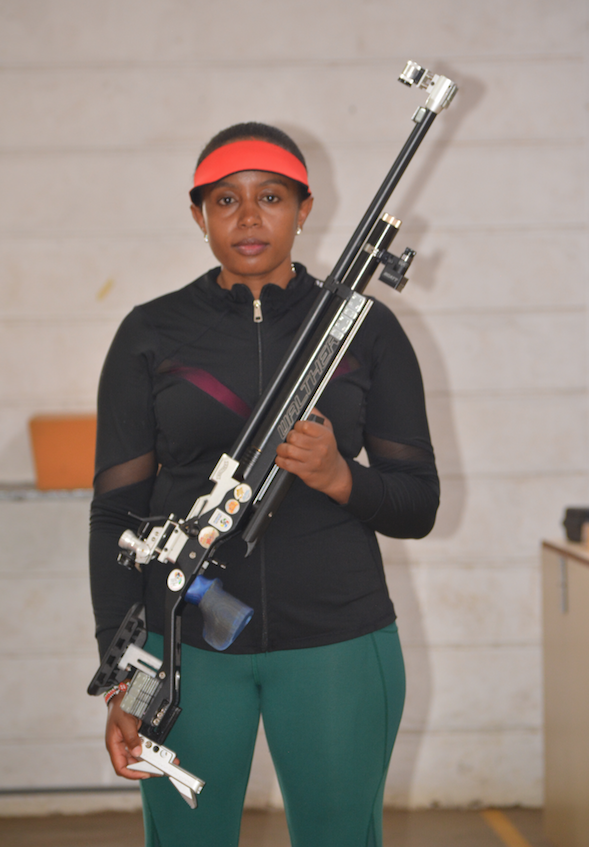
“It is everyone’s dream to be at the Olympics,” she says. “But you must sacrifice and commit to the process.”
Away from the range, she is pursuing an undergraduate degree in counselling psychology — a field that mirrors the mental precision her sport demands. “One thing about the brain is that it cannot multitask,” she says. “When you step onto the shooting line, you must think only about shooting.”
Her days are built around discipline: early wake-up, warm-up, breakfast, training session, then gym work in the afternoon. Yet the real battle is internal. “The first minutes on the line are for mental preparation. This sport is largely mental.”
Her next major test comes at the World Cup and African Championships in Germany this May — competitions that will measure her progress as she intensifies her Olympic build-up. In Kenya’s sporting culture, noise often equals recognition.
Mburu’s journey, however, is unfolding in near silence. There is no roar when she lifts her rifle — only a quiet click and a tiny mark appearing on a distant target.
But if her aim remains steady, that silence could one day explode into history in Los Angeles — proof that sometimes, the loudest statements are made without a sound.