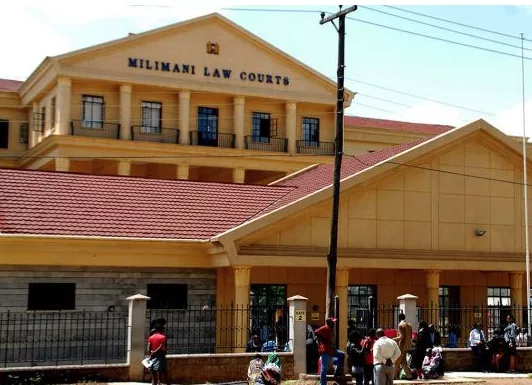
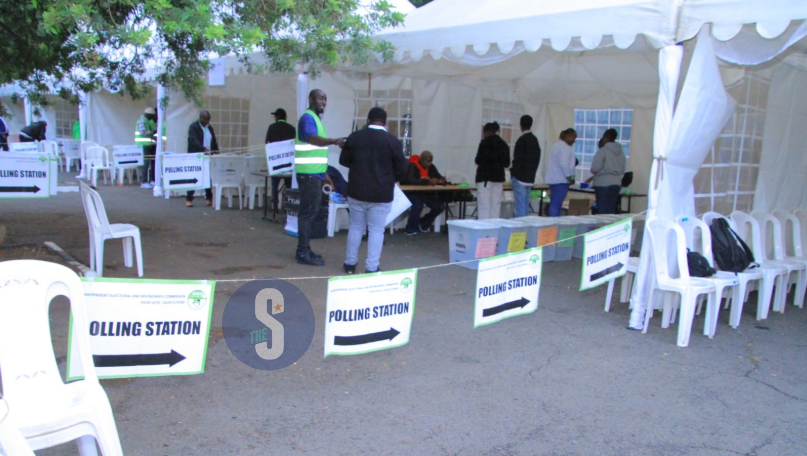
 Lawyers prepare to vote in LSK elections at the Supreme Court in Nairobi, February 19, 2026. /EZEKIEL AMING'A
More than 20,000 advocates across the country are on Thursday casting their ballots in a high-stakes election to determine the next leadership of the Law Society of Kenya, as the tenure of the current council draws to a close.
The outgoing council assumed office on March 22, 2024, for a two-year term, and its exit has triggered a highly competitive race that will determine the society’s leadership at a politically sensitive moment for the country.
On the ballot is the election of the LSK president and vice president, three representatives of the general membership of the society, four upcountry representatives, three Nairobi representatives, and one Coast representative who ordinarily practises at the Coast.
The current office holders are Faith Odhiambo as president and Mwaura Kabata as vice president.
The general membership representatives are Tom K’opere, Teresia Wavinya, and Hosea Manwa.
Nairobi is currently represented by Gloria Kimani, Irene Otto, and Stephen Mbugua, while Vincent Githaiga, Lindah Kiome, Hezekiah Aseso, and Zulfa Roble serve as upcountry representatives. Elizabeth Wanjeri is the Coast representative.
Attention is firmly fixed on the contest to replace Odhiambo as the 52nd LSK president, which has attracted three heavyweight contenders.
Senior Counsel Charles Kanjama, current vice president Mwaura Kabata and senior lawyer Peter Wanyama are facing off in what has become a closely fought and ideologically distinct race.
The vice president’s position is also hotly contested. Wanjeri, who currently serves as the Coast representative, is competing against Debora Anditi and Teresia Wavinya, who presently sits on the council as a representative of the general membership.
Within the general membership category, Ndegwa Wahome and Tom K’opere are battling for the slot reserved for an advocate of at least 25 years’ standing, a position that counts among the three representatives of the general membership of the society.
Beyond that, a total of 11 candidates are competing for the remaining two general membership positions.
Competition is similarly intense in the regional contests, with 10 candidates vying for the three Nairobi representative positions, eight candidates seeking to fill the four upcountry posts, and two candidates facing off for the single Coast representative seat.
Beyond the council membership, nine candidates are contesting positions in the Advocates Disciplinary Tribunal (ADT).
The ADT is composed of six advocates of not less than 10 years’ standing, alongside the Attorney-General or a representative, the Solicitor General, and the chairperson or vice chairperson of the LSK. In addition, three laypersons are appointed to the tribunal.
Eligibility criteria for the various posts are tightly defined.
Candidates for president and vice president must be members of the LSK and either current or former members of the council, or persons qualified for appointment as judges of the Supreme Court.
Those vying to be council members must be members of the society, have been in practice for at least two years from the date of admission, must not have been found liable for professional misconduct by the disciplinary committee established under the Advocates Act in the three years immediately preceding the election, and must meet the requirements of Chapter Six of the Constitution.
Voting is being conducted at court stations across the country. The exercise is being overseen by the Independent Electoral and Boundaries Commission, working in collaboration with the LSK secretariat to facilitate the process and ensure credibility.
Campaigns culminated earlier in the week with a televised live debate on Monday, February 16, for the presidential candidates.
The three contestants faced off in a forum dubbed “The Final Submissions” at the Catholic University of Eastern Africa, where they laid out their manifestos and responded to questions from council members.
Kanjama enters the race as a seasoned legal practitioner with more than 20 years of experience.
He was conferred the rank of Senior Counsel in 2022 and previously served as the inaugural chairperson of the LSK Nairobi Branch between 2016 and 2020, as well as chairperson of the LSK Caucus of Branch Chairs.
Running under the acronym “RIPE”—Rule of Law, Integrity, Practice & Welfare, and Engagement—he has cast himself as a “steady hand,” with a campaign anchored on ethical leadership and completing the Wakili Towers project whose groundbreaking was overseen by the outgoing president.
Kabata, the incumbent vice president for the 2024–2026 term, is a senior partner at Alakonya Law LLP with a practice focused on dispute resolution.
He is widely known for his involvement in public-interest litigation, particularly his role in defending constitutional rights during the 2024–2025 Gen Z protests.
Campaigning under the slogan “A Brave, Bold and Boundless LSK,” Kabata has emphasised continuity of current leadership initiatives, accelerated digital transformation through a paperless LSK, and turning Wakili Towers into a revenue-generating asset to ease the subscription burden on members.
Wanyama, an advocate with 18 years of experience, is making a second attempt at the presidency after finishing as runner-up in the 2024 election.
A consultant in legislative drafting, he has participated in the development of more than 32 statutes for government agencies.
He has positioned himself as a reformist candidate calling for “strategic, purposeful and strong leadership,” with an agenda that spotlights the mental health crisis among lawyers, increased financial support for regional branches and the expansion of economic opportunities beyond traditional litigation.
The significance of the elections has drawn commentary from senior figures in the legal fraternity.
Former Chief Justice David Maraga described the vote as a critical event in Kenya’s history, particularly because the new LSK leadership will still be in office in August 2027, when the country holds its next general election.
He said the society has a critical role in the governance of the country by fostering a culture of constitutionalism and respect for the rule of law, and warned that the incoming council must remain vigilant at all times.
Maraga urged the new team to learn from past office holders while guarding against electoral illegalities and the criminalisation of Kenyans who pursue electoral justice.
“The LSK President cannot be a person who second-guesses or wants to moderate the potency and reach of the constitution for political expediency. Instead he must be one who will insist and take decisive and prompt action to ensure that the constitution is followed to the letter,” he said in a statement.
The former Chief Justice called on advocates to vote for candidates of demonstrable integrity and who carry the hopes of all those who care about the rule of law and constitutionalism.
“I urge you to choose, not those who have strongly professed to reduce LSK into a mere trade union for lawyers, but instead choose those who have genuinely emphasized the role of LSK in guiding Kenya to the path of a more perfect culture of constitutionalism,” he said.
As polling unfolds across the country, the outcome is expected to shape not only the direction of the LSK over the next two years but also its posture during a period when constitutional vigilance and professional independence are likely to be tested.
The Church has already sounded alarm bells, warning the political elite to tone down on what it described as highly-charged early and divisive campaigns.