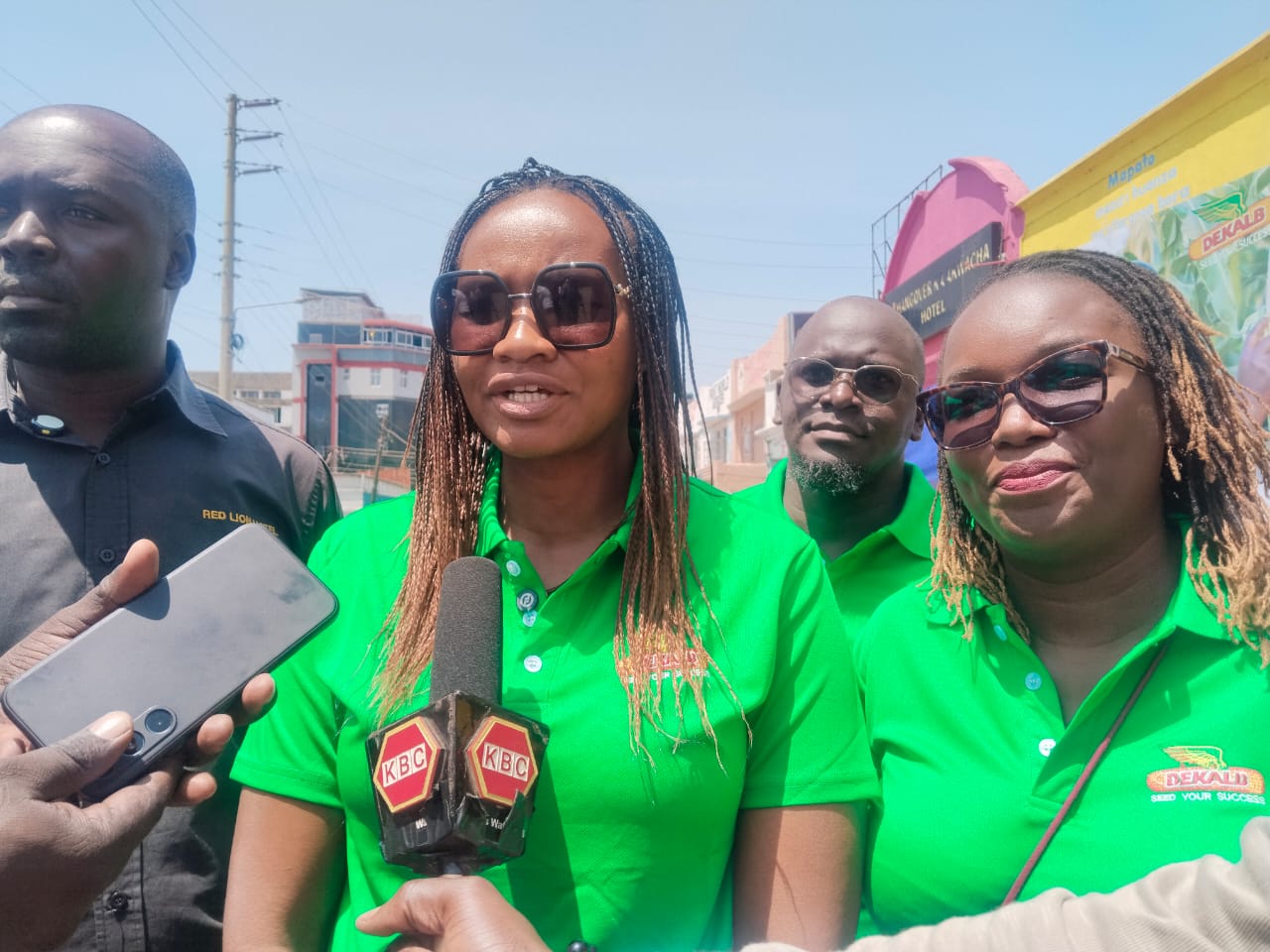
 Everlyne Musyoka, Unit Support Squad for Smallholder Farmers Africa at Bayer, speaking to the media in Kisumu./FAITH MATETE
Farmers across Kenya are being urged to verify the authenticity of the seeds they purchase following the launch of a nationwide anti-counterfeit campaign by Bayer.
The initiative, unveiled by Everlyne Musyoka, who leads Bayer’s Smallholder Business Segment across Africa, aims to help farmers confirm whether the seeds they are buying are genuine before planting.
Speaking during the launch in Kisumu, Musyoka said farmers can authenticate their seed using a scratch-and-send verification system developed in collaboration with the Kenya Plant Health Inspectorate Service (KEPHIS) and the Seed Trade Association of Kenya.
“We are inviting farmers to ensure that the seed they are buying is genuine and of high quality,” Musyoka said. She added, “Farmers should scratch the sticker on the seed package and send the unique code via SMS to 1397. They will receive a confirmation message indicating whether the seed is authentic or counterfeit.”
Tackling counterfeit seed
The campaign comes amid growing concern over counterfeit agricultural inputs in the market. According to Musyoka, fake seed significantly reduces yields and undermines food security.
“When a farmer unknowingly buys counterfeit seed, their harvest is compromised from the start. Quality input begins with certified seed,” she said.
Through the SMS verification system, farmers can confirm the certification status of the seed, including its registered batch number. If the code is invalid or unrecognised, the system alerts the farmer that the product is not certified.
“All certified seeds in Kenya are registered with KEPHIS. If the code cannot be authenticated, that is a red flag,” she added.
Focus on climate-resilient varieties
The campaign specifically targets farmers purchasing Bayer’s DEKALB maize varieties, which are tailored for different ecological zones across the country. Available varieties include:
DK 831
DK 833
DKC 1989
DK 777
Musyoka explained that the varieties cater to different maturity periods and climatic conditions. Early-maturing varieties such as DK 831 and DK 833 mature within 90 to 110 days and are suitable for regions like Eastern Kenya and the Coast.
Medium-maturing varieties take approximately 120 days, while DK 777 is recommended for medium transitional areas such as Kericho and Bomet. Additional options are available for highland regions.
With increasing climate variability and frequent drought cycles, Musyoka said Bayer has invested in drought-tolerant seed capable of performing under limited rainfall.
“Our varieties are developed to withstand drought conditions and help farmers achieve reasonable yields even when rainfall is below average,” she said.
Some of the varieties also offer tolerance to major maize diseases, including Maize Lethal Necrosis (MLN), which has affected production in parts of the country in recent years.
Beyond authentication, the campaign includes a consumer promotion. Farmers who scratch and send the verification code are automatically entered into a national competition, with several prizes up for grabs. One grand prize winner will receive a pickup truck.
“The promotion runs until the end of May, and the final draw will be conducted between mid and late May,” Musyoka said.
She encouraged maize farmers across Kenya who purchase DEKALB seed to participate, emphasising that authentication not only protects their investment but also strengthens national food security.