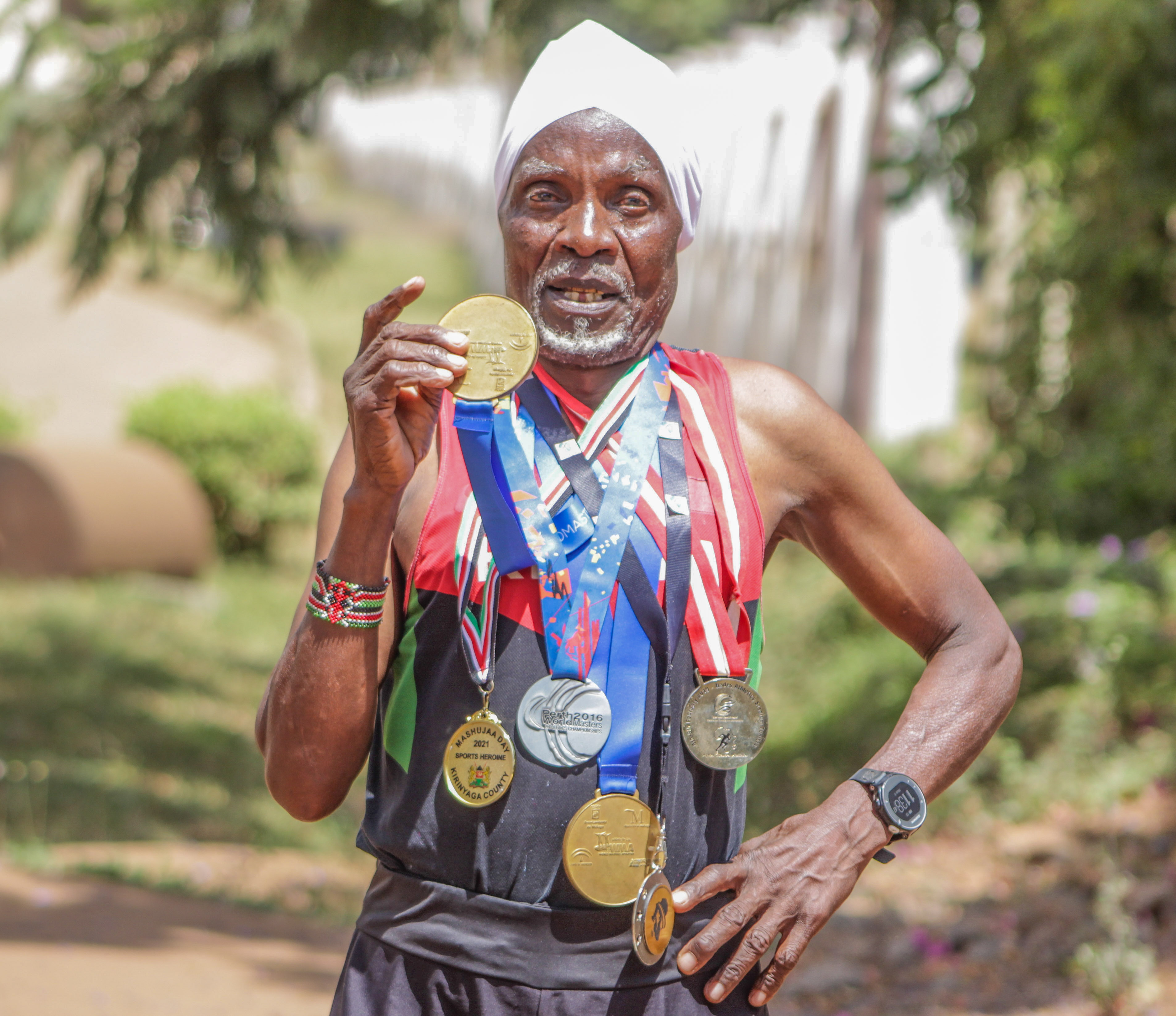
 Stephen Kamande parades some of the medals he has won/ TEDDY MULEI
For most people, turning 70 signals the long exhale.
It is the age of earned rest, of careful steps, of slowing the body so it can last a little longer and of doctor’s appointments.
The wild ambitions of youth are packed away, replaced by routine, safety and memory. It is the period when the consequences of a lifetime of habits become visible, when caution becomes a daily companion, and strenuous exertion is politely shown the door.
The science supports it. Past that milestone, the human engine loses horsepower, muscles thin, bones stiffen, recovery stretches into days instead of hours, and even minor illness can quickly become major.
Strenuous effort is discouraged. Risk is unwelcome. Comfort becomes king. But somewhere on the roads of Kiambu at dawn, while the world still rubs sleep from its eyes, Stephen Kamande is busy dismantling that script.
Known to the athletics community as “Wagithomo,” Kamande is now 74 years old and still looking strong.
To followers of the sport, he is unmistakable, small in stature, with a white turban wrapped firmly around his head, a sacred Akorino symbol fluttering gently as he glides through warm-ups.
His presence at start lines first confuses people, then amazes them and finally inspires them. While many of his peers slow down, he is still pinning on bib numbers, lacing up his spikes and reporting to Athletics Kenya meetings, ready to go toe-to-toe with athletes young enough to be his grandchildren.
In many ways, Kamande is a walking argument against limitation, a man whose pulse seems to beat in rebellion against the expectations of age. Science, of course, warns otherwise. Even the best-conditioned elderly athletes must contend with cardiovascular strain, stiff joints, and slower recovery cycles. Long-distance racing at such an age is a calculated risk.
Yet Kamande continues to glide past those warnings, anchored by discipline and faith in the temple he carries. He says caring for his body is non-negotiable. “I put a lot of focus on my body to ensure I keep myself fit and stress-free,” Kamande says.
What follows next feels almost mythical. Across the 74 years, he has never been admitted to a hospital. In a lifetime, only two injections.
“In my life, the first injection I ever got for being sick was back in 1965, at that time I was in high school. I was doing some rice farming, trying to get a little extra cash. Because that area has a lot of mosquitoes, I got Malaria and had to get an injection.”
“The second injection was during the COVID period, and that was mandatory because to compete or train, you had to show proof you were vaccinated. Also, I have not been admitted to a hospital in my lifetime,” he says.
During the day, he is a fruit vendor at the ever-busy Globe Roundabout. By lifestyle, he is a guardian, strict, deliberate and disciplined.
“You need to be the guard of your own body and know what it is you are aiming at and want to achieve. Also, the food you eat is important to maintain your body. For me, I eat only traditional foods like sweet potatoes, arrowroots and lots of traditional vegetables. I also take care not to use too much oil.”
“You should prevent stress and stay away from drugs like alcohol for your body to stay healthy.”
Years around fresh produce have only deepened his belief in nature’s pharmacy.
“Fruits like beetroot, blended with cucumber and garlic, are very healthy. Taking a glass a day is very healthy. Even athletes come to my stall to try the mixture because it helps to purify the blood.”
Beyond nutrition, he measures his wealth in years having the rare privilege of witnessing history unfold again and again.
“I have seen six administrations in my life, the colonisers, Jomo Kenyatta, Daniel Moi, Mwai Kibaki, Uhuru Kenyatta and now William Ruto. I was part of the young battalion that fought for the release of Kenyatta from detention. “Being able to live through all those administrations for me is more blessings than money itself.”
Still, nothing animates his face like talk of running. “I love running; it’s something that has been embedded in my DNA. I have competed in more than 30 half marathons so far in my career. What gives me much joy in running is to see that I am motivating a lot of people, an old man of my age still running ... that is huge motivation.”
His routine would intimidate athletes in their twenties. “I start my training at 5 am every day and do like 21km or sometimes 17km along Kiambu road, then go to work.”
“Sometimes I even go to Karura Forest and do one to three hours of training. Because the routes are marked, I run around 10km or even 21km,” Kamande says.
Born in 1952 in Gatunduini, Murang’a County, the seeds of this romance with the road were planted early. “I used to study in a school called Njora Primary, and at that time I was the only one who used to run; I did the cross country. I would go all the way to the nationals because there were not many people in central running at that time.”
“I used to run without shoes, and at the nationals, I used to meet students with shoes. So I used to question my teachers, but they encouraged me to continue running.”
But adulthood can be ruthless with dreams. After High School, marriage came, responsibility followed, and this forced me to put athletics aside. “I continued with my schooling while still running, but then I had to stop because after high school, I settled down with my wife.”
“Now I had to go out to work, to fend for my family, doing manual jobs in Nairobi,” he recalls. Like many love stories, the separation was long, but the flame never died.
“Even after I stopped running, that urge was still there and in 2012 that passion returned. At that time, I was 53 years old. Years had gone by, but that did not stop me.”
“I heard of a race which was happening at Mwiki. That was like a sign calling me back to running. I told myself that no matter what, I had to join that race,” he said.
"Registration for the race was only Sh50. I performed very well in that race and beat both old and young athletes. I was given a medal and Sh200 for the win.”
The prize money was little, but the fire it lit was enormous. “From there, my passion for running returned, and I saw I still had the potential.”
It was also there that fate introduced him to coach George Kinuthia of Kabete Cares. “When I was running in that race, he saw me. At that time, I did not even have proper running shoes. He started supporting me because he saw my passion. He was even paying for some of my races.”
“I remember my very first half-marathon was the Beyond Zero and Standard Chartered. Those races remain very fresh in my memory,” he said. He ventured onto the track too, braving the punishing 25 laps at AK meetings.
“My very first Athletics Kenya meeting was in Kapsabet, where he ran 10,000m. From there, I have featured in numerous events.”
However, not everyone welcomed him. “There are some people who wanted to chase me away when I started doing the AK meetings. They used to tell me that my time as an athlete was over and that I should not compete. That did not faze me; I kept on persisting until they became comfortable with me running.”
But inspiration travels faster than criticism. “The younger athletes are so happy seeing me running. I motivate them a lot because now they can see they still have time to achieve their dreams.”
His journey in athletics continued, and in 2016, the boy who once raced barefoot finally flew. “That was my very first time out of Kenya and also to be on an aeroplane. I was 65 years old at that time.”
“I went to represent Kenya at the World Masters Championships in the half-marathon race in Australia.”
At the 2016 global showpiece in Perth, Australia, Kamande clinched silver in the M60 Half Marathon, timing 1:27:39. He trailed Britain’s Paul Thompson, who claimed gold in 1:23:01, with New Zealand's Dennis Wylie rounding off the podium in 1:39:42.
“I was very happy. That gave me the morale to do even more in training because I saw I had flown Kenya’s flag proudly at my age,” Kamande said.
“Many people did not believe in us before we went to Australia, but when we came back, we had almost 15 medals. That performance gave even the young athletes confidence.”
Two years later, Kamande returned to the global stage at the World Masters in Malaga, Spain, winning two gold medals. His first triumph came in the M65 5,000m, where he was in strong form, winning the title in 18:36.61. Germany's Bob Gradbury (18:53.46) and Denmark's Lars Jensen (19:10.88) placed second and third.
Kamande didn't stop there. He went on to secure the Half Marathon title in 1:27:27, leaving Britons Andrew McLinden (1:28:35) and Paul Whelpton (1:28:38) in his wake.
“I was very pleased with my double gold in Malaga. That gave me even more belief. The only challenge before going to Malaga was training shoes; I did not have proper training shoes.”
His continental exploits saw him claim gold at the 2021 Africa Masters Open Championships in Nairobi, clocking 1:56:40 to win the 21km race.
“Last year I had planned to go to the USA for the Masters, but the number was trimmed because of regulations from the US, so we could not do anything.”
Kamande now says he wants to venture into the full marathon and has set a target of three hours. “I want to now venture into the full marathon gradually. My target is to run three hours, with my current age, that will be fast, but it’s something I know I am capable of,” he said.
Beyond personal ambition, his pride also lives in those he has lifted. “I have also mentored some young athletes from my area, like Jackline Wambui. We used to meet early in the morning while on my morning run. She used to wake up early, go for a morning run, then come back home and go to school.”
“I saw her talent and went to her school and approached her parents and told them she has a talent for running. I offered to nurture her, and they agreed, so I brought her to Nairobi and introduced her to a friend of mine who was a coach.”
Wambui would grow to win the World Youth 800m title in Nairobi in 2017, clocking 2:01.46. His journey has not been without its struggles.
“The biggest struggle for me is support. Sometimes I don’t have proper running shoes, and finances are also scarce. If I were to get someone or even a company to help him in my journey as I try to inspire the next generation, it would really be very helpful.”
And in the quietest revelation, he admits he once kept his return secret.
“At first, I did not tell my family that I had gone back to running; I did not want them to know. But now they see me on TV running, and they fully support me.”
His next dream is local but enormous, a marathon in Murang’a. “I am hoping to meet with Murang’a governor Irungu Kang'ata so that we can have a sit-down with him and discuss the idea of starting a Marathon in the area, the Mau Mau Road Marathon.”
“I want to do something that will benefit my community and my country as well. This is a race that will open up the county because even foreigners will come to the county and boost its economy as they learn about our people.”
The father of six, five girls and one boy, says he is also trying to mentor his grandchildren into the sport. "My children are all grown up. They don't do athletics, but there is one of my daughters who does some marathons."
"I have my grandchildren, whom I also want to mentor so they can carry the family tradition and name in athletics."