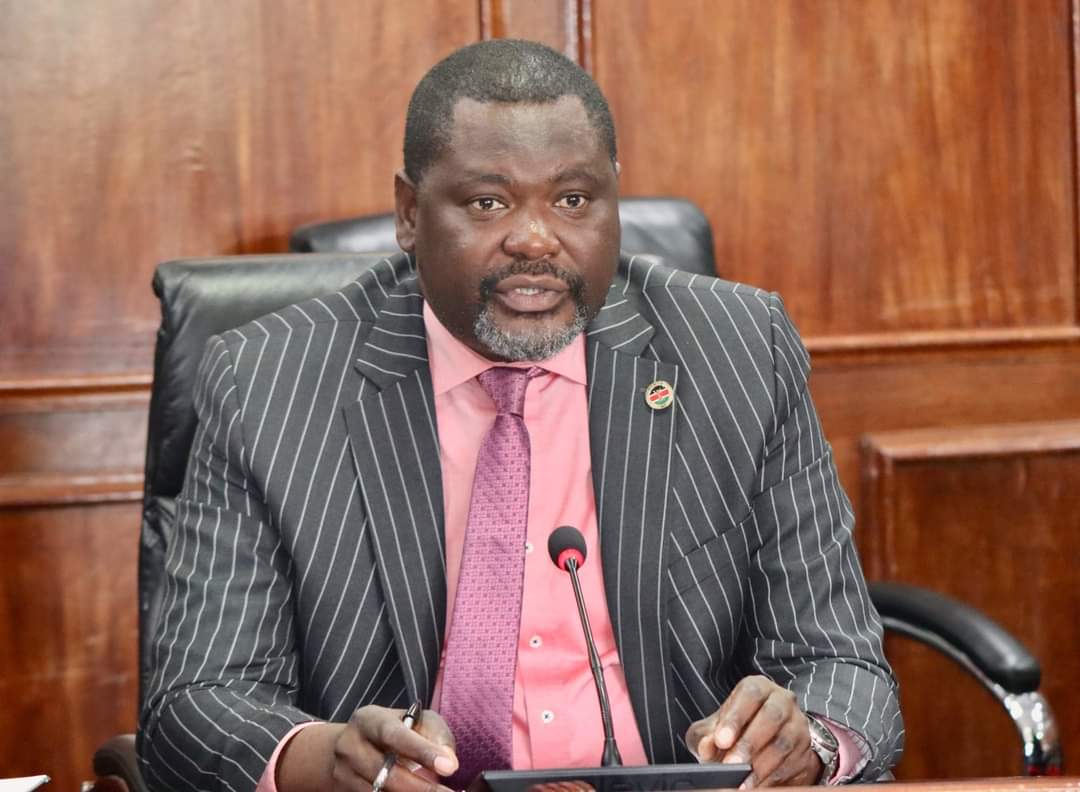
Public Service Cabinet Secretary Geoffrey Ruku has defended the government’s response to the ongoing drought, insisting that authorities anticipated the crisis and moved early to cushion vulnerable communities.
Speaking on Thursday amid growing concern over rising hunger levels, Ruku said the State began preparations as early as July last year, long before the situation escalated.
“The government did not wait for the drought to be a disaster. We knew, and that is why we kept on preparing from July, and we have data to support that. The government has not been caught flat-footed as far as the drought is concerned,” he said during an interview with Citizen TV.
Ruku explained that early warning systems and coordinated planning through the National Drought Management Authority (NDMA) enabled the government to monitor conditions and roll out mitigation measures in advance.
He said the authority’s data has been instrumental in identifying counties at risk and guiding food distribution and water interventions.
According to the CS, relief food distribution has been ongoing in severely affected counties, with supplies dispatched twice every month.
He described the volumes involved as substantial, aimed at cushioning families facing acute food shortages.
“The government has enough food and is committed to saving lives by ensuring nobody dies because of hunger; we shall do whatever it takes,” Ruku said, underscoring the administration’s resolve.
He added that the drought response has not been a standalone effort by his ministry but a coordinated approach involving multiple government departments and development partners.
However, Ruku acknowledged that emergency relief measures are not a long-term solution.
He said the country must invest heavily in water infrastructure to break the cycle of recurring drought crises.
“What we are doing is not sustainable; we need huge resources so that we can construct dams. Water infrastructure is one of the most expensive projects,” he noted.
The CS pointed to the proposed National Infrastructure Fund as a key vehicle to finance large-scale water projects.
He argued that investing in dams and other water systems would go a long way in ensuring that drought emergencies, which have plagued the country for years, become a thing of the past.
Latest data, according to the CS, indicates that the number of Kenyans affected by drought has risen sharply.
One month ago, about 2.1 million people were affected. As of this week, the figure stands at 3.3 million
The NDMA has classified Mandera, Wajir, Kwale and Kilifi as counties in a very severe phase.
Counties at the alert phase include Baringo, Garissa, Kajiado, Kitui, Lamu, Samburu, Taita Taveta, Tharaka Nithi and Isiolo.
Despite the worsening numbers, Ruku maintains that the government remains firmly in control of the situation, relying on data-driven planning, sustained food distribution and long-term infrastructure investment to mitigate the impact of the drought and protect lives.