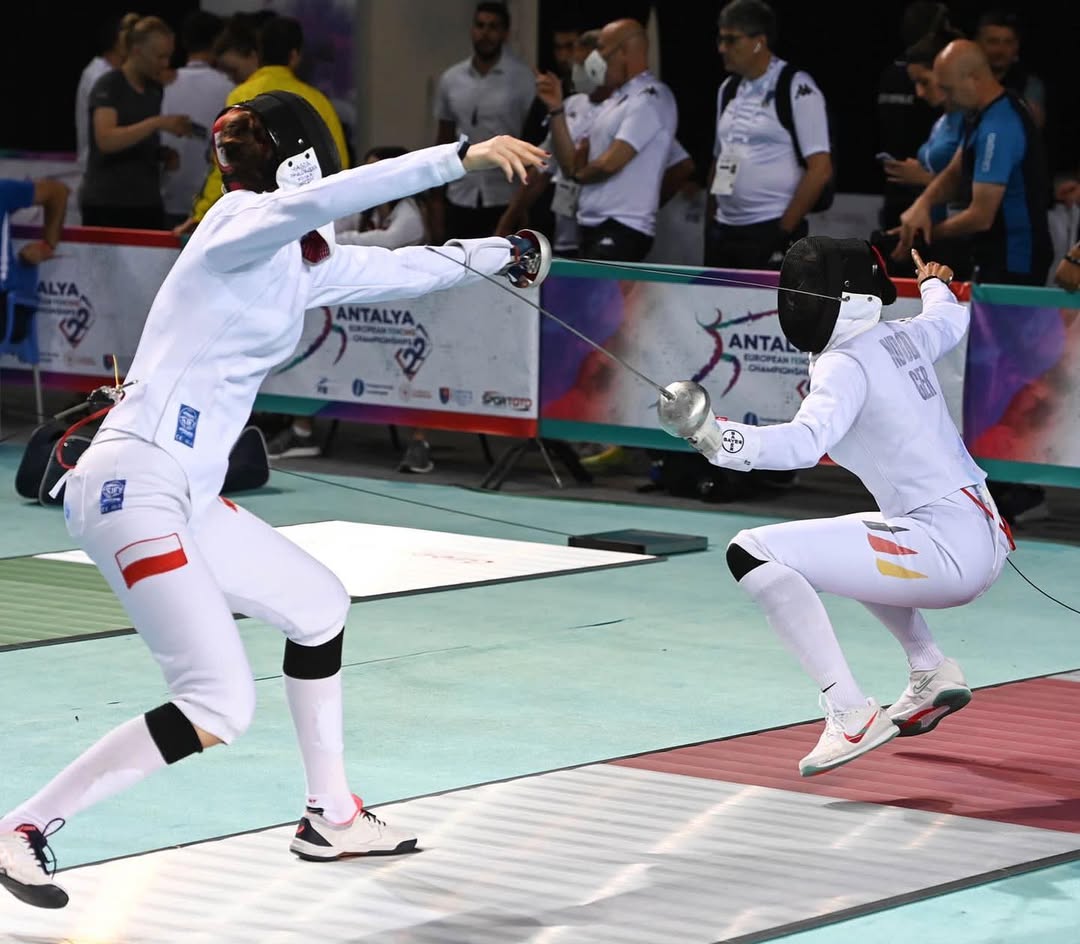
 Kenya's Alexandra Ndolo in a previous bout/ HANDOUT
At the 2024 Paris Olympic Games, Alexandra Ndolo thrust Kenya into the spotlight of a discipline many scarcely knew existed on local soil, fencing.
Rooted in the traditions of historic swordsmanship, fencing is a duel of skill and nerve, where two athletes, known as fencers, wield blunted, flexible blades in a bid to land scoring touches on defined target areas while evading their opponent’s strike.
Read Also
It is a sport of lightning reactions, tactical feints and razor-sharp precision, fought on a narrow 14-metre strip called the piste.
But beneath the speed lies structure. Fencing is contested in three distinct weapons, foil, épée and sabre, each governed by its own tactics, rhythm and scoring zones. Foil is the classic stylist’s weapon. Light and nimble, it allows points only with the tip of the blade to the torso, including the back.
Bouts are governed by the principle of “right of way,” a rule that awards priority to the fencer who initiates the attack, demanding both aggression and awareness. Épée, heavier and more unforgiving, opens the entire body from head to toe as a valid target. There is no right of way here; if both athletes land at the same time, both can score.
Patience, timing and a cool head often separate victory from defeat. Sabre, by contrast, is explosive. Fencers can hit with the tip or the cutting edge, and the valid area runs from the waist upward. Exchanges are ferocious and fast, rewarding bold intent and rapid decision-making. Safety remains paramount in fencing.
Competitors suit up in protective whites, complete with a reinforced mask, a conductive jacket or vest that registers valid hits, and a glove to shield the weapon hand.
Scoring is electronic; a successful touch instantly triggers a colored light, leaving little room for debate. Individual matches typically go to 5 points in pools (3 minutes) or 15 points in direct elimination (three 3-minute periods), with team matches running to 45 points.
Often described as “physical chess,” fencing is a contest of minds as much as muscles. Swordplay stretches back thousands of years, with evidence of Egyptian, Greek and Roman combat dating back as far as 1190 B.C.
Yet the modern sport began to take shape between the 15th and 16th centuries in Spain and Italy. What started as preparation for the battlefield gradually evolved into a safer and quicker activity as lighter thrusting weapons, such as the rapier, came into vogue.
The arrival of the flexible foil and the adoption of protective masks in the late 18th century marked a decisive shift, from lethal intent to athletic mastery.
In 1913, the International Fencing Federation (FIE) formalised the rules that govern épée, foil and sabre today. Fencing has been an Olympic sport since the 1896 Games in Athens and remains one of only five sports to have featured at every Summer Olympics since.
Back home, fencing is still a young but rising discipline. Momentum began to build around 2017, with structured efforts to introduce the sport and nurture talent, particularly among the youth. By the early 2020s, the blades were truly in motion.