
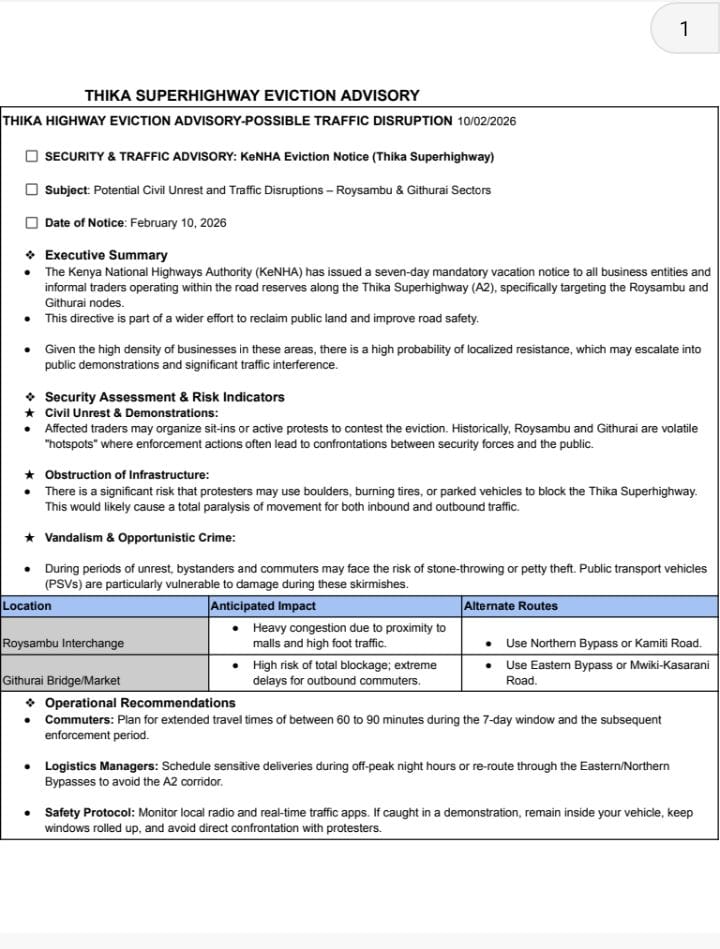
The Kenya National Highways Authority (KeNHA) has issued a formal eviction advisory for roadside traders operating along sections of the Thika Superhighway.
Background to the Advisory
The Thika Superhighway is a critical link between Nairobi and central and eastern Kenya.
With daily traffic volumes among the highest in the country, the highway experiences significant congestion and safety challenges, particularly at interchanges and informal stopping points where public service vehicles (PSVs) and commuters board or alight.
ALSO READ: Details emerge on Thika Road assassination of garbage man
Roadside traders have established informal businesses on the highway shoulders and road reserves, selling goods and creating informal pickup points for matatus and boda-bodas.
The eviction advisory arises from KeNHA’s mandate to manage, maintain, and improve national highways under the Kenya Roads Act and responds to ongoing concerns about traffic flow and road user safety along the corridor.
Key Elements of the Advisory
1. Affected Areas and Deadline
The advisory covers two main sections:
Roysambu:Traders on both sides of the highway
Githurai: Traders on the Nairobi-bound side
Traders in these zones are required to vacate the road reserve and remove all wares within seven days of the notice — effectively by 16 February 2026 — to allow for the next phase of infrastructure works.
2. Purpose of the Eviction
According to the notice, the primary aim is to clear encroachments so that designated bus bays can be constructed.
These facilities are intended to provide safe, orderly zones for passenger pick-up and drop-off, addressing frequent informal matatu stops that contribute to traffic delay and increase the risk of accidents.
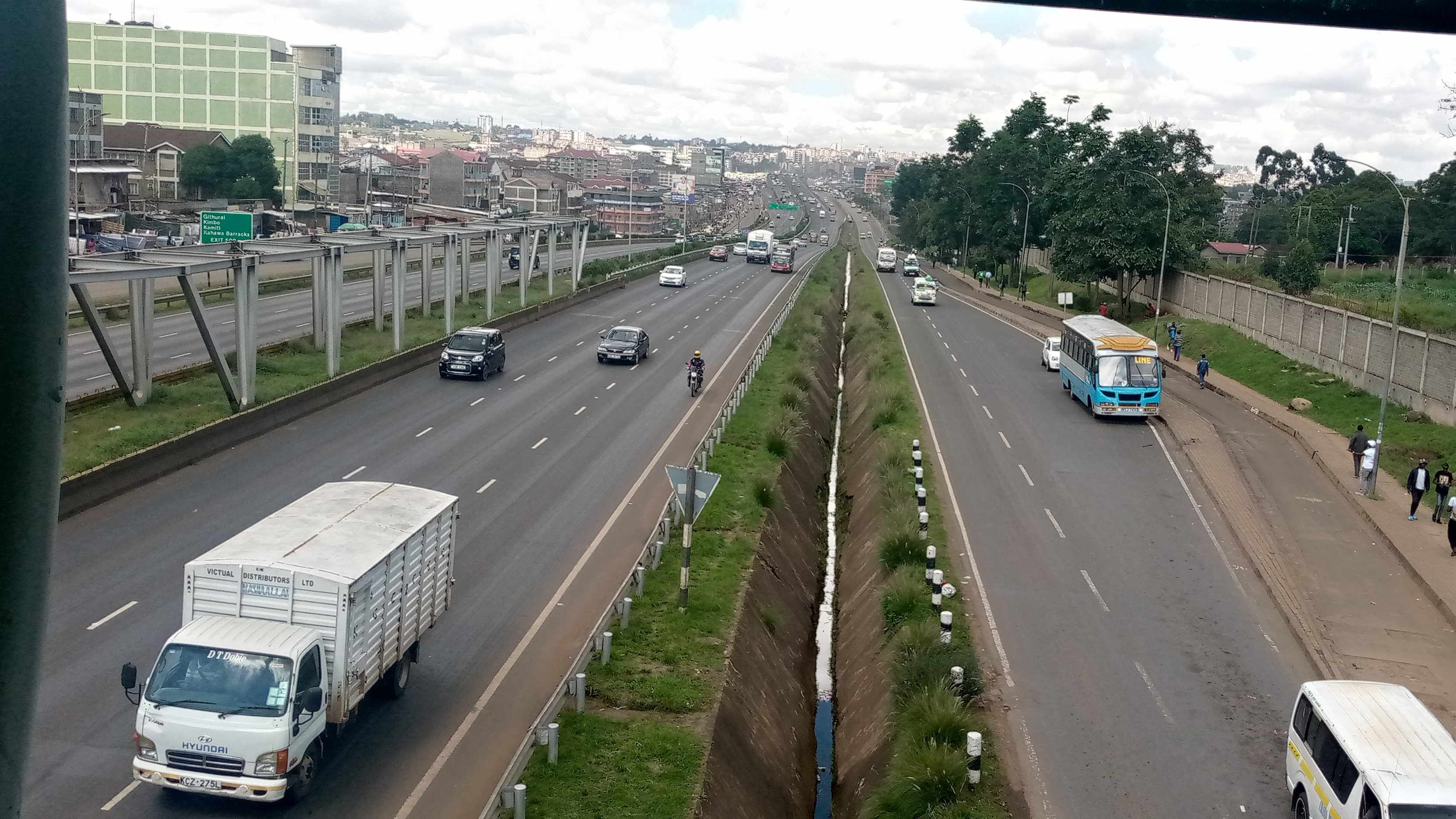
KeNHA’s statement emphasises that the work forms part of a road safety improvement initiative, seeking to reduce accidents and ensure an uninterrupted flow of traffic by removing obstructions within the road reserve.
3. Enforcement and Compliance
While the advisory grants traders a seven-day grace period to voluntarily clear their goods, KeNHA has indicated that enforcement action may follow if traders fail to comply.
This could include the forcible removal of encroachments. The notice provides contact details for inquiries but does not specify alternative trading spaces for those displaced.
4. Broader Road Works and Traffic Management
The eviction advisory is only one part of a series of traffic management and road improvement measures being implemented by KeNHA.
For example, the agency has also announced planned closures and maintenance works on other major roads, such as Uhuru Highway in Nairobi, as part of ongoing infrastructure upgrades.
Purpose and Official Justification
KeNHA’s advisory stresses several objectives:
Enhance Safety: By removing traders and informal stop points, the authority argues that it will reduce accident risks for motorists, pedestrians, and passengers.
Improve Traffic Flow: The designated bus bays are intended to reduce random stopping of PSVs, which often leads to sudden bottlenecks along the highway.
Support Road Infrastructure Works: Clearing the road reserve is a prerequisite for planned construction works aimed at modernising transport facilities on the corridor.
Implications for Traders and Commuters
The eviction advisory directly affects hundreds of informal traders whose livelihoods depend on selling goods at road shoulders.
Many of these traders operate without formal permits and have established businesses over the years, making compliance practical and economic challenges, especially given the short timeline.
At the same time, road users who regularly experience traffic delays around Roysambu and Githurai could benefit from the planned infrastructure changes.








Comments 0
Sign in to join the conversation
Sign In Create AccountNo comments yet. Be the first to share your thoughts!