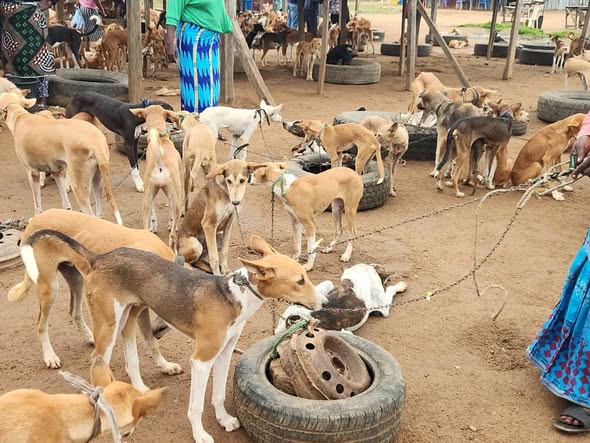
In Nigeria’s central Plateau region, the sight of crowded dog markets is a reminder of a practice that is deeply rooted in culture, belief and local economies.
While the consumption of dog meat locally known as “404” often draws international attention, within parts of the country it remains a long-standing tradition tied to identity, spirituality and livelihood.
But the practice is far from uniform across Nigeria.
It is concentrated in specific regions where historical customs and beliefs continue to shape attitudes toward the animal.
Central Nigeria’s Plateau State is widely known as one of the country’s major centres for dog meat consumption.
Here, dogs are eaten as a traditional delicacy and sold openly in busy markets that attract buyers from across the country, and sometimes from thousands of kilometres away.
At these markets, prices vary depending on size and condition, with a single dog selling for between $25 (Sh3,250) and $40 (Sh5,200).
The demand has helped create a thriving trade network that links suppliers, transporters, traders and restaurant operators.
A BBC report shows that the supply chain stretches far beyond the region.
Dogs are sourced from distant northern states and transported over long distances to meet growing demand.
“Our men go to Kano, carrying charms in their bags. If they get dogs, they will send them to us women. That is how we will then sell it,” one female trader told the BBC at a Plateau market.
The reference to charms reflects the strong spiritual dimension that surrounds the trade in some communities.
Belief systems and spiritual protection
In parts of Nigeria where dog meat is consumed, cultural beliefs about its protective and medicinal value remain a major driver.
Some consumers believe eating dog meat can guard against spiritual attacks or poisoning. According to Gideon Goyoma, chairman of a local Dog Dealers Association, the animal is seen as having special protective qualities.
“If you are eating dog meat, if maybe somebody poison you using herbs, they cannot get you if you are eating dog meat,” he told the BBC.
He added that certain body parts, such as the heart or liver, are sometimes used in traditional charms.
“If maybe you want to charm a woman, you can use the heart or the liver of a dog and mix it with some certain charms, then you can get that person,” he said.
While there is no scientific evidence to support such claims, these beliefs remain influential in shaping demand and sustaining the trade.
Beyond spiritual associations, dog meat consumption is also linked to social life and cultural identity.
In Plateau and neighbouring states, the meat is commonly prepared as pepper soup, grilled dishes or spicy stews, often served in informal eateries and roadside joints.
These spaces function as social hubs where customers gather to eat, drink and interact.
Historically, the dish has also been served during weddings, funerals and festivals, reinforcing its place within communal traditions.
However, cultural attitudes toward dogs vary widely across Nigeria.
In many parts of the country, especially in urban centres and among certain ethnic or religious groups, eating dog is considered taboo.
Nigeria is regarded as one of the countries with the highest levels of dog meat consumption in Africa.
The demand has turned the trade into a significant informal industry, providing income for traders, transporters and food vendors.
Yet the practice is increasingly facing scrutiny.
In 2021, thousands of Nigerians reportedly signed a petition calling for an end to dog meat consumption, reflecting changing attitudes driven by urbanisation, global exposure and the growing culture of keeping dogs as pets.
Animal welfare concerns and public health risks have also become part of the national conversation.
Changing perceptions of dogs
Veterinary experts say the debate over dog meat is also being shaped by a deeper understanding of the animal’s role in human life.
Veterinary doctor Mark Ofua notes that dogs possess abilities that go beyond companionship.
“Dogs are able to perceive cancer, certain cancers, and alert doctors even before science or machines,” he said.
He added that dogs also play an important therapeutic role.
“Autistic children perform better when they have dogs that they are raising.”
Such perspectives are contributing to a shift in how many Nigerians, particularly younger and urban populations, view dogs, increasingly seeing them as companions, protectors or therapy animals rather than livestock.
The debate over dog meat consumption in Nigeria reflects a broader tension between long-standing traditions and changing social values.
Dog meat consumption in the state remains unregulated.
The Akwa Ibom House of Assembly last December rejected a motion seeking to prohibit the consumption and sale of dog meat in the state.
The motion, sponsored by Uduak Ekpoufot, the member representing Etinan State Constituency, failed during plenary after it received no seconder, a procedural requirement before a legislative debate.
Ekpoufot cited public health implications associated with dog meat consumption, warning that unhygienic slaughter practices expose consumers to rabies, salmonella, trichinella and other pathogens.
He also described the killing methods used in the trade as inhumane.
Despite his arguments, no lawmaker supported the motion, forcing the speaker to rule it rejected.
For supporters, the practice is closely tied to cultural heritage and identity, seen as a legitimate expression of community customs passed down through generations.
It is also viewed as a matter of personal choice and dietary preference.
Beyond culture, the trade provides a vital source of income for thousands of families involved in breeding, trading, transport and food preparation.
Critics, however, are raising growing concerns.
Their objections focus largely on animal welfare, potential public health risks linked to the handling and consumption of dog meat, and wider ethical questions.
As urbanisation increases and dog ownership as companion animals becomes more common, attitudes are shifting, particularly among younger and urban populations who increasingly view dogs as pets rather than food.
Nigeria’s diversity means there is no single national view on the issue.
In many regions, the consumption of dog meat is rare or socially unacceptable.
In others, especially parts of the Plateau and the Middle Belt, it remains a normal and culturally accepted aspect of culinary and social life.