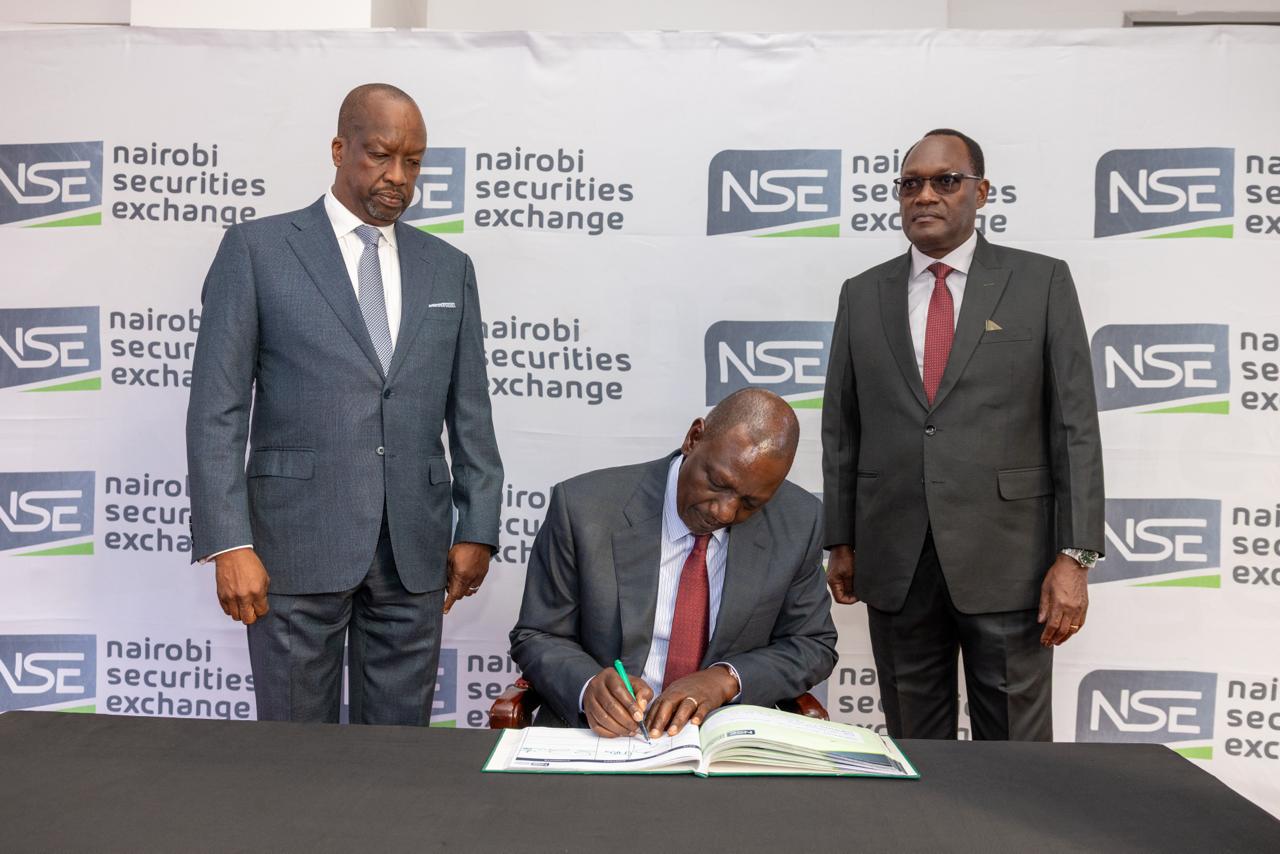
 Chair of Nairobi Securities Exchange Kiprono Kittony, President William Ruto, and National Treasury PS Chris Kiptoo during the launch of the Safaricom Ziidi Trader platform at the NSE on February 10, 2026. /PSC
President William Ruto on Tuesday sought to allay concerns over political interference in Kenya’s proposed National Infrastructure Fund and Sovereign Wealth Fund.
Ruto has assured investors and capital market players that neither politicians nor political appointees will be allowed to manage the two institutions.
The President said strict governance safeguards would be put in place to insulate the funds from political influence, including a mandatory cooling-off period for individuals with prior public sector experience.
“Anybody who has been in the public sector must have a five-year cool-off period before they can be considered to be part of the board of these institutions,” Ruto said.
“We want to depoliticise and de-risk these institutions so that they can serve the greater good of the public,” he added.
Ruto was speaking on Tuesday, February 10, in Nairobi during the launch of the Safaricom Ziidi Trader platform at the Nairobi Securities Exchange (NSE), an initiative that integrates stock trading into the M-Pesa ecosystem.
The platform is expected to widen access to capital markets by allowing users to invest directly in shares, bonds, and other securities listed on the NSE through their mobile phones.
Through the seamless integration of trading into M-Pesa, the President said millions of Kenyans, particularly the youth and women, will gain simple, affordable and convenient access to investment opportunities, helping to deepen financial inclusion and grow domestic participation in capital markets.
The assurances on governance of the two funds come as the government pursues an ambitious 10-year national transformation agenda centred on large-scale infrastructure development.
Ruto outlined key targets under the plan, including the dualling of 2,500 kilometres of highways, the tarmacking of an additional 28,000 kilometres of roads, and the expansion of installed energy capacity from the current 3,300 megawatts to at least 10,000 megawatts.
The agenda also includes the construction of 50 mega dams, 200 mini-dams, and 1,000 micro-dams to bring at least 2.5 million acres of land under irrigation, a move the government says is critical to food security, climate resilience and rural economic growth.
Delivering projects of this scale will require mobilising close to Sh5 trillion over the next decade, the President noted.
“To achieve this, we are pursuing the structured divestiture of strategic national assets to unlock long-term development capital,” Ruto said. He explained that the resources raised would be channelled through the National Infrastructure Fund and the Sovereign Wealth Fund to crowd in private sector investment while financing national priorities.
The National Infrastructure Fund is designed as a government financing vehicle to mobilise and manage long-term capital for large-scale public infrastructure projects.
It is expected to pool resources from the national government, development partners, pension funds, sovereign funds and private investors to finance projects in sectors such as roads, railways, ports, energy, water, housing and digital infrastructure.
The Sovereign Wealth Fund, on the other hand, is intended to manage surplus national wealth for long-term returns and economic stability.
Such funds are typically financed through excess revenues, privatisation proceeds or returns from strategic assets, and are used to support development while safeguarding intergenerational equity, as required by the Constitution.