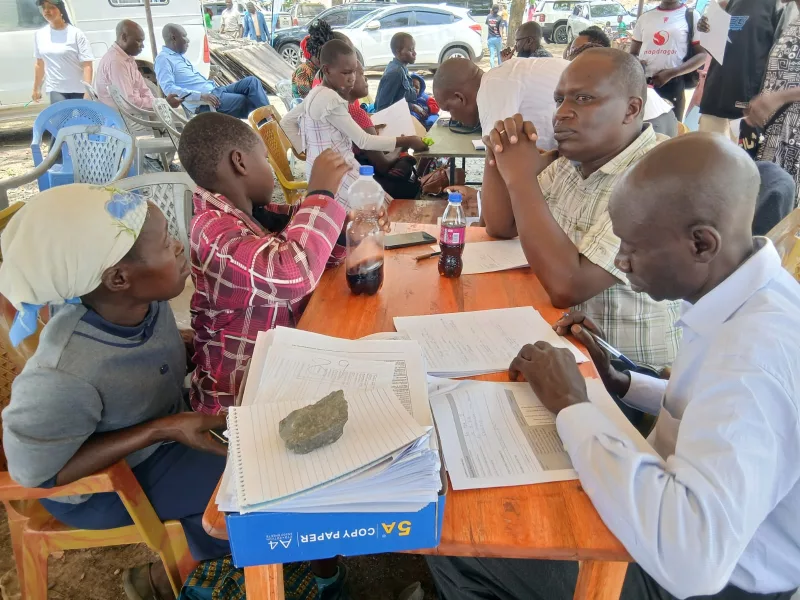
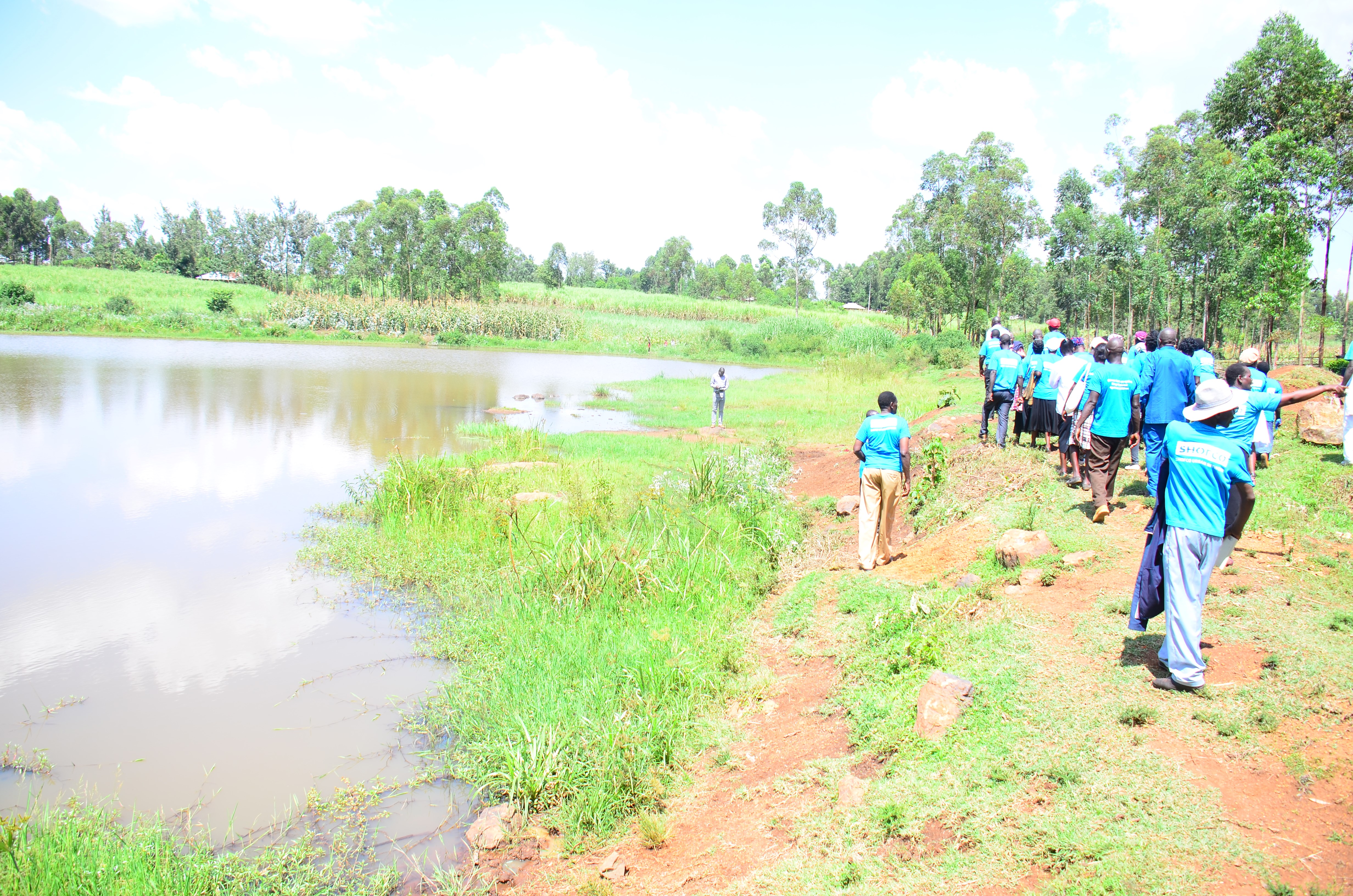
 Mahena community residents inspecting the dam in South Sakwa ward, Awendo subcounty on February 5, 2026.
Shining Hope for Communities, a public benefit organisation that works through community-based organisations (CBOs), has begun desilting Mahena dam in South Sakwa Ward, Awendo subcounty, to increase water levels.
The dam, constructed in 1952 by the colonial administration to provide water for domestic and livestock consumption, had accumulated siltation for over seven decades. This had significantly reduced its water, making it impossible to use for irrigation, fish rearing, livestock or household purposes.
According to Enock Obare, secretary general of the Mahena dam CBO, the first proposal to Shofco was to rehabilitate the dam to revive the economic benefits it can provide, including fish farming, irrigation and water for domestic use.
Shofco official Janel Nyaori said the organisation has been implementing water, sanitation and hygiene (WASH) programmes aimed at addressing health challenges affecting the community.
Nyaori said that by rehabilitating the Mahena dam, WASH challenges such as water-borne diseases and hygiene can be managed to protect the health of the community.
“By desilting the dam, we will establish a deep water level that will generate enough water for domestic use, and enable the community to engage in water activities like fish farming,” the official added.
Senior Shofco official George Okewa, reiterated that the rehabilitation of the Mahena dam will restore a reliable water source for the community.
He also disclosed that the organisation has so far desilted 20 colonial-era dams across the county to improve community access to water for domestic purposes.
He encouraged residents to explore commercial and agricultural uses of the rehabilitated dams to enhance livelihoods and eradicate poverty.
The official also explained that the organisation will continue partnering with the Migori county government to support communities by stocking rehabilitated water pans with fish fingerlings as part of promoting the blue economy.
He noted that Shofco’s initiative to desilt the dam will create proper economic empowerment programmes for the community, as well as make Migori county food secure.
The Mahena dam CBO, which started as a self-help group three years ago, has also been receiving grants from Shofco to empower the group members and surrounding communities.
“We have been supporting girls’ education in our community through the grants that we have been receiving from Shofco, to empower our girls and address issues of early marriages and teenage pregnancies,” Obare said.
He added that they are in the process of engaging the NGO to construct a resource centre to facilitate learning, research and training on issues of agriculture and entrepreneurship.
Nyaori explained that the NGO has been giving financial support to various CBOs to implement campaigns against gender-based violence to enhance family ties in society.
“We have also encouraged the CBOs to have monthly remittance contributions among their members to supplement the grants and address other challenges like supporting each other through welfare when a member is bereaved,” she added.
Pamela Awuor, Shofco youth representative for South Sakwa ward, disclosed that the organisation gave her a grant to start her cosmetics and salon shop.
The business, located in Awendo town, has enabled her to employ one person, contributing to wealth creation in the town.
She said that the Shofco youth wing under the youth voice programme has been assisting young mothers, pregnant teenagers and youth infected with HIV in addressing challenges affecting the youth.
Duncan Odhiambo, another member of Shofco, urged like-minded NGOs to come on board and help the community to be self-empowered to address poverty and the triple-threat effects of new HIV infections, gender-based violence and teenage pregnancies.
Odhiambo called upon Shofco to continue helping and empowering the local CBOs to venture into agricultural enterprises such as maize, beans and sugarcane to generate income and sustain themselves.