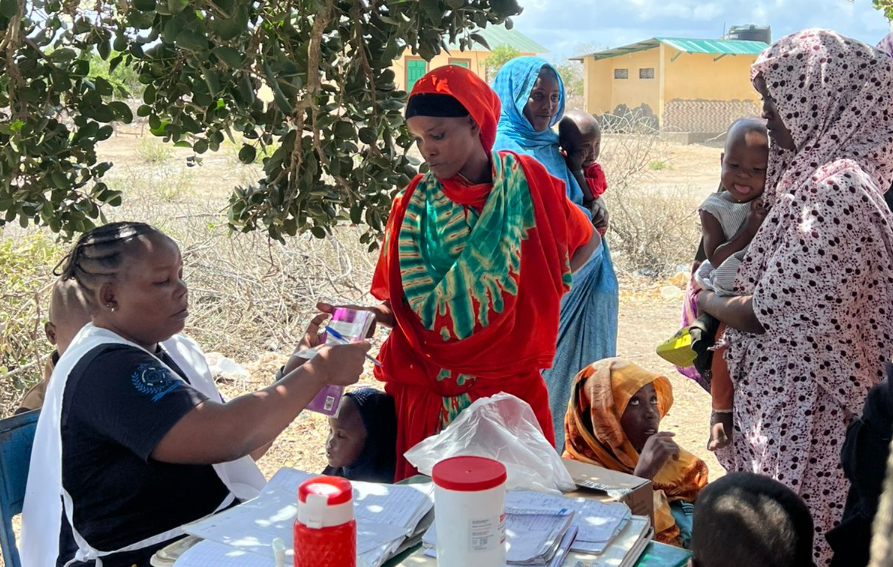
 Community health workers form a critical part of Kenya’s frontline response to HIV, tuberculosis and malaria /WHO/X
More than 41,000 health workers funded by the US through the President’s Emergency Plan for AIDS Relief (Pepfar) face an uncertain future as counties confront an estimated Sh47.8 billion annual wage bill to keep them in service.
A new analysis by the Center for Epidemiological Modelling and Analysis (CEMA) at the University of Nairobi says these workers form a critical part of Kenya’s frontline response to HIV, tuberculosis and malaria.
Their exit, following the withdrawal of US government funding, has already triggered layoffs and threatens to disrupt essential services in public facilities.
Pepfar has long financed a broad range of cadres embedded within county health systems.
These include 1,973 clinical officers, 26 doctors, eight epidemiologists, 661 HIV diagnostic assistants, 649 laboratory technologists and technicians, five medical assistants, 1,249 nurses, 45 pharmacists, 385 pharmacy technicians and 36,537 other staff.
The total supported workforce stands at 41,538. By the end of September 2024, counties had 41,170 Pepfar-supported staff on their rolls.
These workers provide testing, treatment, data management and outreach services that underpin Kenya’s vertical HIV, TB and malaria programmes.
“The abrupt withdrawal of funding has occasioned staff layoffs, further weakening the operational backbone required for service delivery,” the analysis says.
Many of the roles are also not formally aligned to the Ministry of Health staffing structures.
Community health promoters, Dream mentors, lay workers, mother mentors, peer educators and testing and counselling providers make up a large share of the workforce but are not classified within standard MoH cadres.
Yet they are often the first point of contact for patients in high-burden communities. Their absence would leave gaps that counties may struggle to fill quickly.
CEMA estimates that absorbing the entire workforce at government pay scales would cost Sh47.8 billion annually.
Because human resources for health are a devolved function, this burden would fall squarely on county governments.
“HRH deployment is a county function, in which the county governments would collectively require Sh47.8 billion annually to absorb all the 41,170 Pepfar staff,” the report states.
The pressure will even be worse for counties with higher HIV burdens who rely more heavily on donor-supported staff and therefore face larger bills.
Nairobi alone would need an additional Sh10 billion annually to absorb all its Pepfar-supported personnel.
Even so, the report cautions that the Sh47.8 billion figure represents an upper bound. Some positions, such as regional coordinators, may not be necessary if counties hire directly.
The analysis recommends further study before wholesale absorption.
“As such, this analysis generates an upper bound budget if the counties absorb all the Pepfar-supported staff. Counties can undertake a workload indicator survey to determine the optimal number of staff and decide on the number of essential staff to absorb, and this will be lower than what this analysis has shown,” it says.
This call for deeper assessment underscores the complexity of the transition. Counties must balance fiscal realities with service continuity.
The staffing crisis is unfolding alongside a broader contraction in external health financing.
Total external funding for the sector has dropped from Sh126 billion in 2024-25 to Sh54 billion in 2025-26, largely due to the US withdrawal and reductions from the Global Fund and World Bank.
Off-budget support, where much US assistance was channelled, fell sharply from Sh87 billion to Sh26 billion.
The Ministry of Health’s overall budget has risen modestly to Sh138 billion, but this increase is not enough to offset the donor retreat.
CEMA warns that disease programmes are already heavily donor reliant and government contributions remain minimal.
Without the donor-funded workforce, service delivery risks faltering just as funding for medicines and commodities is also tightening.
The report observes that the workers supported by Pepfar include “staff providing critical services such as clinical officers, nurses, pharmacists, epidemiologists, data and records staff.”
Losing them, it adds, “will likely disrupt critical services supported by the above staff.”
Paradoxically, the analysis notes that the cost of absorbing these workers is still lower than what donors spent to run the programmes, “pointing to the high cost of providing services by donors.”
For counties, the analysis provides a stark reality of finding billions to retain experienced staff or risk gaps in testing, treatment and follow-up that could reverse hard-won gains against HIV, TB and malaria.