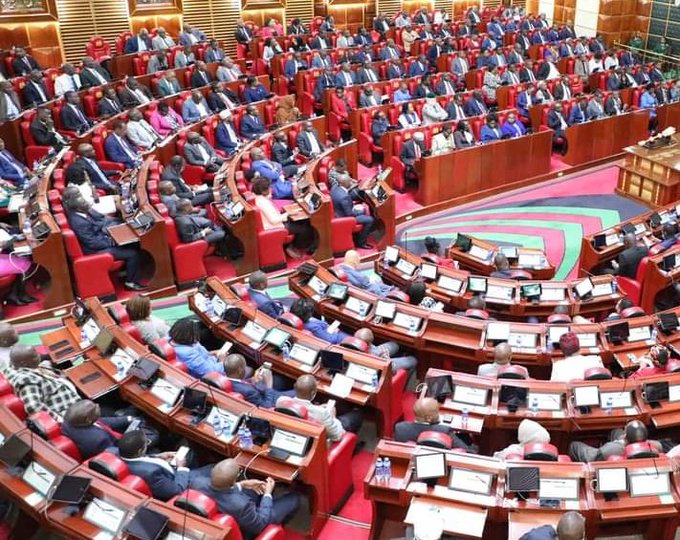
The National Government Constituencies Development Fund, a multi-billion-shillings kitty fiercely guarded by MPs, was on the brink of being consigned to the dustbin of history.
On September 20, 2024, the High Court delivered a ruling declaring the law anchoring it - NG-CDF Act, 2015, unconstitutional.
It ordered the entity to cease operations at the stroke of midnight on June 30, 2026.
For legislators, the ruling posed a threat to a crucial tool of political patronage, visibility and delivery of grassroots development. A constituency gets up to Sh200 million annually.
But on Friday, in a sweeping reversal, the Court of Appeal threw them a lifeline, dismantling the High Court’s reasoning.
The appellate court said the fund is constitutional. Justices Francis Tuiyott, Aggrey Muchelule and Daniel Musinga said there was only one problematic clause.
They want MPs to amend the law which ties the term of the fund account manager to the life of Parliament.
The judges held that it is this linkage that violates the doctrine of separation of powers, as it creates the perception of parliamentary control.
“We find that the link of the term of office of the fund account manager to the term of Parliament is, on the face, problematic,” the judges said.
They went on, “At a perception level, therefore, we find that section tethers the functionality and independence of the fund account manager. His position has to be delinked from the political tenure of the Member of the National Assembly.”
The High Court’s central fear was that the CDF architecture implicated MPs in Executive functions, blurring the line between the Legislature and the Executive.
The judges saw MPs lurking in the fund’s shadows and declared the kitty unconstitutional, a move that jolted the lawmakers, even prompting a law change.
“The member of the National Assembly remains in the shadows of the fund, controlling its operations, however remotely, at the constituency level,” the High Court had said.
The lower court cited National Assembly approval for board appointments as yet another flaw in the current structure.
For the appellate court, however, the condemnation was flawed.
Justices Musinga, Tuiyott and Muchelule said healthy checks and balances can be distinguished from a true violation.
On the board appointments, the Court of Appeal found the parliamentary role legitimate, akin to other approval roles MPs play.
“Parliament is involved in the approval process of the Chief Justice, Cabinet Secretaries… We find that the learned Judges erred when they read more into this section. The section does not in any way violate the doctrine of separation of powers.”
A major anchor of the petitioners’ case was that the CDF, by using the constituency as a service delivery unit, created an unconstitutional ‘third tier’ of government.
The High Court agreed, saying it that the arrangement where the CDF was being funded to execute near-similar county projects “undermines devolution.”
But the Court of Appeal has rejected the assertion, anchoring its reasoning in constitutional text and existing law.
It said Article 6(3) obligates the national government to ensure reasonable access to its services across the republic.
“The constitution permits the national government to decentralise funds and services to lower administrative units without creating a new level of government,” the court said.
The judges highlighted the National Government Coordination Act, which formally recognises constituencies as national government service delivery units.
“Under section 14(1A)… all the constituencies established under Article 89 of the Constitution are recognised and established as a national government service delivery unit… The constitutionality of this section has not been challenged.”
The court also pointed to the Public Finance Management Act, which allows for national public funds.
The conclusion was that CDF is not a rogue entity but operates within a settled decentralised framework of the national executive.
The High Court had also feared the CDF would cause “duplication of funding… leading to wastage of scarce public resources.”
The appellate court found the concern speculative and unsupported by evidence.
They held that Section 24 of the NG-CDF Act strictly limits projects to “works and services falling within the exclusive functions of the national government.”
“Bound by the decision of the Supreme Court… we reiterate that the Act does not trench upon, interfere with or duplicate the county government functions,” the court said, referring to last year’s Supreme Court ruling.
It also said the absence of factual proof of chaos. “We did not find in the record any evidence… to demonstrate that… there has arisen any dispute between the national government and the county governments on account of duplication of funding.”
The court criticised the High Court for acting on a “hypothetical and speculative harm” rather than a clear textual violation. “Courts do not invalidate legislation on such bases.”
In the appeals court’s judges’ view, the High Court’s decision to strike down the entire Act was a gross overreaction.
“The remedy of striking down the entire Act was disproportionate and inconsistent with the principle of severability,” the judges ruled.
They argued that section 43 (9), being the only unconstitutional clause, couldn’t be enough threshold to invalidate the entire law.
“We find that section 43(9)… can be severed from the Act without defeating the purpose, structure and legislative desire of the Act. Its removal does not impair the coherence or operation of the Act.”
MPs have been on edge, as CDF is a cornerstone of their development aspirations. A proposed law to anchor the fund in the constitution is currently before the Senate.