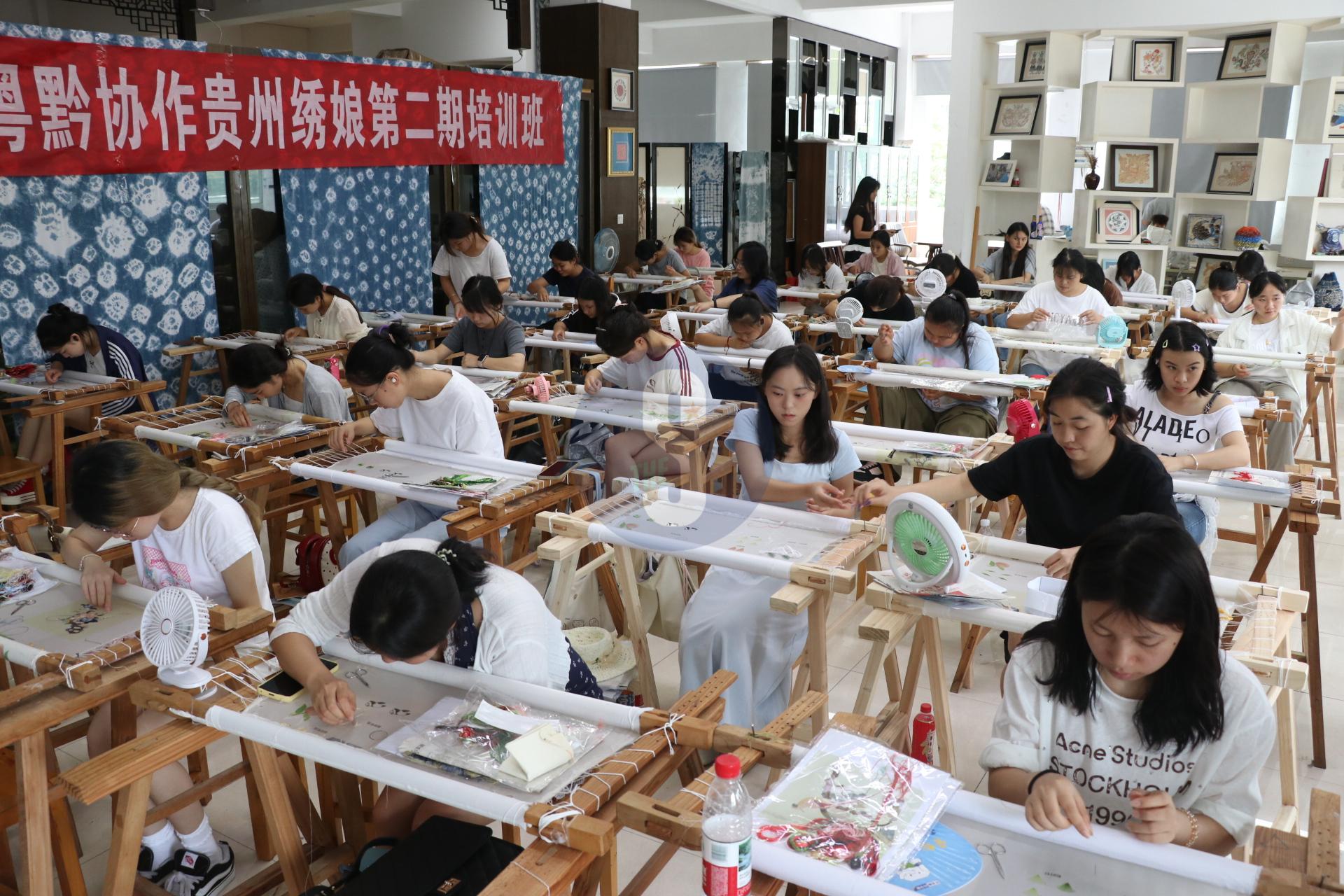
 Young girls in an embroidery classroom at Guizhou Forerunner College, China on September 8. 2025/LEAH MUKANGAI
The number of university graduates grew from about one million per year in 1999 to more than 11 million by 2023.
China's emergence as one of the world's most powerful economies did not happen by a miracle. Behind the skyscrapers, factories, and technological advancements lies a long-standing commitment to education that has shaped the country's development for decades.
Although China boasts the largest education system in the world, its educational journey is often overlooked. With a population of approximately 1.4 billion, the system currently educates around 300 million students and employs nearly 20 million teachers.
When the People's Republic of China was established in 1949, the situation was dire. About 80 per cent of the population was illiterate, hindering national development. Recognising that economic progress required an educated populace, China's leaders prioritised education.
This vision was later championed by Deng Xiaoping, who introduced the Four Modernisations, namely, agriculture, industry, science and technology, and national defence. Deng emphasised that education served as the foundation for achieving these goals.
Compulsory Education
A significant breakthrough came in the mid-1980s when China implemented extensive education reforms. The Communist Party of China (CPC) introduced compulsory education for all children up to the age of 15, a policy that was later enshrined in law and rolled out nationwide.
Today, all Chinese students must complete nine years of compulsory education, which includes six years of primary school and three years of junior secondary education. To promote inclusivity, entrance examinations for junior secondary school were abolished and replaced with mandatory enrollment based on residence, guaranteeing access for all children, regardless of their background.
These reforms improved literacy rates. Illiteracy among young and middle-aged citizens has plummeted from over 80 per cent to about five per cent, marking one of the most remarkable educational turnarounds in modern history.
China's education system has expanded rapidly over the past two decades. According to official statistics, the number of kindergartens, primary schools, and secondary schools increased from 436,400 in 2010 to nearly 498,500 in 2023. During the same period, student enrollment rose to approximately 291 million, up from 176 million in 2010.
This growth has been fueled by sustained public investment. Government data shows that education spending has consistently exceeded 4% of the country's GDP, with annual increases in both fiscal spending and total education funding. Between 2013 and 2023, China built hundreds of thousands of new schools, enrolled tens of millions of additional students, and recruited millions of teachers.
Closing the rural–urban gap
A key focus of China's education strategy has been to reduce inequality between rural and urban areas. Since 2006, the government has abolished school fees for all rural students in compulsory education. Textbooks are provided free of charge, and students from disadvantaged families receive living allowances, particularly in central and western regions.
Since 2011, nutrition improvement programs have benefited over 38 million rural students annually, and by the end of 2021, around 350 million students had reaped the rewards, leading to improved attendance and learning outcomes.
In poorer provinces like Yunnan, which I had the privilege to visit a few years ago, targeted assistance ensures that children from vulnerable households remain in school. This support is also present in other provinces across China.
Technology has played a significant role in this progress. China has invested heavily in distance learning and digital education platforms, enabling rural teachers and students to access high-quality teaching resources from urban areas. These initiatives have significantly enhanced teaching standards in remote regions.
China's educational success is closely linked to its investment in teachers. The government has implemented policies to improve pay, living conditions, and career opportunities, particularly for rural educators.
The Rural Teachers Support Program (2015–2020) provided subsidies, established unified urban–rural pay structures, and introduced teacher rotation programs to ensure balanced staffing. Millions of teachers, even in the most remote areas, now receive special allowances.
Teacher training has also been a priority. Since 2010, over 18 million teachers have benefited from the National Teacher Training Program. New regulations require teachers to renew their professional certification every five years, ensuring quality and accountability across the education system.
Economic Transformation
China's educational advancements have directly supported its economic growth. Nearly 100 percent of children are now enrolled in primary and secondary education, and the country consistently ranks at the top of global assessments such as PISA, particularly in mathematics and science.
Higher education has expanded dramatically as well. The number of university graduates surged from about one million per year in 1999 to more than 11 million by 2023, with around 40 per cent specialising in science and engineering, significantly higher than in many Western countries.
Vocational education has also played a key role. Under initiatives such as "Made in China 2025," over 50 million workers have received training in advanced manufacturing and technical skills, supporting industrial upgrading and productivity.
China's experience demonstrates that education is not merely a social service but a strategic investment. By prioritizing basic education, strengthening the teaching workforce, expanding access, and aligning learning with economic needs, China has cultivated a skilled workforce capable of driving sustained growth.
As the country continues to modernise, education remains central to its long-term vision, illustrating that the development of human capital can be one of the most powerful engines of national progress.