Driving always starts somewhere. Maybe in a local driving school. Maybe in your father’s old pickup. Maybe in a friend’s parent’s car. But no matter where it begins, eventually, you face the rite of passage: driving school. Not necessarily to learn how to drive but to get a licence.
In Kenya, that process is… flexible. Pay between Sh3,000 and Sh5,000, walk in, answer a few basic questions about road signs or traffic light colours, and voilà, you’re licensed.
At the NTSA centre in Thika, instructors are already paid. Your name is called. You’re asked the most basic questions. You’re marked as passed. You go home Sh5,000 lighter but miraculously, legally allowed to drive.
Ironically, the people who fail driving school are often the best drivers, the ones who truly know the road. Which makes sense; in Nairobi, driving isn’t really learned in school. It’s learned on the streets.
And that’s where the nganya culture comes in.
To understand this, you have to look at Kenya’s unemployment.
Many PSV drivers started as jobless youths who became touts, learning to navigate the streets before they ever touched a steering wheel. They dodged pedestrians, swerved past other vehicles and adapted to the chaos around them.
Over time, they graduated to actual drivers, earning “squads” — trips assigned by someone who owns a vehicle. They get paid off the trip, make a living for a day, rest, repeat.
On the streets, survival isn’t about rules; it’s about instinct. Move too slowly and you lose money. Move too cautiously and you risk being pushed aside.
For these matatu drivers, survival means being TAT: tough, alert and tactical. You overlap lanes, cut corners, ignore road signs and bully your way through traffic, not out of recklessness but necessity.
Once they finally secure their own vehicle, the PSV drivers buy a licence and step fully into the system. But you, the newcomer, quickly realise that the streets don’t care about your knowledge of traffic laws.
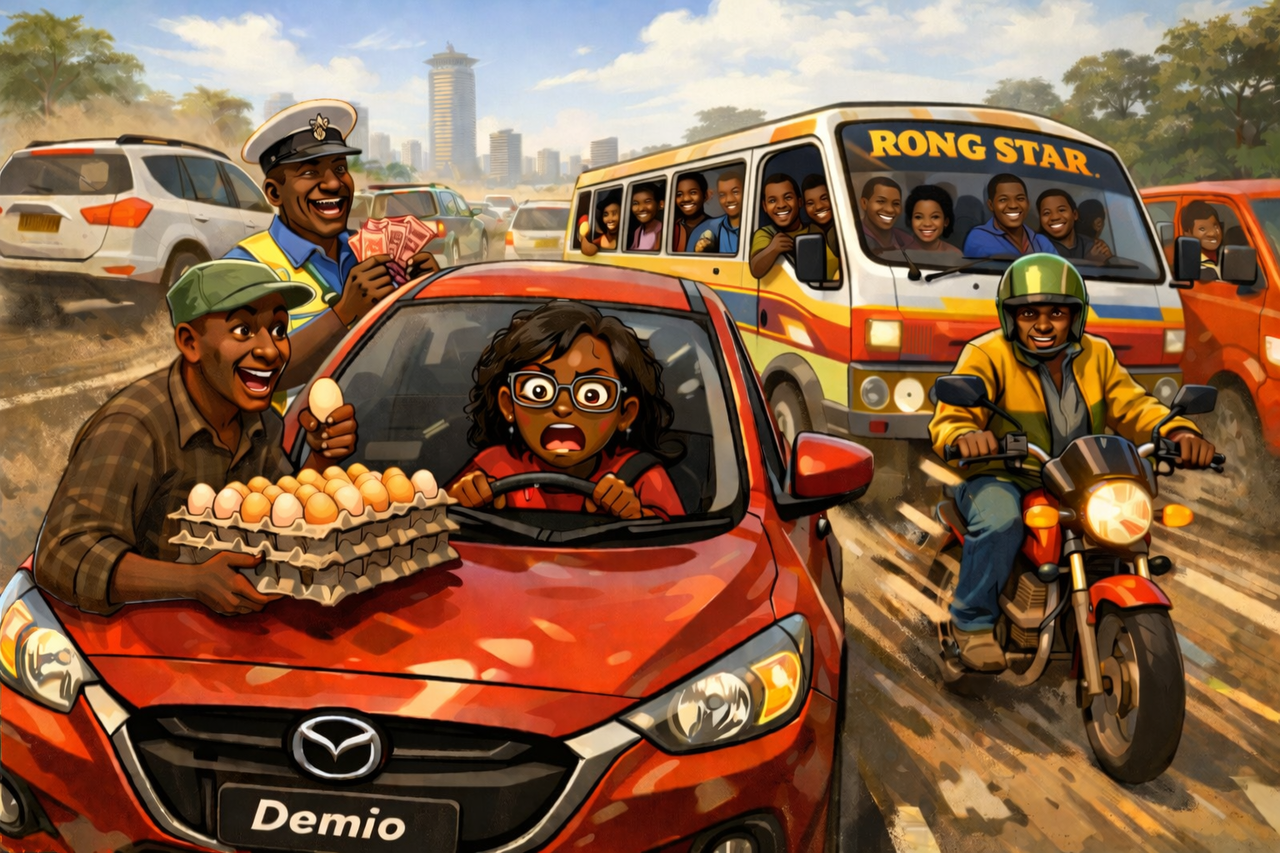
Now imagine a baby girl in a freshly bought wine-red Demio on the roads for the first time. You have gone through driving school, you know the signs, you know the rules. You have done everything and are now ready to say bye to being a passenger princess.
You get on the road and just as you get on the highway, someone is hooting at you. You are confused, but before you process, someone is shouting, “Learner, songa mbele!”
You are now sweating. Your heart is beating off your chest. You quickly realise no rule is applying because you are doing everything right but nothing is working.
Keeping on your lane is not helping because you don’t even know your lane. There are six lanes on a two-lane road.
You try to indicate but no one is keeping distance. Everyone is tailing the other, and all you want to do is exit.
You were going to Survey but you find yourself in Meru because you are too afraid to change lanes, and every time you try, someone hoots at you.
Hakuna mtu anatambua wewe ni baby girl.
This is day one.
You will be lucky if you survive without getting a scratch. But that first day on the road for a newbie is almost always a nightmare.
Your initiation is brutal.
Matatus squeeze past from the left. Nduthis swerve in from the right. Someone crosses with a cart. A boda boda zooms past like it was fired from a cannon. And yes, a hawker is selling eggs right in the middle of your lane.
The police? They’re supposed to enforce the rules, but most days they’re part of the game. Overloaded buses, reckless drivers, speeding taxis… a few shillings later, they’re waved on.
On these streets, rules exist only if someone chooses to follow them, and most drivers learn to bend the system to survive.
You learn fast. Survival isn’t about memorising road signs or following rules. It’s about reading everything: mirrors, lane changes, the twitch of a steering wheel.
You learn to read drivers like people, spotting hunger, panic, ego or fatigue. You learn when to push, when to slip in, when to disappear.
Leave space but not too much. Forget the L sign, it won’t protect you here. Driving in Nairobi is less a skill and more a fight for your life.
You will scream in your Demio. Curse. Cry. Shake. But slowly, patterns emerge. Rush hours, corners where matatus reign, streets dominated by nduthis.
You become alert, instinctive, careful, yet daring all at once.
The chaos never stops. Kiambu Road is just one battleground. Every street tests you. Every day teaches fear, humility and instinct.
One day your heart stops beating on the road and you find that you are breathing just fine.
In Nairobi, driving isn’t taught — it grows into you.