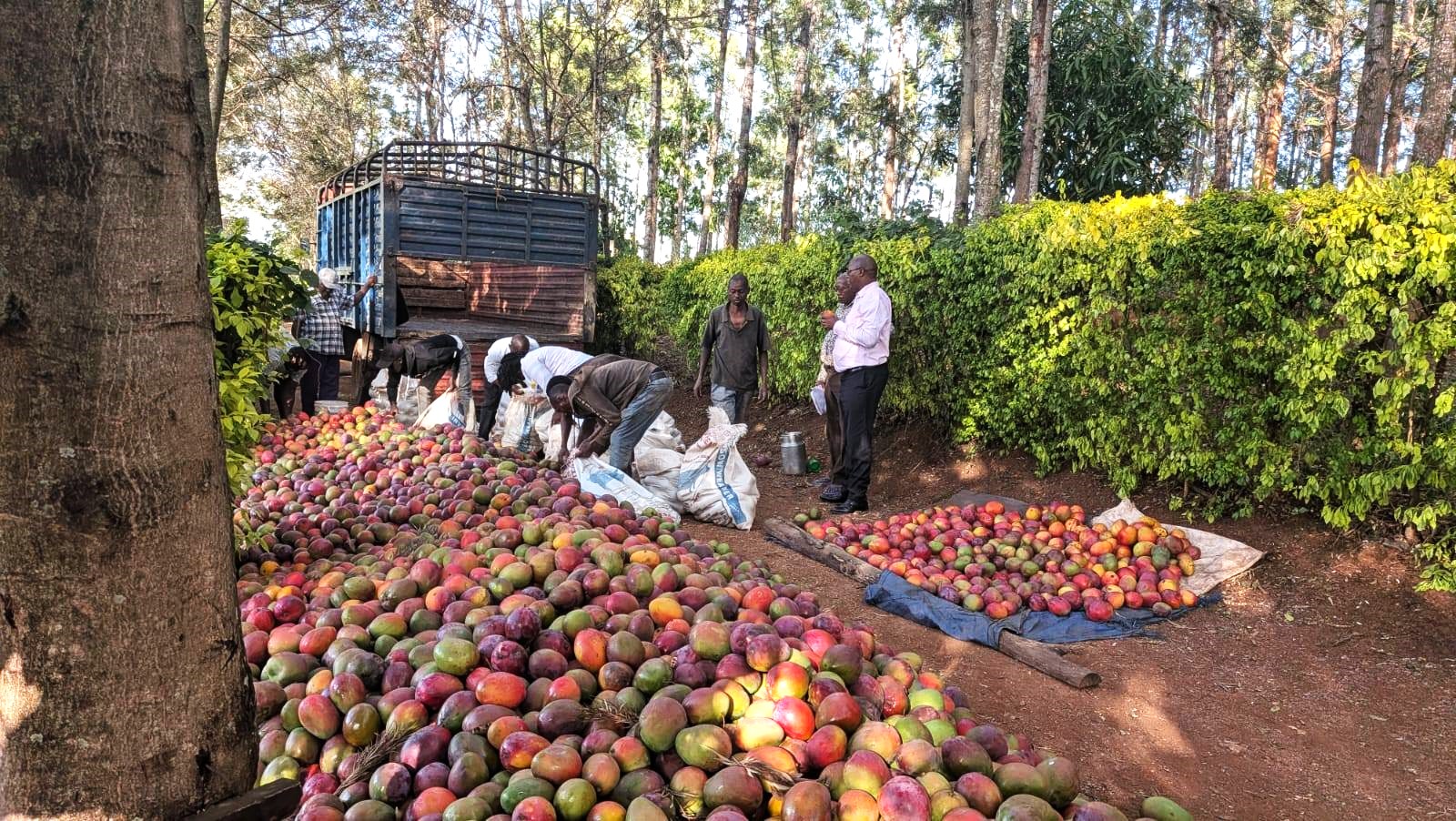
 Farmers sorting mangoes for sale in Ithanga, Murang'a county/ ALICE WAITHERA
The Murang’a government has partnered with a non-governmental organisation to protect mango farmers from heavy losses.
This follows a glut triggered by favourable weather conditions that sharply increased production this season.
The county administration is working with Food4Education (F4E) to absorb surplus mangoes by channelling them into the organisation’s large-scale school feeding programme.
This has turned a looming post-harvest crisis into an opportunity that supports farmers livelihoods while improving nutrition for schoolchildren.
Heavy rains last October followed by hotter-than-usual weather, led to unusually high mango yields across semi-arid parts of lower Murang’a, creating a short-term demand-supply imbalance that overwhelmed local processors.
With mangoes being highly perishable, thousands of farmers faced the risk of seeing their harvest go to waste.
Last week, Governor Irungu Kang’ata acknowledged that processors were unable to buy all the harvested fruit, prompting the county to intervene.
“Farmers are asked not to harvest their mangoes unless express authorisation is given by Lower Murang’a Cooperative officials,” the governor said in a public notice, noting that uncoordinated harvesting would worsen the glut and depress prices further.
The county government helped form the Lower Murang’a Cooperative in 2023 to consolidate farmers for better market access, coordinated harvesting, and access to subsidies, after years of low prices and repeated losses.
Under the partnership with Food4Education, the county continues to purchase mangoes from farmers through the cooperative.
It also coordinates harvesting and transportation of the fruit to Food4Education’s warehouse in Ruiru, Kiambu county, from where the mangoes are distributed to schools across several counties.
Food4Education, which feeds more than 600,000 children daily, has committed to absorb about 1.3 million surplus mangoes from Murang’a county, accounting for more than half of the volumes that local processors were unable to handle this season.
The fruit is incorporated into school meals, including programmes such as Dishi Na County in Nairobi, at an estimated cost of about 30 cents per serving.
The first batch of 250,000 mangoes was distributed to learners this week, with sustained deliveries expected over the coming weeks as harvesting continues in the lower parts of Murang’a.
Both Governor Kang’ata and Nairobi Governor Sakaja Johnson have publicly celebrated the collaboration saying it will boost learners’ nutrition while ensuring farmers get an income.
The intervention is critical in stabilising incomes for about 5,000 smallholder farmers, many of whom depend on mangoes as their main source of livelihood.
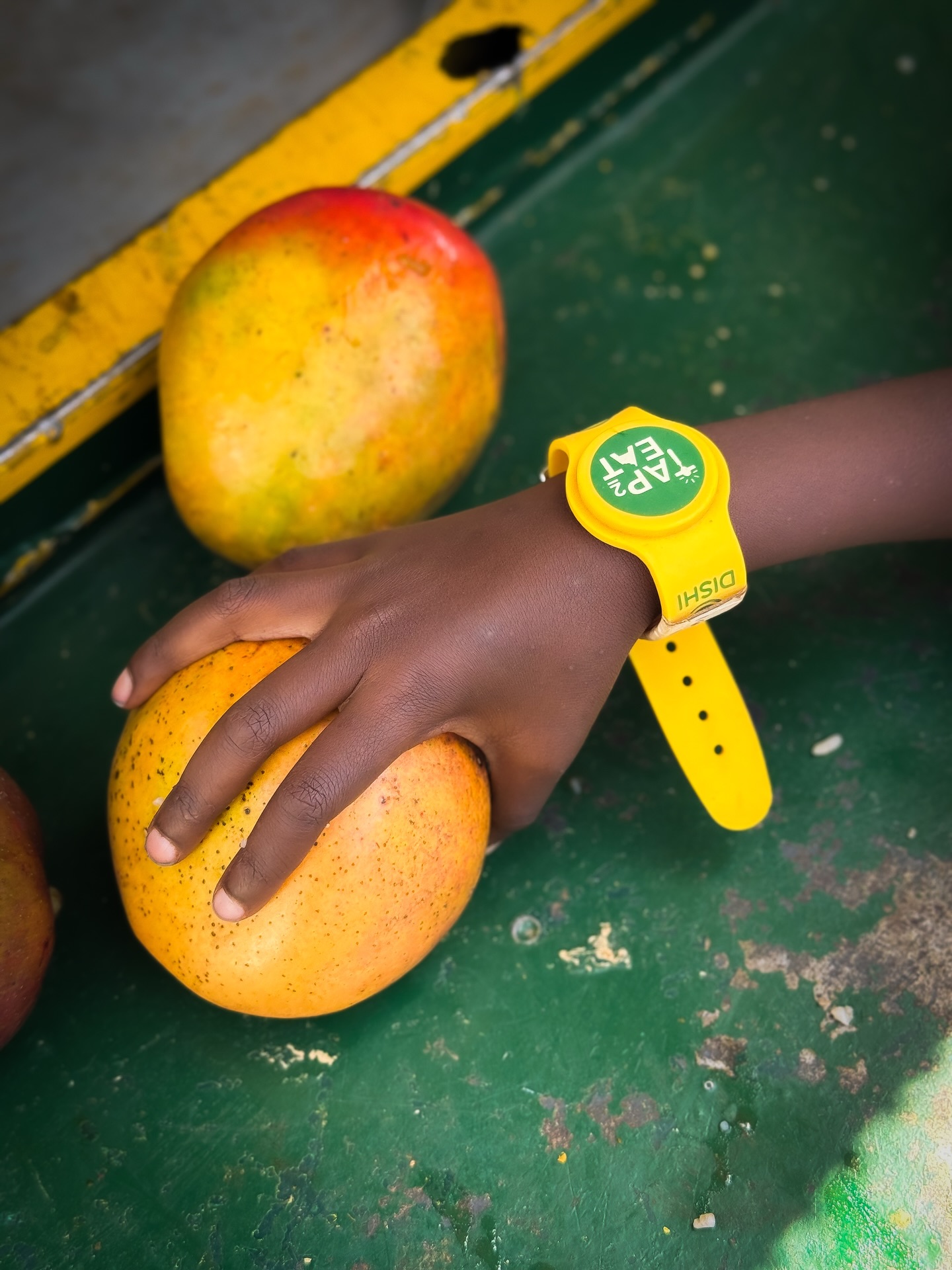 A learner picks a mango as part of a lunch programme./ALICE WAITHERA
“Without this new market, these mangoes would rot. The processors are full. There is nowhere else to take the fruits,” farmer Mwangi Kariuki said.
Food4Education officials said the programme demonstrates how school feeding can function as a market solution, responding flexibly to both shortages and surpluses driven by climate variability.
“We have the logistics infrastructure and distribution capacity to respond quickly when climate creates these situations,” Food4Education’s chief operating officer Wairimu Nyandia said.
“We distribute between one and 1.2 million pieces of fruit every month. When processors can normally handle about two million mangoes per season and suddenly there are millions more, we can step in and absorb what traditional markets can’t.”
In previous seasons, when drought affected maize supply and prices surged, the organisation adjusted by sourcing alternative grains such as sorghum and millet. This season, the challenge has been excess production rather than scarcity.
She said the partnership reflects a broader shift in how school feeding programmes are viewed, not simply as a social expense, but as an economic tool that allows public investment to circulate back to farmers and rural communities.
Murang’a recently engaged Food4Education on expansion of school feeding, with discussions focused on economic returns, including how much local agricultural production could be absorbed and how many jobs could be supported along the value chain.
But Nyandia said Food4Education sources about 80 per cent of its ingredients from local cooperatives and smallholder farmers.
Beyond the mango growers themselves, the current intervention supports aggregators, transporters, warehouse workers, kitchen staff, and other actors in the local supply chain.
Murang’a county has in recent years intensified efforts to help mango farmers access reliable markets by strengthening cooperative societies, supporting aggregation centres, investing in value addition, and training farmers on post-harvest handling to reduce losses during peak seasons.
Kenya imports roughly $50 billion in food annually, even as local farmers periodically face waste from overproduction as climate change makes agricultural markets increasingly unpredictable, triggering shortage and surplus, sometimes in the same regions within the same year.
Nyandia observed that school feeding programmes, operating at institutional scale, can function as stabilisers—buying what's available, pivoting when needed, and maintaining consistent service regardless of commodity market volatility.
"This is school feeding functioning as a market solution, not just a government spend," Food4Education CEO Wawira Njiru said.
"We're building systems that respond to climate volatility—that turn it into opportunity rather than crisis, that keep children fed and farmers paid when traditional markets fail."