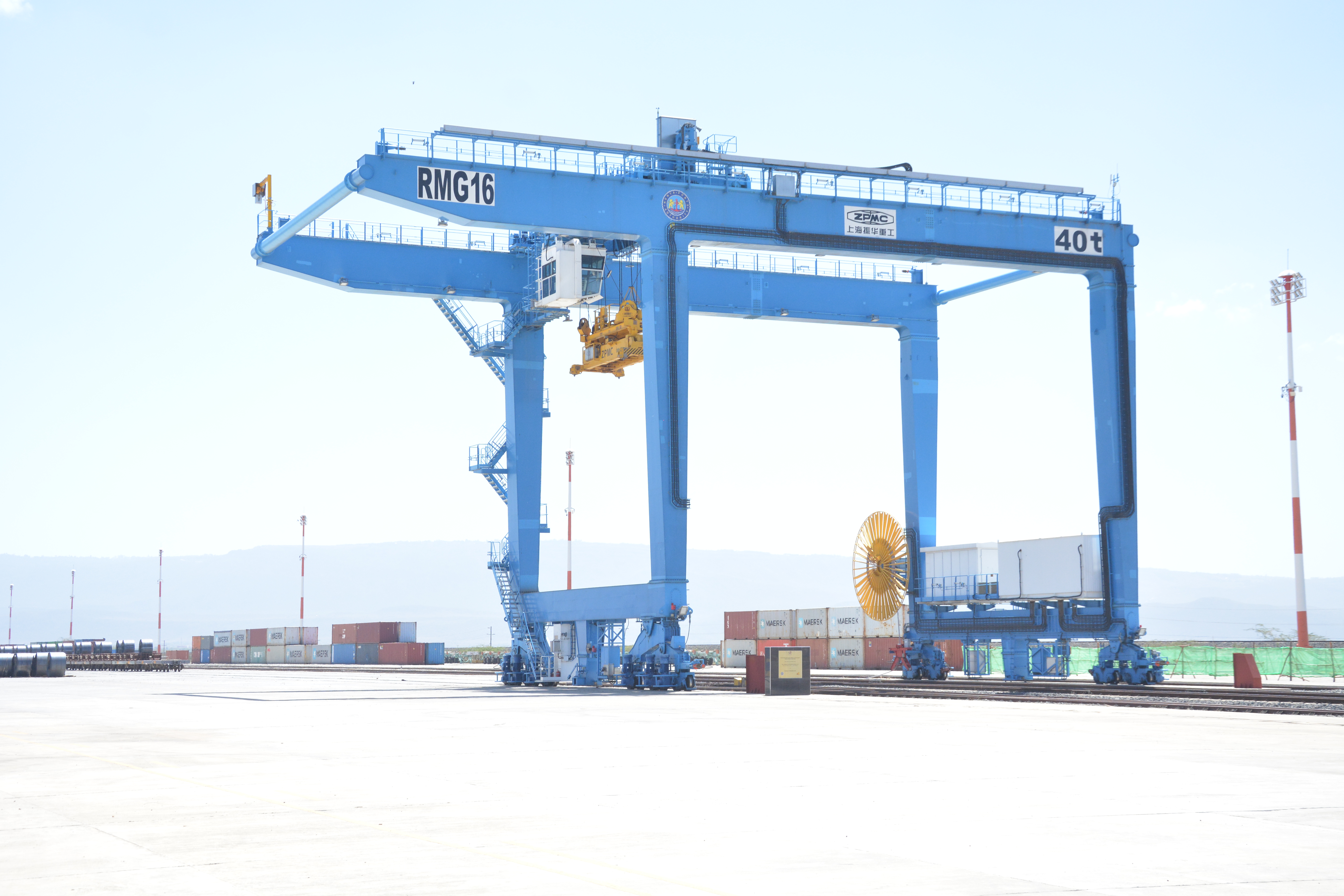
 A Rail Mounted Gantry crane, which is used to ease the loading and offloading of containers from trailers to the SGR and metre-gauge railway line trains at the Naivasha Inland Container Depot.
The government has moved to operationalise the Naivasha Inland Container Depot as a strategic cargo clearance hub for transit goods destined for neighbouring countries, in a bid to ease chronic congestion at the Port of Mombasa.
The decision follows a sustained surge in cargo volumes at Kenya’s principal seaport, which has resulted in clearance delays, higher logistics costs and slower turnaround times for importers and regional transit traders.
According to official data, Mombasa Port handled 45.45 million metric tonnes of cargo in 2025, up from 40.99 million metric tonnes in 2024, placing significant pressure on port infrastructure and customs operations.
Kenya Revenue Authority Commissioner General Humphrey Wattanga said the Naivasha ICD would now be prioritised for long-haul cargo bound for Uganda, Rwanda, the Democratic Republic of Congo and South Sudan, allowing Mombasa Port to focus on domestic and short-haul traffic.
“The utilisation of Naivasha ICD will reduce congestion at the port, lower clearance timelines and cut transport costs for regional traders while maximising the efficiency of the Northern Corridor,” Wattanga said.
The depot, which is linked to Mombasa by the Standard Gauge Railway and onward to the metre-gauge railway, has a handling capacity of 4,000 twenty-foot equivalent units but is currently operating at just 19 per cent occupancy.
Wattanga noted that customs revenues from port activities account for nearly a third of Kenya’s total cost of cargo handled, contributing approximately Sh900 billion in revenue.
He attributed the recent spike in cargo volumes partly to regional geopolitical developments, including traders rerouting shipments through Kenya amid political uncertainty in neighbouring countries, such as during Tanzania’s and Uganda’s last general elections.
“Mombasa has remained the port of choice as regional players sought stability and reliability in their supply chains, and we seek to utilise the Naivasha ICD to decongest and improve efficiency,” he said.
The commissioner announced the long-overdue measures at the Mai Mahiu ICD during an official visit by a delegation from South Sudan, whose government has been allocated 10 acres of land within the Naivasha Special Economic Zone to establish an alternative cargo clearance facility.
South Sudan Revenue Authority Commissioner General William Kuol said Juba plans to commence operations at the site within the next five months, citing persistent delays at Mombasa that have previously disrupted cargo flows to South Sudan.
“The Naivasha ICD offers a faster and more predictable clearance process, which will significantly improve cargo movement to South Sudan,” Kuol said, adding that the move is expected to restore confidence among traders.
According to Kenya Ports Authority official data, by 2025 South Sudan accounted for 12.7 per cent of the total transit cargo through the Port of Mombasa, an indication of the crucial role the port plays in boosting trade within the East African region.
Special Economic Zones Authority Chief Executive Officer Kenneth Chelule said the zone has already attracted 20 investors, with land allocated to Uganda, Rwanda, Burundi, the DRC and South Sudan to establish national cargo handling and clearance stations.
He termed Naivasha an emerging regional logistics hub following the government’s designation of 6,000 acres as a Special Economic Zone to support manufacturing, logistics and trade facilitation.
He said infrastructural works, including road networks and power connectivity, are under way to support investors and regional governments operating within the zone.
“With South Sudan taking the lead, Burundi and Uganda are next in line, and the investment will, in the long run, accelerate cargo evacuation, boost intra-regional trade and significantly reduce congestion at Mombasa Port,” Chelule said.
Naivasha ICD Operations Manager Ahmad Toya said increased uptake by neighbouring countries would unlock the depot’s full potential and improve cargo turnaround times across the Northern Corridor, a key artery to the regional bloc.
“The ICD was designed to complement the Port of Mombasa and is currently underutilised, but with regional governments starting operations, this is set to boost cargo haulage efficiency,” Toya said.
The government’s investment in the expanded inland container depot offers a long-term solution to port congestion, regional trade inefficiencies and the rising cost of logistics in the region.
In addition, the Kenya government has been in final talks with financiers, especially China, to fund the extension of the SGR from Naivasha through Kisumu to the Malaba border, where Uganda and subsequent countries will fund the railway to South Sudan.
When completed, the key railway route is expected to spur and ease the transport of cargo from the Port of Mombasa to the hinterland and neighbouring countries, while boosting trade ties in the region.