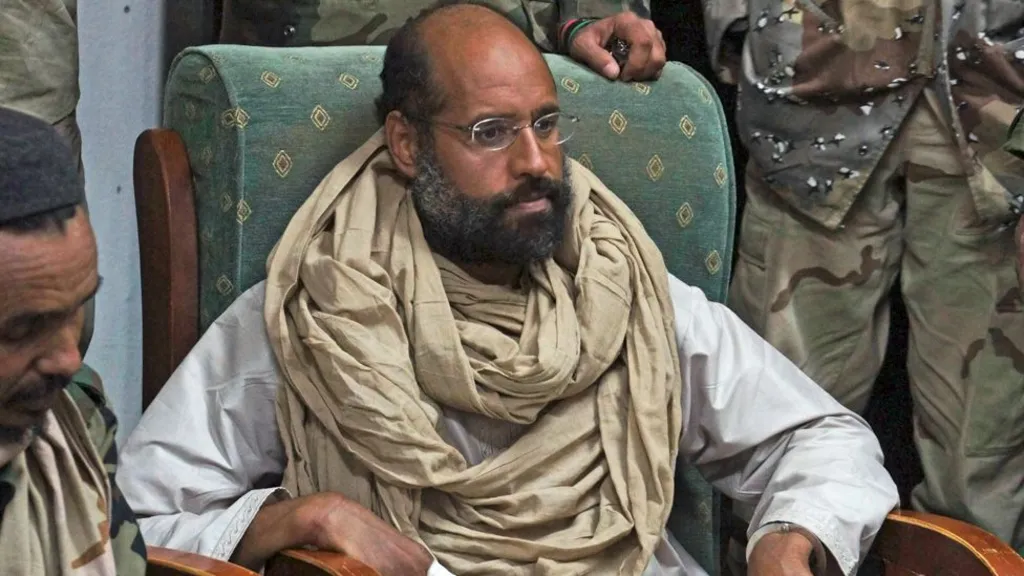
 Saïf al-Islam Gaddafi/FILE
The Chairperson of the African Union Commission has condemned the killing of Libyan political figure Saïf al-Islam Gaddafi.
In a press release issued February 4, 2026, Mahmoud Ali Youssouf said he had learned with deep concern of reports that Gaddafi was killed on February 3, 2026, in Zintan City.
He “strongly condemns this violent act,” warning that it risks undermining efforts toward a credible and inclusive political transition in Libya.
The Chairperson also conveyed condolences to the family of the deceased and to all those affected by the incident. He stressed the need to resolve political differences through peaceful and lawful means.
Youssouf called on Libyan authorities to uphold the rule of law.
He urged them to ensure the circumstances surrounding the killing are thoroughly investigated and that those responsible are held accountable in accordance with the law.
The statement further appealed for calm among political actors in Libya.
The Chairperson urged restraint and reiterated the African Union’s continued commitment to supporting the Libyan people and institutions.
He said the goal remains a durable, consensual, and peaceful resolution to the political and security crisis that has affected the country since 2011.
The death of the 53-year-old, who was once widely seen as his father's heir apparent, was confirmed by the head of his political team on Tuesday, according to the Libyan News Agency.
His lawyer told the AFP news agency a "four-man commando" unit carried out an assassination at his home in the city of Zintan, though it was not clear who may have been behind the attack.
In a competing version of events, his sister told Libyan TV that he had died near the country's border with Algeria.
Saif al-Islam Gaddafi was long seen as the most influential and feared figure in the country after his father, who ruled Libya from 1969 until being ousted and killed during an uprising in 2011.
Born in 1972, he played a key role in Libya's rapprochement with the West from 2000 until the collapse of the Gaddafi regime.
After his father's removal, Saif al-Islam Gaddafi - who was accused of playing a key role in the brutal repression of anti-government protests - was jailed by a rival militia in the city of Zintan for almost six years.
The International Criminal Court wanted to put him on trial for crimes against humanity for his alleged role in the suppression of opposition protests in 2011.
In 2015, he was given a death sentence in absentia for his role in the crackdown by a court in Tripoli, in the west of the country, where control is in the hands of the UN-backed government.
But he was released by militia in Tobruk, in the east, under an amnesty law two years later.
Since the overthrow of Gaddafi, Libya has been split into areas controlled by various militias and is currently divided between two rival governments.
During his father's time as leader, he shaped policy and led high-profile negotiations despite having no official role in government, including those which led his father to abandon his nuclear weapons programme.
Such agreements saw international sanctions on the north African country lifted, and some considered Gaddafi a reformist and acceptable face of a changing Libya.
Gaddafi had always denied that he wanted to inherit power from his father, saying the reins of power were "not a farm to inherit".
However, in 2021 he announced he would run for the presidency in elections which were then postponed indefinitely.