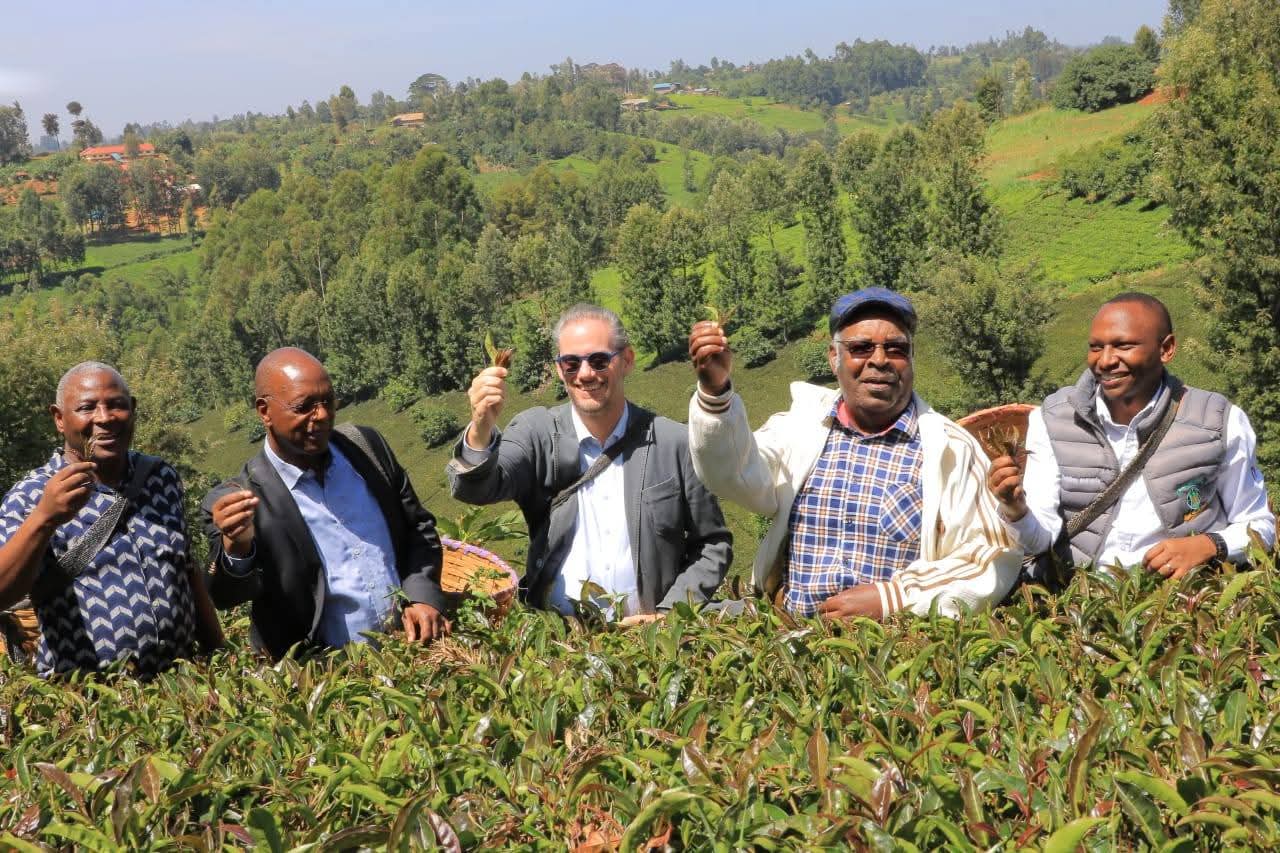
 Equity Bank CEO James Mwangi (left), French Ambassador to Kenya Arnaud Suquet (centre) and Murang'a Deputy Governor Stephen Munania at Gatura Greens Tea Farm in Gatanga/ ALICE WAITHERA
Murang’a tea is steadily gaining global recognition as Kenya’s high-altitude tea moves closer to Geographical Indication certification.
GI certification is a form of intellectual property protection that links a product’s quality, reputation and characteristics to its place of origin
This is a milestone that could redefine the country’s position in the global premium tea market.
The significance of the initiative was highlighted at Gatura Greens Tea Farm in Murang’a county during a high-level specialty tea tasting event that brought together local leaders, international partners and industry stakeholders.
The gathering attracted growing international interest, including from France-based premium tea house Palais des Thés, signalling strong prospects for Murang’a tea in upscale European markets.
The tasting session offered participants a firsthand experience of the distinctive flavour profile and craftsmanship associated with Murang’a’s high-altitude tea, shaped by the region’s climate, soils and long-established farming practices.
Speaking at the event, Equity Group managing director and CEO James Mwangi said the GI journey has been guided by research and evidence, noting that months of work have gone into developing a baseline study to inform stakeholders.
He cited globally recognised examples such as Champagne in France and Darjeeling tea in India that he said demonstrate how GI status protects producers, prevents misuse of names and enables products to command premium prices by guaranteeing authenticity and quality.
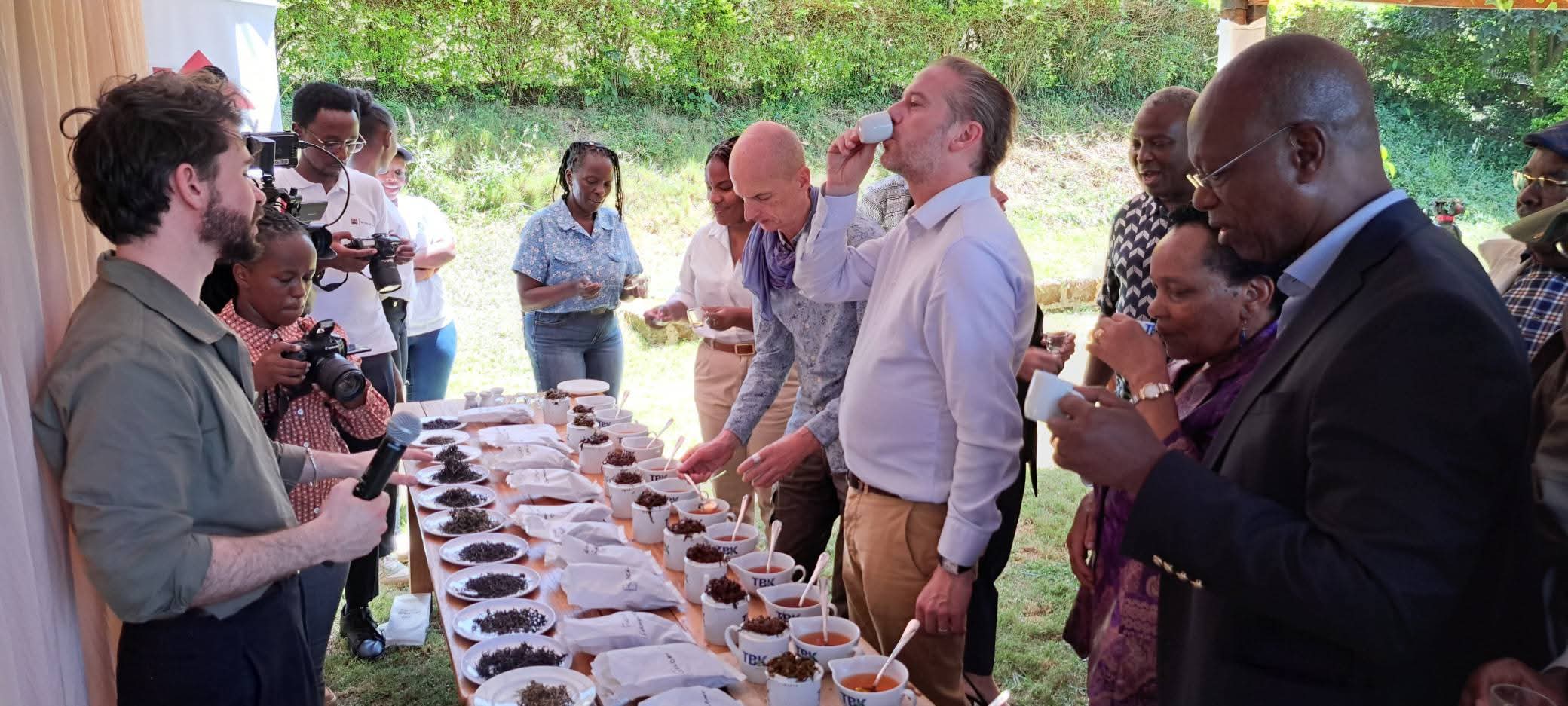 French Ambassador to Kenya Arnaud Suquet sips tea during a tea tasting event at Gatura Greens Tea Farm in Gatanga, Murang'a, on January 31, 2026/ ALICE WAITHERA
"For Kenyan tea that's famed for its volume and quality but often sold generically, GI represents a strategic shift toward origin-based branding and higher value realisation for farmers," Mwangi said.
The initiative has been driven by strong public-private partnerships, with Equity Group playing a central role by providing financial and technical support across the tea value chain.
This includes financing factory modernisation, supporting farmer capacity building, promoting premium processing methods such as orthodox tea production and enabling traceability systems that enhance sustainability and market credibility.
Kenya is the world’s leading exporter of black tea, yet most of its produce is blended and marketed without reference to specific regions.
The GI process will help to clearly define and protect tea-growing areas such as Murang’a, set agreed production standards and ensure traceability from the farm to the cup.
Governor Irungu Kang'ata said for Murang’a, whose tea farms are already at full capacity, GI offers a pathway to grow earnings vertically through value addition rather than expanding acreage.
"With tea production already at maximum capacity, the only viable growth strategy lies in increasing value rather than volume. Branding through GI offers a sustainable way to raise farmer incomes," he said.
Drawing from global experience, he pointed to the Champagne region in France as a powerful example of how geographical delineation and collective discipline can transform a local product into a globally protected premium brand.
While acknowledging that the process requires national legislation and strong institutional frameworks, the governor welcomed assurances that progress toward a supporting legal framework is ongoing.
He further highlighted the strategic importance of upcoming high-level engagements between Kenya and France, including a major French-African summit to be hosted in Nairobi.
Such platforms, he said, provide an opportunity to elevate Murang’a tea onto the global stage and attract investment into value addition and premium markets.
French Ambassador Arnaud Suquet echoed these sentiments, describing Kenyan tea’s potential to follow a similar path.
He said that if Murang’a tea is properly protected, registered and consistently produced for upscale markets, farmers stand to benefit from long-term premium pricing.
He emphasised, however, that GI must be a bottom-up process that's owned by farmers and local communities, rather than imposed from above saying it's a transformative opportunity for Murang’a county.
The Tea Board of Kenya also reaffirmed its support for the initiative as part of its mandate to promote, protect, and add value to Kenyan tea.
TBK chief executive Willy Mutai said that, with backing from the national government’s value-addition agenda and funding from the French Embassy and Equity Group, a GI baseline study was conducted by Cirad, a French agricultural research organisation.
The study lays the foundation for positioning Murang’a and other Kenyan specialty teas in European markets, including through Palais des Thés’ network of more than 100 international shops.
For farmers, the expected benefits are substantial, including higher and more stable earnings, stronger global branding of Kenyan tea, improved sustainability and secure access to premium international markets.
As Murang’a tea moves closer to GI certification, the initiative marks a turning point for Kenya’s tea industry as it shifts from bulk exports to origin-distinct, premium branding.
In 2024, the county produced tea worth Sh17.8 billion, accounting for 19.9 percent of all tea exports in the county, and is the largest tea producing county with 10 tea factories.
INSTANT ANALYSIS
The significance of the initiative was highlighted at Gatura Greens Tea Farm in Murang’a county during a high-level specialty tea tasting event that brought together local leaders, international partners and industry stakeholders.
TBK chief executive Willy Mutai noted that, with backing from the national government’s value-addition agenda and funding from the French Embassy and Equity Group, a GI baseline study was conducted by Cirad, a French agricultural research organisation.