Recently, Kenya’s Social Health Authority (SHA) became the centre of a massive public finance controversy.
Between October 2024 and April 2025, the system recorded roughly Sh11 billion in fraudulent claims and irregular payouts—money meant for healthcare that ended up in the wrong places through ghost facilities, inflated claims, and questionable billing practices.
Health Cabinet Secretary Aden Duale and the Ministry of Health have acknowledged the fraud and launched actions, including suspending facilities and cracking down on fake claims. But in the middle of investigations many Kenyans are asking the same hard question:
How does billions of shillings go missing in a supposedly digital system?
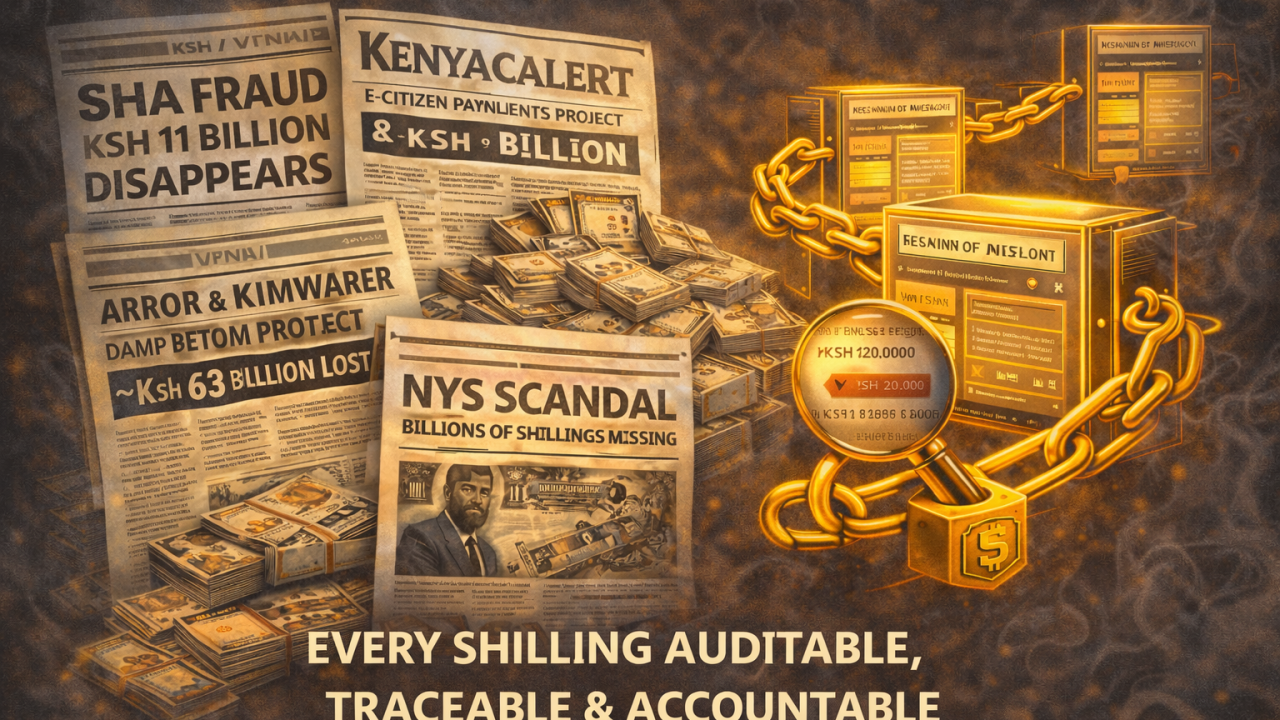
The SHA story isn’t an isolated incident. Kenya has seen several large financial scandals in recent years where accountability and traceability have been weak:
Arror & Kimwarer Dam Scandal—Sh63 billionIn a long-running case involving the construction of two dams, investigators found irregularities and inflated costs. Approximately Sh63 billion meant for the projects was misused or lost, and years later the infrastructure is still unfinished.
National Youth Service (NYS) Scandal—Sh6.2–7.9 billionThe NYS faced scrutiny over fraudulent tenders and procurement of supplies that never arrived, resulting in billions of shillings tied up in disputes and legal battles.
NHIF Civil Servants Scheme Scandal—Sh 7+ billionThe National Hospital Insurance Fund saw over Sh7 billion lost via fraudulent claims and irregular payments before reforms were introduced.
e-Citizen Payment Irregularities—Sh9 billionThe government’s e-Citizen digital services platform was found to have lost or illegally collected around Sh9 billion, according to the Auditor-General’s review of digital payment flows.
These aren’t small accounting errors. There are billions of shillings that either can’t be traced, were paid without proper verification, or were claimed fraudulently with little real-time oversight.
The core problem: Fragmented tracking and siloed records
The common thread in the above cases isn’t just corruption—it’s that we’re still tracking huge sums of public money with disconnected systems, delayed reconciliation, and audits that happen months or years after money has already been spent.
When claims are submitted and paid, invoices approved, budgets released to agencies, or tenders processed, many of these steps still depend on manual checks, disconnected databases, and systems that don’t communicate with each other.
The result is a gap between the moment money moves and the moment anyone truly knows where it went—and it’s in that gap that accountability quietly disappears.
Blockchain isn’t a magic wand—but it offers a different way to track money.
Blockchain technology can’t eliminate bad actors on its own. But itcandramatically change how public money is recorded and tracked, and here is how:
Shared, tamper-proof recordsEvery transaction is visible to authorised parties and nearly impossible to alter without detection.
Real-time transparencyMinisterial departments, auditors, and oversight committees can see money flows as they happen, not months later.
Automated rule enforcementSmart contracts can ensure funds are only released once agreed conditions are met (e.g., delivery confirmation, verified claims).
Independent audit trailsBlockchain’s record isn’t a spreadsheet—it’s a continuous, decentralised log that doesn’t depend on one agency’s internal systems.
In other words, blockchain turns money into information you can trust instantly—not data that needs to be reconciled AFTER the fact.
Why this matters for every Kenyan citizen
When billions of shillings meant for healthcare, infrastructure, or social services go missing, the impact goes far beyond numbers on a page.
Patients wait longer for care, roads and dams remain unfinished, hospitals struggle to secure funding, and public trust in institutions slowly erodes.
If we’re serious about government accountability, we also have to be serious about how public money is tracked, because systems that leave huge gaps in visibility will continue to fail us—no matter who is in office.
Blockchain isn’t a cure-all. But if Kenya wants a government where every single cent is auditable, traceable, and accountable, exploring transparent financial ledgers should be part of the conversation.
Kenya has never been afraid of leading when technology genuinely improves people’s lives—from mobile money to digital public services. That same leadership is needed now.
Adopting transparent, modern financial infrastructure isn’t about politics or personalities; it’s about ensuring public money actually reaches the citizens it’s meant to serve.
If President William Ruto’s administration truly wants to move the country forward, building systems where funds can be tracked end-to-end—and where leakage at the top becomes harder, not easier—would do more for ordinary Kenyans than any slogan ever could.