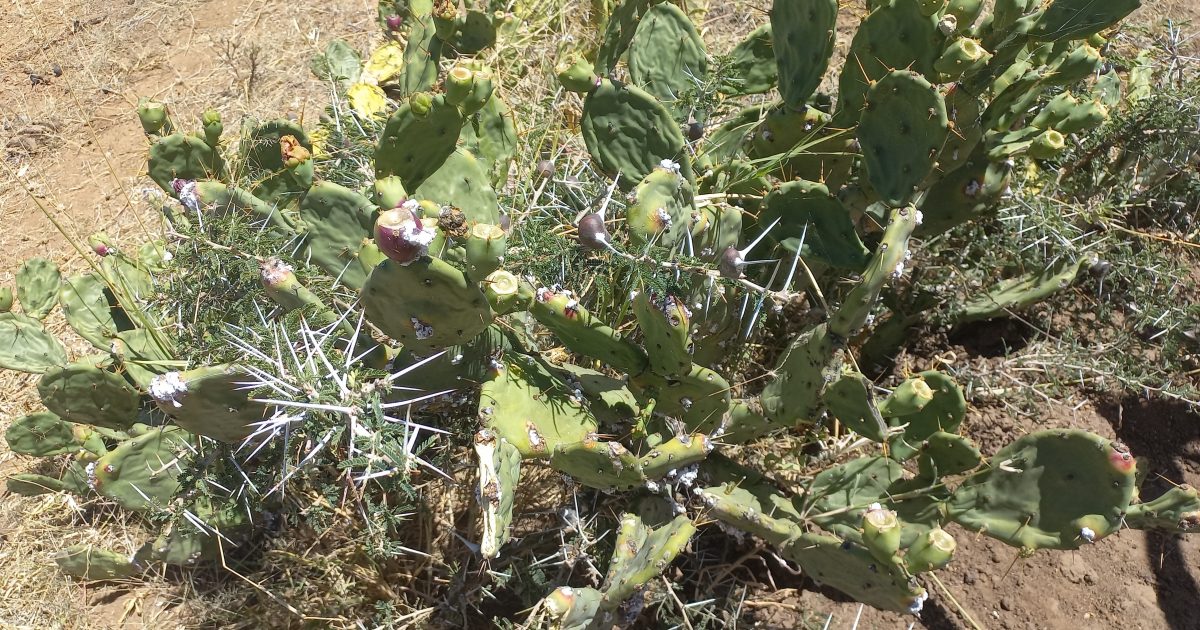
 Opuntia stricta, the invasive cactus plant being used to generate biogas for households in Laikipia./KNA
In an ambitious move to eradicate the invasive cactus plant, Laikipia North residents have devised an innovative and profitable means of containing the retrogressive weed.
The residents have finally found an economically sound method of reducing the spread of the thorny plant, which they now use as raw material for the production of biogas.
For decades, cactus plants have colonised hundreds of thousands of acres of land in the pastoral areas, choking grazing fields and killing livestock when consumed due to their thorny nature.
“The invasive opuntia stricta spread very quickly in our land and homesteads forcing some families to abandon their homes. It’s a destructive plant, mostly affecting sheep, which renders their ability to feed difficult,” resident James Masaine said.
The cactus, introduced to Kenya by the colonial administration, has been blamed for causing livestock deaths after animals feed on its brightly purple-coloured fruit with tiny spines, injuring their digestive systems.
In a bid to remove the invasive species and save their land, residents have been using mechanical and chemical methods with minimal success.
In 2016, a biological approach was introduced, where predator insects—cochineal—were brought in from South Africa to control the spread.
However, a project supported by the Jomo Kenyatta University of Agriculture and Technology is providing double benefits to locals, minimising the spread of the succulent weed and utilising it in the generation of clean energy using simple technology.
According to JKUAT Professor Willis Owino, they started the initiative of removing the cactus weed with a pilot project involving two households two years ago in Makurian location within Maiyanat Community land. The project has expanded to 30 households, a move that has minimised their usage of wood fuel as a source of energy.
“The cactus species we have in Kenya is invasive and this necessitated the need of finding out the solution of addressing the challenges associated with this plant in Laikipia. Women informed us that fuel was a major drawback, which informed piloting a biogas project in two households to see how it would perform before rolling out to other areas,” Owino explained.
The project has since been embraced by women to generate biogas. They first chop the plant and put it in a grinding machine to produce slurry, which they later feed into a biodigester.
Resident Sayanat Kuraru highlights that they are now assured of efficient cooking, devoid of adverse health effects associated with wood smoke, with no need to walk long distances to fetch firewood.
“We were walking for long distances to fetch firewood, we have now benefited from biogas. There is a big change compared to using wood fuel, promoting good health and cooking efficiency. Wood fuel had soot which affected our eyes,” she notes.
The semi-arid area has in recent years lost dozens of trees, felled for firewood and charcoal and as a source of fodder during drought.
Owino emphasises that, if the invasive cactus eradication is completed, introduction of spineless cactus would be ideal for the residents in future.
A research study done by Chuka University in 2020 titled "Cactus invasion: A Threat to Biodiversity and Food Security" found that invasive cactus occupies 17,000 acres of land in Naibunga Conservancy in Laikipia and invades at least 2 kilometres per year.