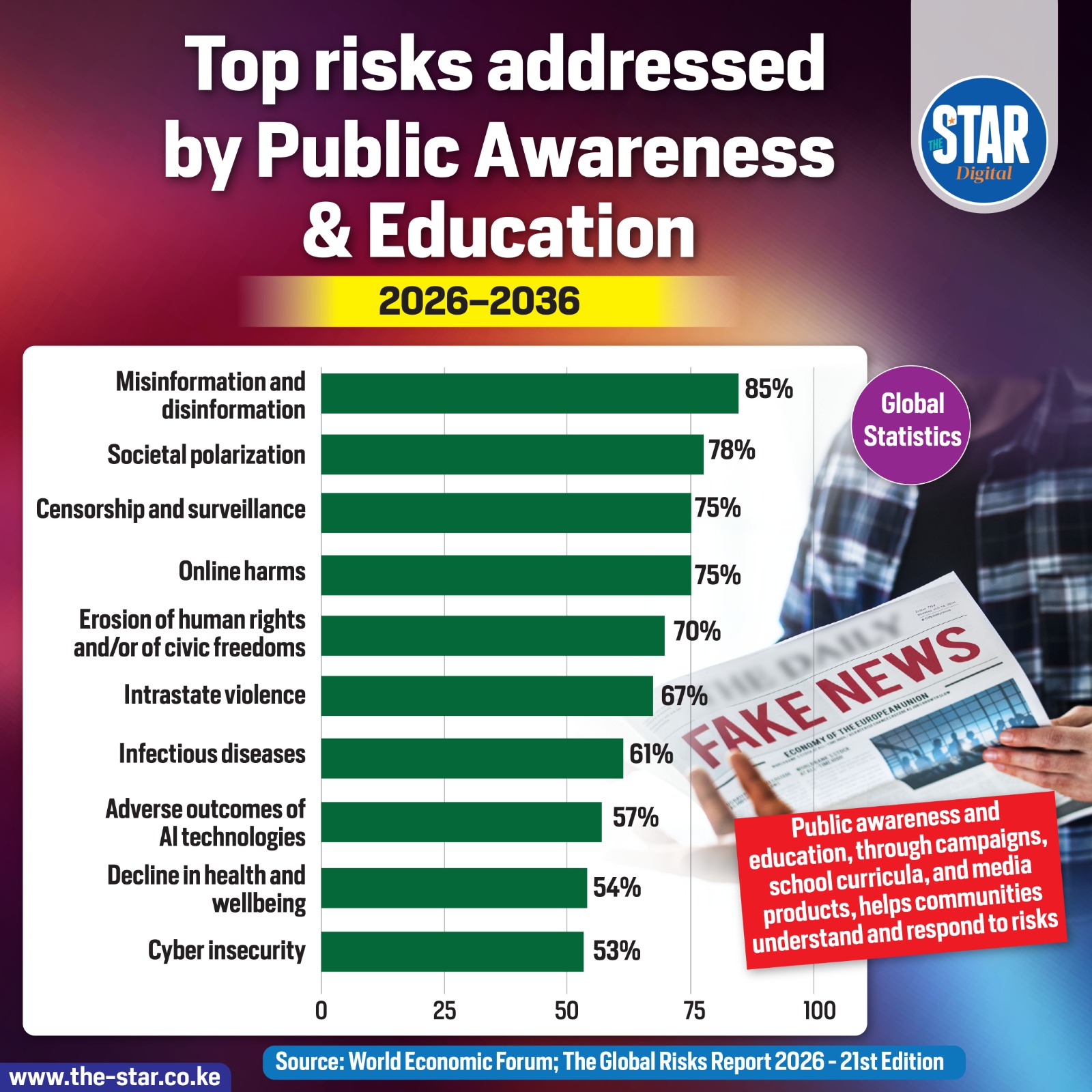
Public awareness and education are proving to be powerful tools in addressing global risks over the next decade.
Misinformation and disinformation top the list, with 85% effectiveness attributed to awareness campaigns, school curricula, and media interventions. This reflects the urgency of countering false narratives and restoring trust in information ecosystems.
Societal polarisation follows closely at 78%, highlighting the role of education in bridging divides and promoting civic dialogue.
Censorship and surveillance, along with online harms, both stand at 75%, indicating that informed communities are better equipped to resist digital overreach and protect personal freedoms.
Erosion of human rights and civic freedoms registers at 70%, showing how public education can reinforce democratic values and empower citizens. Intrastate violence, at 67%, suggests that awareness efforts can help reduce tensions and foster peaceful coexistence, especially in fragile states.
Infectious diseases are addressed with 61% effectiveness, underscoring the importance of health literacy and community engagement in outbreak response. Adverse outcomes of AI technologies rank at 57%, pointing to the need for digital literacy and ethical understanding as AI becomes more embedded in daily life.
Decline in health and wellbeing (54%) and cyber insecurity (53%) round out the list, reinforcing the idea that informed populations are more resilient. The data affirms that education is not just a support tool—it is a frontline defense against complex global threats, capable of shaping behavior, strengthening institutions, and safeguarding societies.