Artificial intelligence is becoming a central pillar in global cybersecurity strategies as organisations grapple with increasingly sophisticated digital threats.
According to the World Economic Forum’s Global Cybersecurity Outlook 2026, companies worldwide are deploying AI primarily to strengthen threat detection, response speed, and operational efficiency.
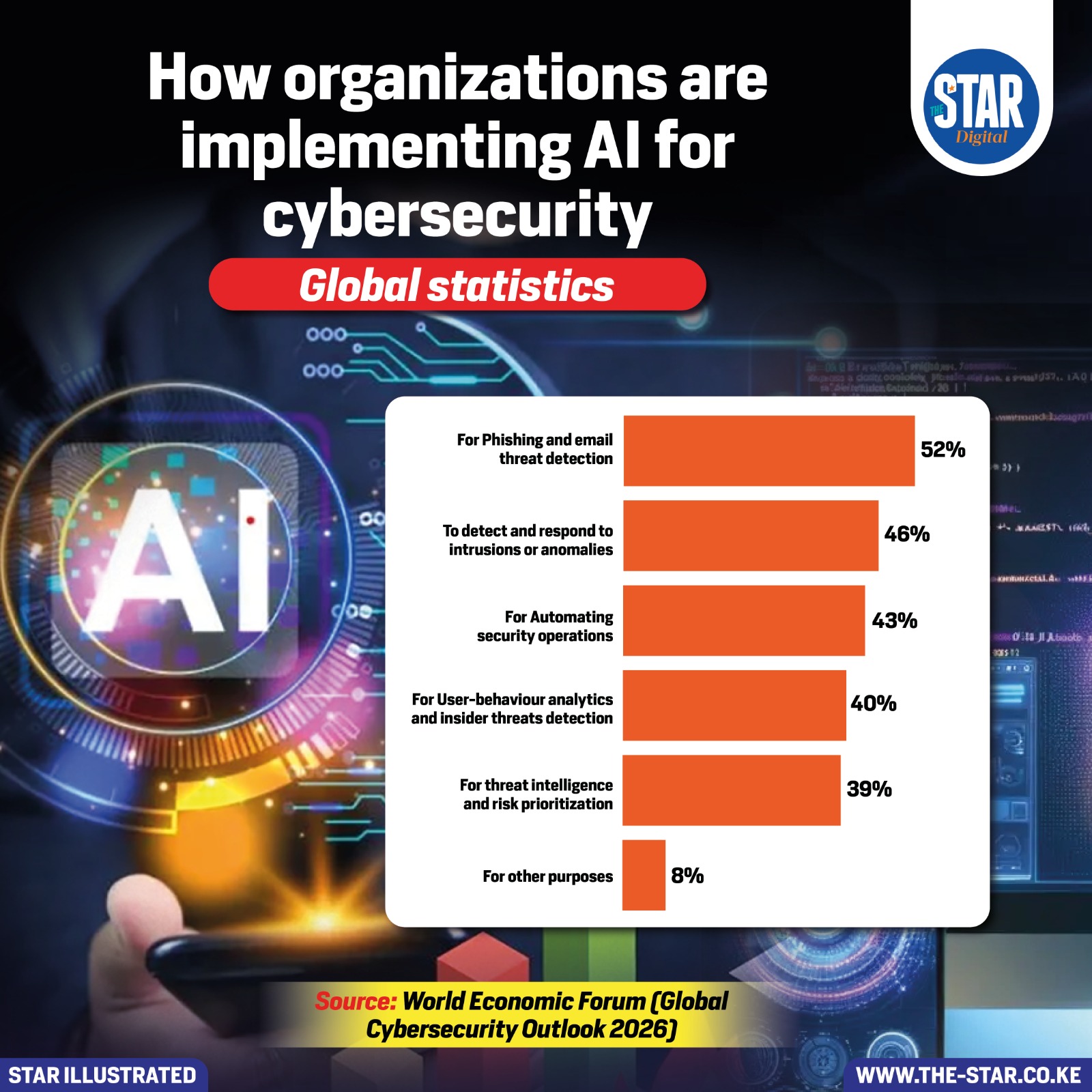
The most common application of AI is in phishing and email threat detection, cited by 52 per cent of organisations.
As phishing attacks continue to evolve in scale and realism, AI-driven systems are proving critical in identifying malicious patterns that traditional rule-based tools often miss.
Detection and response to intrusions or network anomalies ranks second at 46 per cent. Here, AI helps security teams monitor vast data flows in real time, flagging unusual behaviour before breaches escalate into major incidents.
Closely following is the automation of security operations, adopted by 43 per cent of organisations, reflecting efforts to reduce manual workloads and address the global shortage of cybersecurity professionals.
AI is also being used for user-behaviour analytics and insider threat detection, with 40 per cent of organisations leveraging machine learning to identify irregular access patterns or suspicious internal activity.
Meanwhile, 39 per cent apply AI to threat intelligence and risk prioritisation, enabling organisations to focus resources on the most critical vulnerabilities.
Only eight per cent reported using AI for other purposes, indicating that most deployments are concentrated on core defensive functions.
Overall, the data illustrates a clear trend: AI is no longer experimental in cybersecurity but a foundational tool in safeguarding digital infrastructure amid rising global cyber risks.