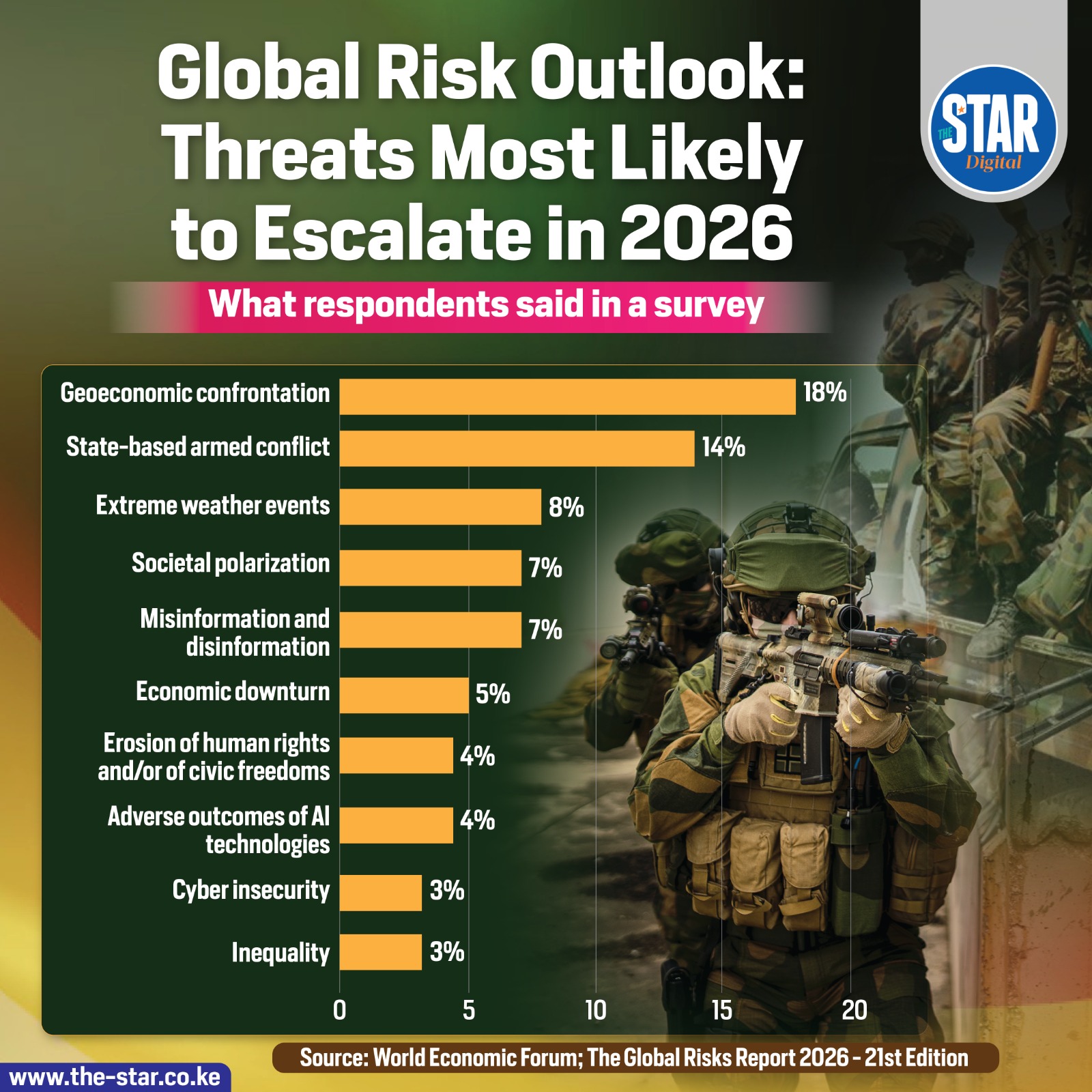
According to the World Economic Forum’s Global Risks Report 2026 (21st Edition), several key global risks are set to escalate this year. At the top of the list is geoeconomic confrontation, cited by 18 per cent of respondents as the most likely threat to intensify.
This reflects growing tensions driven by trade wars, sanctions, protectionist policies and competition over critical resources, as countries increasingly prioritise national interests over multilateral cooperation.
Closely following is state-based armed conflict at 14 per cent, underscoring persistent geopolitical instability across several regions.
Ongoing wars, unresolved territorial disputes and proxy conflicts continue to pose significant risks to global security, economic stability and humanitarian conditions.
Extreme weather events, ranked third at 8 per cent, point to the accelerating impact of climate change. More frequent floods, droughts, heatwaves and storms are straining infrastructure, food systems and disaster-response capacities worldwide.
Societal polarisation and misinformation and disinformation, each at 7 per cent, reflect rising divisions within societies, amplified by social media, political mistrust and information manipulation.
Lower down the list are economic downturn (5 per cent), erosion of human rights and civic freedoms (4 per cent), and adverse outcomes of artificial intelligence technologies (4 per cent), signalling concerns over shrinking democratic space and the unintended consequences of rapidly advancing technologies.
Cyber insecurity and inequality, both at 3 per cent, round out the ranking. Overall, the graphic paints a picture of a world facing interconnected risks, where geopolitical tensions, climate pressures and technological disruptions are likely to shape global stability in 2026.