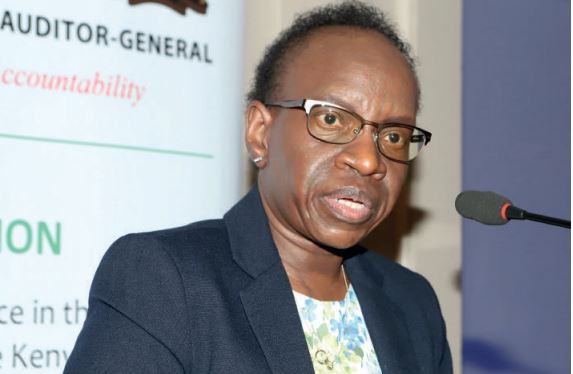
 Auditor General Nancy Gathungu/FILE
Millions of shillings advanced to MCAs and other top county officials—including governors—as car loans and mortgages may never be recovered, it has emerged, in the latest scandal to rock the devolved units.
The revelations lay bare deep structural flaws in the two multibillion-shilling schemes, coming at a time when public confidence in devolved governance appears to have nosedived.
Reports by Auditor General Nancy Gathungu show that county assemblies and executive arms have failed to recover loans advanced to officials.
Some of the pending loans—which were meant to be cleared within five years—date back to the early years of devolution from 2013, raising serious doubts over whether the money will ever be recovered.
According to the reports on car loans and mortgage schemes for county assemblies and executives for the period ending June 30, 2025, many MCAs and county officials, including governors who served between 2013 and 2022, have defaulted on repayments.
In many cases, the borrowers have since exited office, died, or vanished from county payrolls, with little evidence that recovery measures were pursued.
The Auditor General has expressed serious doubt over the recoverability of the funds, warning that the losses could ultimately be borne by the public.
“Some officers and MCAs passed on without repaying their loans, while others left office without settling outstanding balances,” the report states.
The situation has been worsened by the failure of some counties to insure the loans, lack of collateral, weak or non-existent regulations, and poor enforcement of recovery mechanisms.
In some cases, loans were issued without a proper legal framework to guide their management.
In Mombasa county, the assembly is yet to recover Sh53.56 million advanced to MCAs under car loan and mortgage schemes.
Of this amount, Sh6.43 million is owed by four MCAs who served between 2013 and 2018 and have since defaulted.
A further Sh3.76 million is owed by two MCAs who are deceased, while Sh959,720 is owed by a member whose contract ended on August 8, 2017.
“The recovery of the outstanding amounts remains doubtful,” the Auditor General notes.
In Bungoma county, the assembly has failed to recover Sh23 million advanced to members of the first (2013–2017) and second (2017–2022) county assemblies who were not re-elected.
Auditors questioned why the loans were structured in a manner that went beyond the five-year tenure of MCAs.
“No explanation was provided on why the former members were advanced loans that were not confined to the term of their respective office tenure,” the report says.
In Uasin Gishu county, Sh118.94 million advanced to county staff through car and mortgage loans has been classified as non-performing.
The audit also flagged a former governor who defaulted on a 20-year mortgage loan initially issued at Sh40 million during the 2016-2017 financial year.
The loan was later topped up to Sh64 million, exceeding the approved ceiling for a governor’s mortgage benefit by Sh24 million.
This contravenes the Salaries and Remuneration Commission circular, which caps a county governor’s mortgage benefit at Sh40 million.
“The irregular top-up violated existing remuneration guidelines,” the report notes.
Last year, the Senate County Public Investments and Special Funds Committee uncovered what appeared to be widespread abuse of car loan and mortgage schemes involving current and former governors and senior county officials.
The committee established that many county executives, particularly former governors, have defaulted on their loan repayments.
“We had a case where a governor borrowed Sh50 million. How can one possibly repay Sh50 million in five years? In Parliament, we also access loans, but all must be cleared within our term,” chairman Godfrey Osotsi said.
Governors earn Sh957,000, including allowances, every month.
In the latest report, Marsabit county assembly disbursed Sh26.89 million in loans without securing insurance cover to insulate public funds, contrary to the law.
Regulation 13(4) of the Public Finance Management (Marsabit County State Officers and Other Public Officers Car Loan Scheme Fund) Regulations, 2015, requires that every loan issued under the scheme be insured.
However, auditors raised concerns over whether the regulations were properly enacted as county-specific legislation in line with constitutional requirements.
In Samburu, Sh14.82 million advanced in mortgage loans to MCAs who served in the previous assembly remains unpaid.
“There was no evidence that the Loan Management Committee had initiated recovery measures such as issuing demand letters, instituting legal proceedings, or engaging debt collection agencies,” the report states.
The county further advanced Sh387.85 million in mortgage loans to MCAs and staff without charging any collateral, contrary to Regulation 16(1) of the Samburu County Assembly Car Loan and Mortgage Fund Regulations, 2021.
In West Pokot, the assembly failed to insure Sh67.63 million advanced to members and staff, exposing the fund to losses in the event of death, disability, or default.
Auditors also noted that beneficiaries did not provide collateral, placing the fund at high credit risk.
In Kajiado county, the Auditor General cast doubt on the recoverability of Sh14.38 million issued to five executive officers between 2016 and 2022.
The officers have not been making consistent repayments and could not be traced on the county executive payroll, suggesting they may have exited public service.
“Although management explained that the recovery process was initiated, no evidence was provided for audit review,” the report says.
It further notes that the county has not exercised its legal option of auctioning charged property to recover the funds.
In Murang’a county, two MCAs have defaulted on car and mortgage loans amounting to Sh1.97 million.
The fund administration committee has neither repossessed the vehicles nor taken any steps to recover the outstanding amounts.
“No recovery measures have been initiated for these long outstanding loans,” the report states.
In Siaya county, all car and mortgage loans advanced to MCAs and assembly staff were found to be non-performing.
A similar situation was reported in Nyamira, where Sh51.18 million advanced to 18 members of staff is non-performing.
Five of the defaulters have already exited service, owing Sh30.91 million, which auditors warn may not be recovered.
“There is no evidence of measures instituted to recover the loans, although some title deeds are reportedly held by the fund management committee as security,” the report notes.
In Kilifi county, the Auditor General flagged the absence of sound policies and procedures to guide the management of the car loan and mortgage fund.
In Nakuru county, the assembly was faulted for irregular mortgage loan top-ups amounting to Sh24.46 million.
Management failed to provide approval documents or application letters explaining the purpose of the top-ups.
“This raises concerns over the propriety and accountability of the transactions,” the report says.
The Auditor General has warned that unless county governments tighten controls, enforce recoveries, and hold accounting officers personally liable, car loan and mortgage schemes risk collapsing.
The findings come amid increased scrutiny by the Senate and oversight agencies over the use of public funds at the county level, with pressure mounting on governors, speakers, and clerks to explain how millions meant to benefit public officers have turned into bad debts.
For now, the unpaid loans remain a stark reminder of weak accountability — and the growing cost of poor financial governance in Kenya’s devolved units.
INSTANT ANALYSIS
The government provides official car loans and mortgage schemes with favourable terms to state and public officers. These schemes offer lower interest rates and longer repayment periods compared to commercial lending and are managed by different government agencies depending on the employee's role. However, some beneficiaries are defaulting on repayments, triggering concerns about the possibility of loss of public money.