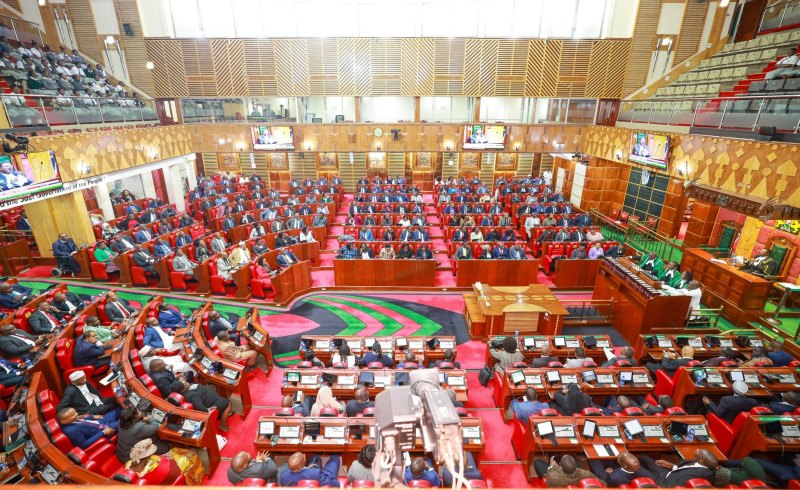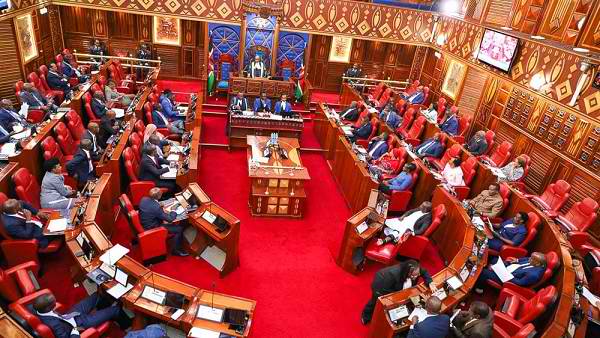
A showdown is brewing between governors and senators as county chiefs prepare to face questioning in Parliament over the use of public funds.
The development follows the release of hundreds of audit reports by Auditor General Nancy Gathungu detailing how counties spent taxpayers’ money in the 2024-25 financial year.
The Senate, through its watchdog committees, has summoned governors for what is expected to be a marathon round of questioning on audit queries.
The hearings come amid growing concerns over waste, weak accountability systems, and persistent financial irregularities in county governments.
Senate Speaker Amason Kingi has directed the County Public Accounts Committee (CPAC) and the County Public Investments and Special Funds Committee (CPISFC) to start the interrogation of governors and senior county officials immediately.
The move follows the Senate’s receipt of hundreds of audit reports from the Office of the Auditor General covering county executives, assemblies and devolved entities.
The sittings will start earlier than usual as the Senate races to comply with a court ruling that strictly enforces constitutional timelines on the consideration of audit reports.
Lawmakers are under pressure to interrogate and act on the reports within three months of receipt, failure to which the process would be rendered unconstitutional.
The committees will review audit reports relating to county executives and assemblies, as well as county-owned or managed entities such as hospitals, water companies and special-purpose funds. .
These entities have in the past been flagged as major centres of financial mismanagement, with auditors repeatedly citing unsupported expenditures, procurement flaws and weak internal controls.
Late last year, the Senate adopted a motion allowing the Speaker to refer urgent audit reports to relevant committees even before they are formally tabled in the House.
The move was aimed at beating the constitutional deadline for the consideration of audit reports and avoiding a repeat of past delays that have drawn criticism from the courts.
“The Senate resolves that during the recess of the Fourth Session of the 13th Parliament, where any statutory instrument or paper is transmitted for tabling in the Senate, and the Speaker determines that it is of priority, the Speaker shall forthwith refer it to the relevant committee for consideration,” the resolution says. Such papers are deemed to have been tabled upon referral.
The decision was influenced by a High Court ruling that strictly enforced the constitutional timeline on audit oversight.
In a judgment delivered by Justice Jairus Ngaah, Parliament and county assemblies were barred from debating audit reports more than three months after receiving them from the Auditor General.
“A declaration is hereby issued that the constitutional timelines spelt out in Article 229(4) and (8) of the Constitution and Sections 48 and 50 of the Public Audit Act, 2015 are mandatory and must be complied with,” Justice Ngaah ruled.
Under the constitution, the Auditor General is required to audit and submit reports on national and county government accounts within six months after the end of each financial year.
Parliament and county assemblies must then debate and take appropriate action on the reports within three months of receipt.
Already, CPAC, chaired by Homa Bay Senator Moses Kajwang’, and CPISFC, chaired by Vihiga Senator Godfrey Osotsi, have written to all governors instructing them to appear before the committees to respond to specific audit queries.
Governors will start appearing before CPISFC on Monday, while CPAC has scheduled its hearings from January 26.
The governors are expected to submit detailed written responses and provide documentary evidence to justify expenditures flagged by the Auditor General.
Failure to provide satisfactory explanations could result in adverse findings and recommendations, including referrals to investigative agencies such as the Ethics and Anti-Corruption Commission and the Directorate of Criminal Investigations.
Previous audit sessions have often been tense, with some sessions degenerating into bitter exchanges between senators and governors.
Lawmakers have accused some county bosses of arrogance, evasiveness and contempt for oversight institutions, while governors have, in turn, complained of political witch-hunts.
The two committees are expected to conclude their hearings and table reports in the Senate by March 31 for debate and adoption by the House.
Audit reports have consistently exposed widespread irregularities across counties, ranging from unsupported expenditures and inflated procurement costs to poor record-keeping and weak internal controls.
In the 2023–24 financial year, CPAC revealed that the 47 county governments could not account for Sh39.09 billion in irregular expenditures, Sh4.97 billion in unsupported spending and Sh13.93 billion in excess or unbudgeted expenditures.
In past sittings, the committees have issued hard-hitting recommendations against governors and county officials found culpable of financial mismanagement.
In 2019, CPAC recommended investigations into at least 13 sitting governors and 10 former governors over the possible loss of public funds during their tenures.
“We don’t have a committee in the Senate to follow up on the implementation of reports, so our committee will follow up,” Kajwang’ previously told the Star, underscoring the Senate’s determination to ensure audit findings translate into action.
Past audits have uncovered a range of malpractices, including flawed multi-million-shilling tendering processes, conflicts of interest, overpayments, misuse of car loans and mortgages and manipulation of pending bills.
Other losses were linked to poor book-keeping, inflated costs and failure to recover imprests issued to county staff.
“The committee noted that non-compliance with the law resulted in the loss of public funds and recommends that the DCI and the EACC investigate the violations with a view to prosecuting those responsible,” reads a past CPAC report.
INSTANT ANALYSIS
Weak financial systems and failure by officers to safeguard public resources has put Sh532.67 billion at a potential risk of loss in the counties. A report by the Senate County Public Accounts Committee exposes the worrying levels of fiduciary risk exposure by the counties. The committee, chaired by Homa Bay Senator Moses Kajwang’, tabled its report after scrutinising the Auditor General’s report for the county executives for the financial year ending June 30, 2024.