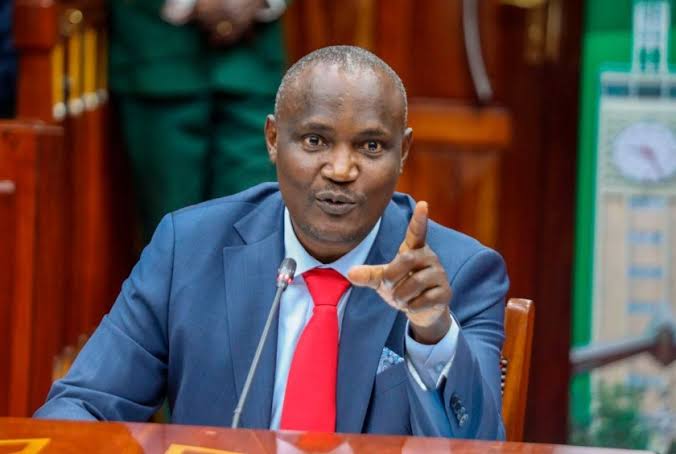
 Treasury CS John Mbadi/FILE
Kenya Kwanza administration has, for the second consecutive year, avoided introducing significant new taxes to increase revenues for funding next year’s budget.
Keen to avoid a resurgence of public and political pressure that forced the collapse of the 2024 Finance Bill, President William Ruto’s administration is proceeding with caution.
The strategic retreat has been revealed in the Draft 2026 Budget Policy Statement (BPS) published by the National Treasury recently, and set for tabling in Parliament by February 15.
The CS John Mbadi-led Treasury is opting to prioritise administrative reforms and expenditure rationalisation over revenue-raising measures that could trigger renewed social unrest.
“The government will deepen tax policy and administrative reforms to expand the tax base, minimise tax expenditures, enhance compliance and leverage technology to modernise tax processes,” the draft BPS states.
Treasury has framed its revenue strategy for the budgets beginning July 1 around efficiency rather than expansion, just as was the case in the current spending period.
The emphasis will be on improving tax compliance, sealing revenue leakages, and leveraging technology, not on expanding the tax base through new levies or rate hikes.
“The government will implement a mix of administrative and tax policy measures to boost revenue collection, thereby supporting economic activity,” the policy statement reads in part.
Tax increases, particularly through the Finance Bill 2024, sparked never-seen-before nationwide protests led largely by young, digitally-savvy Kenyans.
The demonstrations, which were also fueled by economic grievances and demands for political accountability, presented a huge domestic challenge to President Ruto’s government.
Treasury, appearing to have learned a critical lesson, has taken a new dimension to shore up collections. It has set a target of Sh3 trillion for ordinary revenue.
The BPS reveals that the government seeks to harmonise tax laws, rationalise and target tax expenditures, and create a fair tax system.
“These reforms aim to enhance compliance, reduce administrative complexity, support investment and move revenue collection toward 20 per cent of GDP in the medium term,” the policy reads.
Treasury says it will leverage technology to ‘modernise tax framework, improve compliance, broaden tax base, strengthen customs valuation and seal revenue leakages’.
“Leveraging digital systems will promote fairness and ensure every Kenyan contributes their fair share, reducing the burden on already compliant taxpayers,” BPS states.
Part of the strategy is to scale up non-tax revenues by “enhancing the capacity of ministries to effectively generate income from public services.”
“The government will focus on strengthening its operational systems to improve service-based revenue performance,” the document reads.
With the path of new taxes blocked, the National Treasury has outlined alternative measures to shore up the country’s finances and fund its ambitious development plans.
They include a radical austerity and fiscal consolidation plan alongside the push to privatise state assets like Safaricom and Kenya Pipeline Company.
The government is looking at raising over Sh200 billion from the partial divestiture of Safaricom and about Sh110 billion from the Kenya Pipeline Company.
The Cabinet has approved the creation of a National Infrastructure Fund and a Sovereign Wealth Fund, aiming to mobilise Sh5 trillion, part of which will be proceeds from the sale of the entities.
Privatisation proceeds will thus be “ring-fenced” for food security, infrastructure, and energy-driven industrialisation.
Ministries and state agencies have been directed to “re-examine all existing and proposed programmes”.
Treasury says this will be with the view to eliminate low-impact activities and ensure that resource allocation focuses on high-priority, high-return interventions.
The zero-based budgeting approach is intended to weed out wasteful spending by state agencies.
An optimistic Treasury is projecting a rise of 5.3 per cent GDP growth in 2025 and 2026, fuelled by agriculture and a recovering industry sector.
It argues that the projected growth, combined with stringent expenditure controls and asset sales, will allow the government to gradually reduce the fiscal deficit.
Treasury projects that the deficit would come down from an estimated 5.3 per cent of GDP in 2026-27 to 3.4 per cent by 2028-29 without resorting to controversial taxes.
Significant risks have been acknowledged in the document, including extreme weather events that threaten agricultural output and could fuel inflation.
BPS also highlights the persistent challenge of a high public wage bill and low development spending at the county level, amid fears that many devolved units are still exceeding legal limits on personnel costs.
Experts at the Parliamentary Budget Office said the Finance Bill of 2025 proved that the government can collect more taxes without introducing new levies.
Without new taxes, the Treasury still managed to collect about Sh30 billion in additional revenue through simplified laws, stronger enforcement and administrative reforms.
“This evolution reflects a growing recognition that sustainable revenue mobilisation thrives as much from public trust and policy credibility as from tax measures themselves,” the Dr Martin Masinde-led PBO reads.
The flipside, however, is that the government is set to borrow more cash (Sh200 billion compared with this year) to cure the projected Sh1.1 trillion deficit.
The draft 2026 BPS shows that the Treasury is grappling with a negative budget (-Sh231 billion), threatening funding for critical government programs.
INSTANT ANALYSIS
The defining question is whether the gamble will succeed in calming public sentiment while stabilising the nation’s finances. While the 2026 BPS posits a bold new economic direction, it is more a testament to the power of citizen protest. It reflects a government consciously treading a careful path between fiscal necessity and political survival.