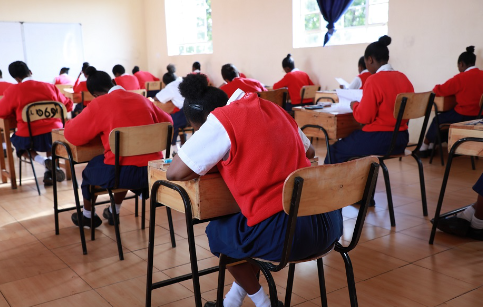
Girls are conspicuously absent from exam halls in the arid Northeastern region and neighbouring areas, and those who sit are often much older than their counterparts elsewhere.
The 2025 KCSE data released by the Education ministry on Friday shows older candidates dominated KCSE in marginalised regions, a trend that played out in the past two years.
In counties like Garissa, Mandera and Wajir, the classrooms remain a predominantly male space.
In the referenced counties, only 33.76 per cent, 34.91 per cent and 39.90 per cent of candidates were female, respectively.
The data of Garissa was more telling, where for every two girls sitting the KCSE exam, there were four boys.
During the year, 10 counties had a significant entry of more male than female candidates, of which counties in the north were the majority.
Turkana had female candidates accounting for 42.33 per cent, 47.57 per cent in Samburu, and 46.9 per cent in Narok (also a pastoralist county).
Other counties with low female candidate population included Mombasa (47.92 per cent), Homa Bay (48 per cent), Nyamira (48 per cent) and West Pokot (48.16 per cent).
It sharply contrasts counties like Kiambu, which had 53.23 per cent females, with Nairobi reporting 52.9 per cent.
In the cited counties, the girls are not just present but are leading in enrolment.
On the flip side, 14 counties had a significant entry of more female than male candidates, including some hardship areas.
They included Vihiga with 55 per cent accounting for females, a similar proportion in Elgeyo Marakwet, while in Kisumu, girls accounted for 52.87 per cent.
Others which had more girls than boys sit exams are Kwale at 53 per cent, Kakamega (52.47 per cent), Meru (52.22 per cent), Isiolo (52.21 per cent), Uasin Gishu (52.14 per cent), Machakos (51.87 per cent), Kitui (51.74 per cent), Busia (51.72 per cent) and Tharaka Nithi (51.57 per cent).
Twenty-three counties recorded a near-perfect gender parity, among others, Lamu, Embu, Tana River, Laikipia, Kisii, Kericho, Murang’a, and Makueni.
A further analysis reveals that the layers of inequality go beyond the gender gap, which seems to be just the first layer.
The age profile of candidates from the marginalised regions also reveals a telling trend.
Education experts consider the typical KCSE candidate to be 17 or 18 years old, going by the age at which most pupils enter school.
“The highest percentage of candidates registered for the 2025 KCSE examination was within the appropriate age bracket of between 17 and 19 years, constituting 716,048 (72.02 per cent) of the total candidature,” Education CS Julius Ogamba said.
Yet, in Turkana, 27.27 per cent of candidates in 2025 were 22 years or older. In Garissa, the number of those above 18 was 33.48 per cent.
Nationally, only 2.65 per cent of candidates were 16-year-old or below, sharply contrasting with the cited counties.
The number of candidates aged 16 years and below increased by about 6,000 compared to last year, when 20,546 wrote the exam.
The figures from the North point to rampant interruptions in education, with children starting school late due to poverty or pastoralist lifestyles.
There are cases of students who drop out for seasons to support their families, and a high prevalence of class repetition.
For girls, the interruptions are often tied to early marriage, domestic burdens or security concerns.
The schools available in the region are overwhelmingly subcounty institutions, which the data shows have the country’s lowest performance.
The data shows only 13.6 per cent of students from the marginalised counties achieved the university-qualifying grade of C+ and above.
President William Ruto’s administration has proposed a policy to address the disparities.
The national policy on ethnic minorities and marginalised communities acknowledges the damage caused by the neglect.
It seeks to intervene “by providing a targeted framework for affirmative action in education”.
“The policy aims to close the vast educational gap and empower children (from ethnic minorities) with the skills needed for social and economic mobility,” the policy reads in part.