Nearly half of the candidates who sat the 2025 Kenya Certificate of Secondary Education examination scored grade D+ and below.
This is even as students in national, extra-county, and private institutions maintained strong performances over their colleagues in county and subcounty schools.
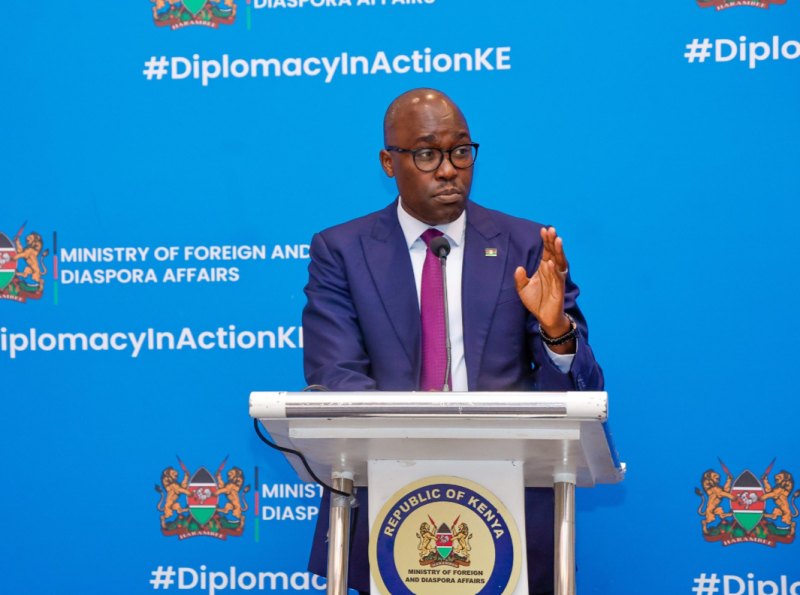
Education Cabinet Secretary Julius Ogamba released the results at Chebisaas Boys High School in Eldoret, Uasin Gishu county, on Friday.
According to the results, 482,030 out of the 993,226 candidates who sat the examination scored D+ and below, representing 48.53 per cent of the total candidature.
The figures paint a picture of persistent performance disparities across different categories of schools, with students in county and sub-county schools accounting for the bulk of lower grades, while national, extra-county and private schools dominated the top grades.
A breakdown of the results shows that 126,952 candidates attained grade D+, 145,557 scored D (plain), 161,724 received D– (minus), while 47,798 candidates scored grade E, the lowest possible grade in the examination.
An analysis by school category indicates that county and sub-county schools were the most affected by poor performance.
In county schools, 25,317 students scored D+, 23,767 scored D, 14,741 attained D–, while 2,104 candidates scored grade E.
The situation was more pronounced in sub-county schools, where 75,436 candidates scored D+, 104,413 obtained grade D, 134,149 scored D– and 39,325 candidates received grade E.
In contrast, performance in national, extra-county and private schools remained relatively strong.
Only 39 students, representing 0.39 per cent of candidates in national schools, scored grade E, while 115 students, or 0.06 per cent, in extra-county schools attained the same grade.
In private schools, 6,081 candidates, equivalent to 9.10 per cent, scored grade E.
Some 1,526 students in national schools scored grade A (plain), with some 197 from extra-county schools and 185 from private schools getting the top grade.
Only six students from county schools and 18 from subcounty schools got grade A.
In addition, 5,363 in national schools, 2,358 in extra-county schools and 869 in private schools scored grade A- (minus).
Only 239 students in the county and 507 in the subcounty schools got the A- grade.
Overall, 37,539 students in national schools, 101,431 in extra-county schools, 22,446 scored C+ and above, accounting for 59 per cent of the 270,715 students who scored the top grades.
Despite the high number of low grades, the Education Cabinet Secretary noted a marginal improvement in the overall number of candidates attaining a pass grade.
“The number of candidates attaining a pass grade (grade D+ and above) was 634,082, representing 63.67 per cent in the year 2025 KCSE examination, compared to 605,774 candidates or 62.76 per cent in 2024,” Ogamba said.
The results also showed an improvement in the number of candidates attaining top grades.
A total of 1,932 candidates, representing 0.19 per cent of the total candidature, obtained an overall mean grade A (plain), up from 1,693 candidates, or 0.18 per cent, in 2024.
Subcounty schools, however, outperformed county schools in the number of candidates scoring grade C+ and above, producing 72,699 candidates compared to 36,600 candidates from county schools.
Overall, the number of candidates scoring grade C– and above stood at 507,131, representing 50.92 per cent of the candidature, compared to 476,889 candidates, or 49.41 per cent, in 2024.
A total of 270,715 candidates scored grade C+ and above, qualifying for direct entry into universities.
This represents 27.18 per cent of the total candidature and marks an improvement from 246,391 candidates, or 25.53 per cent, recorded in 2024.
This means that 722,511 candidates, or 72.74 per cent of those who sat the 2025 KCSE examination, did not qualify for direct university entry and are expected to pursue post-secondary education in colleges, technical institutes and other tertiary institutions.
“The candidates whose results we release today are now expected to transit to tertiary education, either in universities or TVET institutions,” Ogamba said.
At the tertiary level, the government is implementing the Student-Centred Funding Model, under which students receive financial support in the form of scholarships and loans based on their level of need.
“To enhance access and affordability, fees for academic programmes in our public universities have also been rationalised by between 15 per cent and 40 per cent, so that fees range from Sh5,800 to Sh75,000 per semester,” Ogamba said.
The Cabinet Secretary encouraged all eligible candidates to apply for placement to programmes of their choice once the process begins.
A total of 993,226 candidates sat the 2025 KCSE examination, compared to 962,512 candidates in 2024, representing an increase of 30,714 candidates or 3.19 per cent.
However, results for 1,180 candidates were cancelled after they were implicated in examination irregularities.
“Consequently, and in line with the applicable law and regulations, their examination results have been cancelled,” Ogamba said.
Gender parity continued to improve, with female candidates outnumbering male candidates for the second consecutive year.
Of the total candidature, 492,012 candidates were male while 501,214 were female, representing 49.54 per cent and 50.46 per cent respectively.
Ten counties recorded significantly higher numbers of male candidates than female candidates. These were Garissa, Mandera, Wajir, Turkana, Narok, Samburu, Mombasa, Homa Bay, Nyamira and West Pokot.
Fourteen counties recorded significantly more female candidates than male candidates.
These included Vihiga, Elgeyo Marakwet, Kisumu, Kiambu, Kwale, Nairobi, Kakamega, Meru, Isiolo, Uasin Gishu, Machakos, Kitui, Busia, and Tharaka Nithi.
The remaining 23 counties recorded near-perfect gender parity.
The analysis also showed an increase in the number of underage candidates. The number of candidates aged 16 years and below rose from 20,546 (2.13 per cent) in 2024 to 26,391 (2.65 per cent) in 2025.
“The highest percentage of candidates registered for the 2025 KCSE examination was within the appropriate age bracket of 17 to 19 years, constituting 716,048 candidates or 72.02 per cent of the total candidature,” Ogamba said.
Subject performance analysis showed mixed results. Seventeen subjects recorded a significant performance improvement, the same number as in 2024, while 11 subjects recorded a significant decline compared to 10 subjects the previous year.
Female candidates outperformed male candidates in six subjects: English, Kiswahili, Kenyan Sign Language, Home Science, Christian Religious Education (CRE), and Art and Design.
Male candidates performed better in Mathematics (Alternatives A and B), Biology and Biology for the Blind, Chemistry, General Science, History and Government, Geography, Islamic Religious Education (IRE), Building Construction, and Business Studies.
Performance was comparable in Physics, Agriculture, Computer Studies, French, German, Arabic, and Music.
Ogamba noted that female candidature in five technical subjects — Metalwork, Power Mechanics, Electricity, Drawing and Design, and Aviation Technology — was too low to allow for meaningful gender-based performance comparison.
The 2025 KCSE examinations were administered nationwide between October 21 and November 14, 2025.