
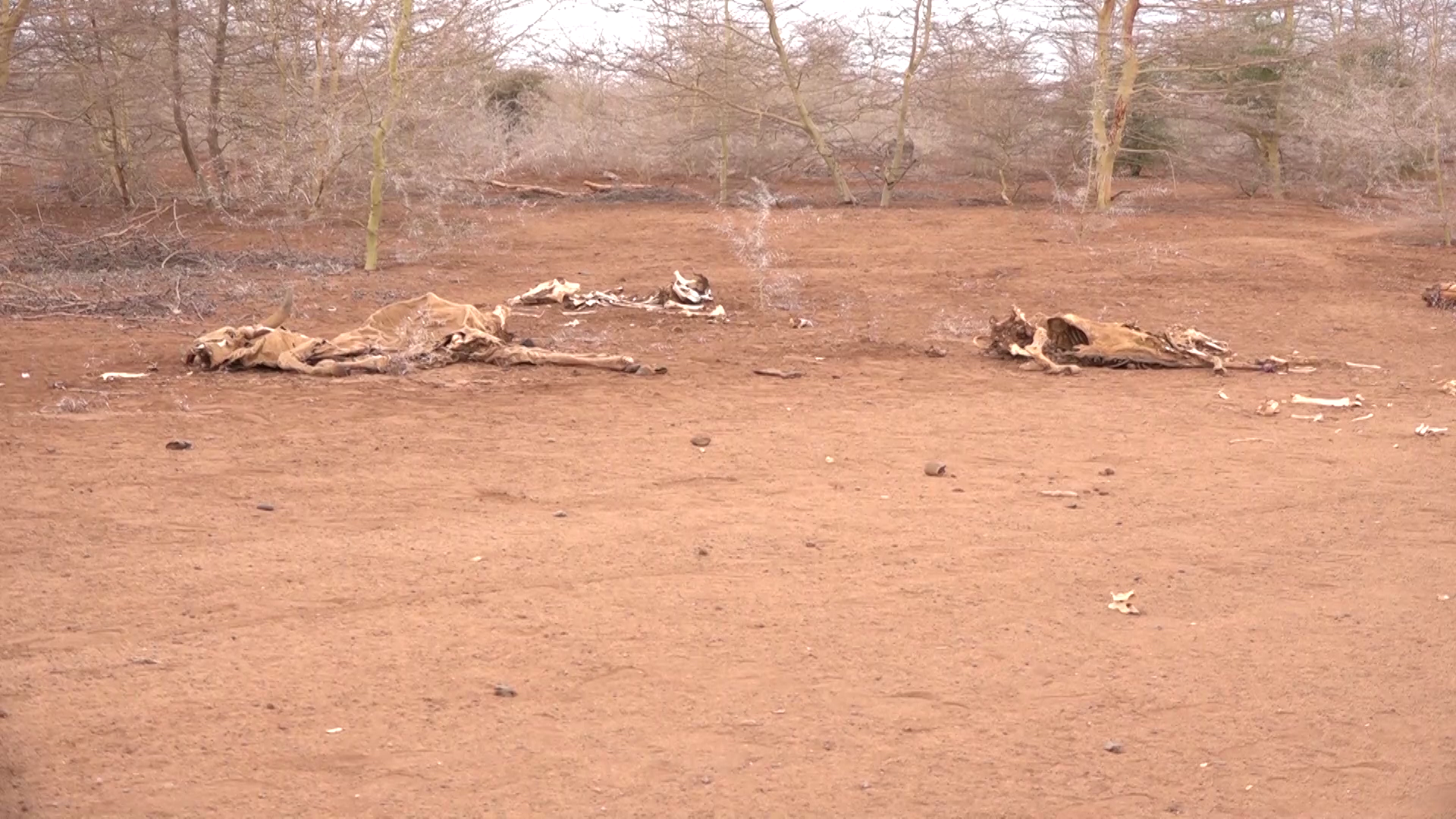
 Carcasses of dead animals in Dertu, Dadaab sub county, Garissa, in the 2022 drought. Photo/ STEPHEN ASTARIKO
Thousands of Kenyans will need relief food to survive over the next three months, as hot and dry weather continues to tighten its grip across the country.
The Kenya Meteorological Department has warned of food insecurity in the northern and eastern parts of the country, as water, pasture and food supplies continue to decline.
The Met called on national and county governments, as well as humanitarian organisations to act early and prevent loss of lives.
“The dry weather conditions expected during the month are likely to worsen the food security over the northern and parts of the eastern sectors of the country as availability of food, water and pasture for human as well as livestock use is expected to decline further,” the department said in a statement signed by deputy director Kennedy Thiong’o.
He said health risks may also increase as temperatures rise and food becomes scarce in the hardest-hit regions.
“Malnutrition related diseases are likely to increase over the northern sector of the country,” Thiong’o said in the statement, the Climate Outlook for January-March 2026. “Plans should therefore be put in place to provide food and food supplements to the most vulnerable communities.”
While parts of the country are expected to receive occasional rainfall, the overall outlook points to continued dryness, high temperatures and rising stress on livelihoods that depend on rain-fed farming and livestock.
“The outlook for the next three months indicates that most parts of the country are likely to experience sunny and dry weather conditions throughout the forecast period,” the department said.
It added that only a few areas may see some improvement later in the season.
“However, a few areas over the Western sector and especially those around the Lake Victoria region and Southern Rift Valley may experience occasional rainfall in January and February. In March, the rainfall is expected to spread to several places,” the statement said.
Meteorological officials say these isolated rains may help crops still in the fields, but will not be enough to reverse the wider impacts of the dry season.
For counties such as Turkana, Marsabit, Samburu, Mandera, Wajir and Garissa, the forecast shows little relief from the harsh conditions.
“Sunny and dry conditions are expected in January. High day time (Maximum) temperatures (30°C - 40°C) are expected to prevail in most places during the month,” the statement said.
The department warns that such high temperatures increase water loss, dry up pasture faster and weaken livestock, which many households depend on for food and income.
“Temperatures are expected to be warmer than average over the whole country. Daytime (Maximum) temperatures over northeast and northwest are expected to be high and may occasionally rise beyond 37°C,” the statement said.
The dry conditions are also expected to affect access to clean water, forcing communities and animals to travel longer distances in search of water, raising the risk of conflict and disease.
According to the department, the weather pattern is being driven by global climate systems that are suppressing rainfall over East Africa.
“Overall, the combination of persistent La Niña conditions in the Pacific and a neutral IOD suggests a tendency towards suppressed rainfall over parts of East Africa, including Kenya, during January 2026, although localised rainfall may still occur due to transient weather systems,” the statement said.
In Western Kenya, parts of the Rift Valley and areas around Lake Victoria, the department says occasional rainfall may occur, but dry weather will still dominate most days.
“Areas are likely to experience generally dry conditions for most of the month. However, occasional light to moderate rainfall is expected during the month,” the statement said of regions including the Lake Victoria Basin and the Central and Southern Rift Valley.
The department cautioned that farmers should not expect sustained rainfall.