Latest National Treasury disclosures reveal the President is eyeing the Sh5 trillion infrastructure fund to make a mark.
With this being his full budget before the 2027 general elections, Ruto is rallying behind capital-intensive projects.
His last budget for the first term prioritises mega dams, a 10,000MW energy boost, airport upgrades and dual highways.
The CS John Mbadi-led Treasury says the projects would make Kenya an industrial and regional logistics hub.
According to the plan, Ruto’s team is ready to modernise Jomo Kenyatta International Airport (JKIA).
The government was in 2024 forced to cancel the Adani deals following protests by a section of Kenyans. The Indian firm sought to upgrade the airport at Sh296 billion. Its other electrification deals were also cancelled.
The ports of Mombasa and Lamu are also set for major facelifts, with reforms also planned to ‘restore the operational and financial stability of Kenya Airways’.
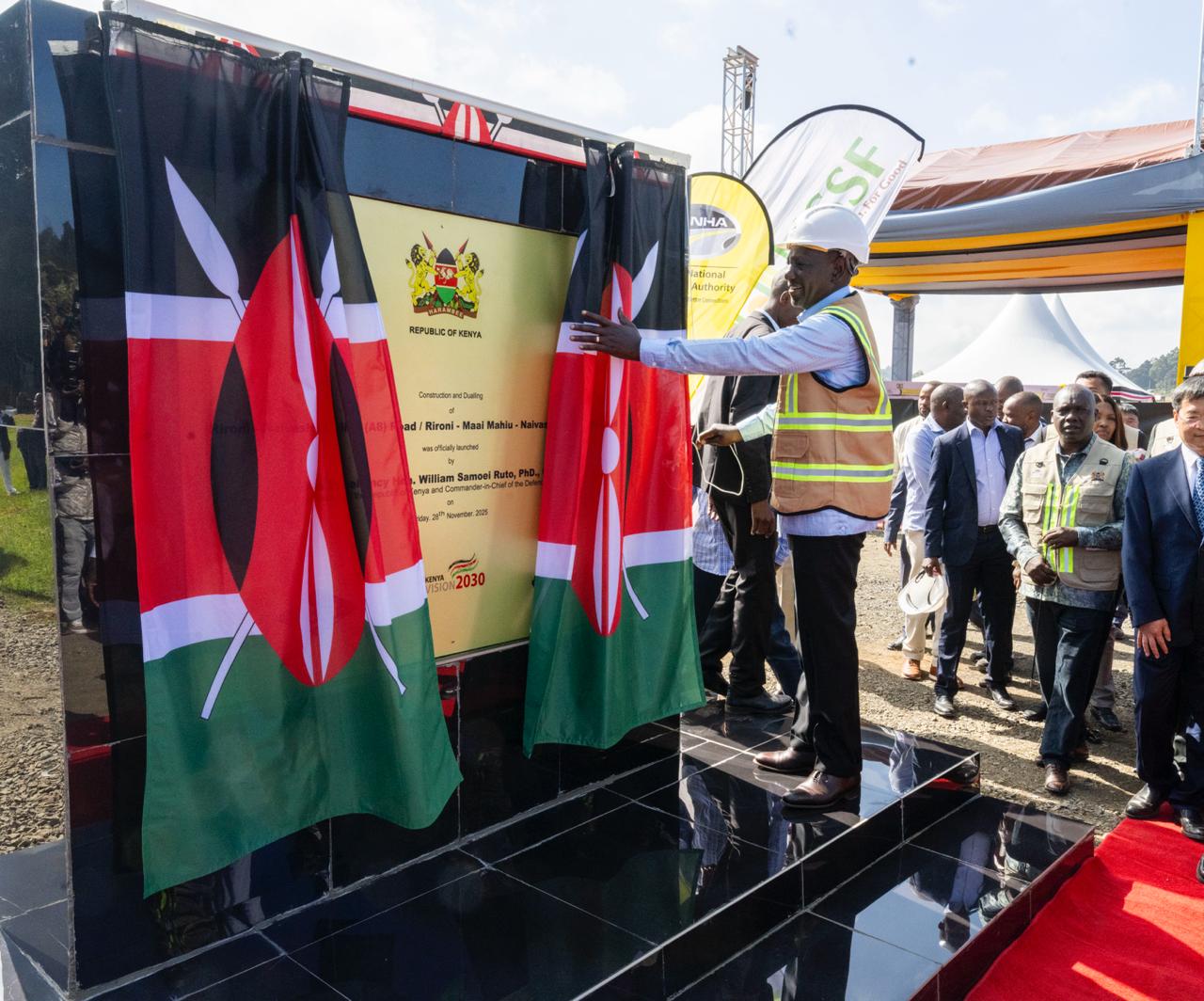
Major projects, which are already underway, including the dualling of the Rironi–Naivasha–Nakuru–Mau Summit and the Rironi–Maai Mahiu–Naivasha roads, have also been streamlined in the budget.
Ruto targets the project to woo not only the Rift Valley and Western vote, but also parts of central Kenya. The proposed Thika expressway is, however, not featured in the report.
“Additional key corridors across the country have been earmarked for expansion to eliminate congestion and improve mobility,” the BPS reads.
Other major roads are also set for upgrades and rehabilitation.
The blueprint shows Kenya Kwanza plans to dual 2,500km of highways and tarmac 28,000km of roads.
The government also plans to construct 1,900 kilometres of roads, rehabilitate more than 500 kilometres, and periodically maintain 1,224 kilometres.
The extension of the Standard Gauge Railway from Naivasha to Kisumu and onward to Malaba has also been factored into the 2026-29 budget cycle.
Treasury says work to lay the groundwork for the project has already begun, 'marking a significant step towards enhanced regional connectivity'.
In his recent messages, Ruto said he was ready to stake big and deliver the Singapore dream, arguing that Kenya has grown at a slow pace because of the cautious approach its leaders have employed in development pursuits.
"We have wasted time making peace with mediocrity and working with average; it's time we embrace excellence and transform our country,” he said at the launch of the Rironi-Mau Summit highway.
As per the budget outline, at least 50 mega dams, 200 mini-dams and 1,000 micro-dams are also planned nationwide, including High Grand Falls (Mandera), Isiolo-Barsalinga, and others.
They include Sigly canal in Garissa, Soin Koru (Kisumu), Rumuruti (Laikipia), Thuci (Embu and Tharaka Nithi), Lowaat (Turkana), Muhoya (Nyeri and Kirinyaga), Narosura (Narok), Arror (Elgeyo-Marakwet), Ndarugu (Kiambu), Kokwanyo (Homa Bay), Rare (Kilifi) and Tongaren (Bungoma).
The goal is to irrigate an extra 2.5 million acres, ensure nationwide coverage and end reliance on rain-fed agriculture.
With 214,057 units already under construction, the Affordable Housing Programme is set to scale further, targeting one million jobs by 2026.
The programme is central to Ruto’s ‘Bottom-Up’ economic mantra.
Some 37,645km of fibre optic cables, 18,680 public institutions connected to the internet and full automation of government services are planned.
Treasury says the ventures are aimed at positioning Kenya as a digital economy leader.
In the sports sector, Treasury has unveiled plans for the upgrade of Moi International Kasarani, Nyayo National Stadium and Kipchoge Keino Stadium to meet Afcon standards.
“Over the next three years, the government will continue strengthening the sports sector,” the plan reads.
Kenya is set to host 26 international events, including the 2027 Afcon and support 143 Kenyan teams to participate in global competitions.
“Talent development will be prioritised through the establishment of 60 constituency-based sports academies and the training of 10,200 athletes and 4,800 technical personnel.”
Treasury also lists plans to complete the Kenya Academy of Sports Complex and upgrade 14 stadia and 23 community sports facilities.
It added that preparations for the 2027 Afcon have advanced significantly, citing the Talanta Sports City, which is expected to be ready by mid-2026.
The 60,000-seat multi-purpose stadium is designed primarily for football, but has adjacent training grounds for athletics and rugby.
Construction began in March 2024 and now employs more than 3,300 workers operating on day and night shifts to accelerate progress.
In the education sector, the government plans to recruit 30,000 additional teachers “with priority given to Stem and technical subjects”.
Treasury says to eliminate crowding, 20,000 new classrooms will be constructed and 15,000 others rehabilitated.
“Special emphasis will be placed on building laboratories, especially in rural schools, and providing digital resources to support modern teaching and learning,” it says.
Ruto's team further plans to establish 100 Technical and Vocational Education and Training (TVET) centres “equipped with modern equipment and offering industry-relevant curricula”.
According to the draft BPS, investments in the energy sector are envisioned to increase the country’s capacity from the current 3,300MW to more than 13,000MW in seven years.
Treasury says the projects would leverage geothermal, hydro, wind, solar and nuclear energy sources. The report says the government added 160MW to the grid in the last three years.
Several other energy projects, including high transmission lines and substations, have been advertised to be delivered through PPP arrangements.
Cabinet recently approved the National Infrastructure Fund and Sovereign Wealth Fund to mobilise Sh5 trillion through the sale of assets and private capital.
Mbadi said the proceeds would be ring-fenced for food security, industrialisation and infrastructure expansion.
“These infrastructure priorities will be pursued alongside continued investments in agriculture, MSMEs, housing, health and other BETA pillars,” he said.
Despite the massive spending plans, Treasury CS Mbadi emphasised the need for revenue reforms and expenditure control.
“All budget proposals for FY 2026-27 and the medium term must be firmly aligned to the BETA value chain approach and the government’s strategic shift towards capital, talent, technology and infrastructure,” he said.
“Given the constrained fiscal space, prioritisation of expenditure will remain essential.”
Ministries, Departments, and Agencies (MDAs) would thus be required to re-examine existing programmes, eliminate low-impact activities and prioritise resource allocation to sectors that create jobs and expand export capacity.
Analysts see this budget as Ruto’s attempt to shift his legacy from social welfare programmes to tangible, brick-and-mortar projects that voters can see and feel ahead of the 2027 polls.
“This is a legacy budget,” economist David King’oo said.
“Ruto is betting on infrastructure that transforms production, not just consumption.”