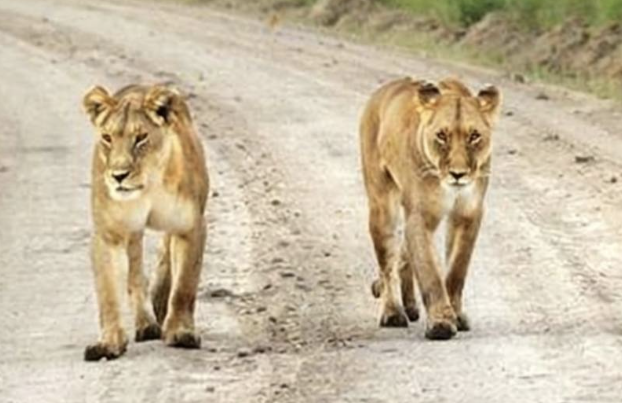
 Lionesses/COURTESY
The Kenya Wildlife Service (KWS) has confirmed the successful capture and safe return of two lionesses that had strayed from Nairobi National Park and were sighted near Rongai, easing public anxiety after hours of heightened alert in surrounding areas.
In a statement issued on Thursday, KWS said the two lionesses, earlier spotted outside the park, were tracked using an advanced wildlife monitoring system and safely guided back into Nairobi National Park by KWS patrol teams during a night operation.
The authority assured the public that the situation was fully under control and that residents could resume their normal activities.
“The two lionesses earlier sighted outside Nairobi National Park have been successfully tracked using the EarthRanger system and safely guided back into the park by KWS patrol teams during the night,” KWS said.
“The situation is fully under control, and the public may safely go on with their normal activities.”
KWS also thanked members of the public for remaining calm and for promptly reporting sightings, noting that cooperation from residents played a crucial role in ensuring the safety of both people and wildlife.
The confirmation followed an earlier public advisory issued by KWS after the lionesses were sighted in the Sholinke Trading Area, approximately 8.3 kilometres from the Nairobi National Park boundary, in the Rongai area.
At the time, KWS said ranger teams were on the ground, and veterinary units were en route to safely manage, dart, capture and relocate the animals.
In the advisory, KWS urged residents to remain calm, avoid the area, keep children indoors and immediately report any sightings through the toll-free number 0800 597 000 or via WhatsApp on 0726 610 509.
Public safety, the agency said, was the top priority throughout the operation.
The stray sighting sparked concern among residents and motorists, given the proximity of the animals to human settlements and busy transport corridors.
“This outcome highlights that conservation is a shared responsibility,” KWS said, adding that collaboration between the agency, partners, stakeholders and local communities remains critical in protecting wildlife and promoting safe coexistence.
Nairobi National Park is uniquely located next to the capital city, making incidents of human-wildlife interaction more likely as urban development continues to expand toward wildlife dispersal corridors.
KWS has repeatedly warned that such encounters may occur from time to time and has called on the public to remain vigilant and promptly report wildlife sightings outside protected areas.
The authority said it would continue monitoring wildlife movements around the park and surrounding communities to prevent similar incidents in the future.