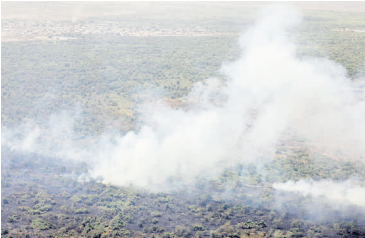
 A file photo of a wildfire in Isiolo last year/HANDOUT
As hot weather scorches most parts of the country, the Kenya Forest Service has called for heightened caution to prevent wildfires.
KFS chief conservator Alex Lemarkoko said the service is on high alert, as the dry season normally sparks fires.
“What we are doing currently is prevention and mitigation measures,” Lemarkoko said.
The service has since deployed various technologies to help monitor fire incidents.
“We have technology that we have installed that is able to monitor and give real-time reports of the occurrence of fires,” Lemarkoko said.
The chief conservator said KFS has been able to put in place firebreaks and maintain some of the roads.
In March 2025, KFS launched a Sh2.8 billion state-of-the-art forest firefighting and surveillance project, funded by the French and Kenyan governments.
The move sought to strengthen the capacity of the service to combat fires in the Mau, Aberdares and Mt Kenya forests across 14 counties.
KFS is now equipped with advanced fire engines, chaff trucks, troop carriers, surveillance drones with a 100 km range, digital communication tools and a command centre for rapid response.
The service has also trained a total of 22 officers as firefighters at its Forest Law Enforcement Academy in Londiani, Kericho county.
The officers are now part of the firefighting brigade for the service and are responsible for managing forest fires in gazetted forests as well as assisting other institutions in emergency situations.
The trainees were drawn from the Protection and Security Directorate and were trained by trainers from Valabre School of Security and Fire Fighting from France.
KFS has maintained a high fire danger rating across all its stations due to the current dry weather characterised by high temperatures, low humidity and strong winds, creating an extremely high risk of forest fires.
Rapid drying of vegetation and the accumulation of combustible materials exacerbate the situation.
In March last year, the KFS Command Centre recorded 180 fires that burnt 3,355 acres (1,357 hectares) of different vegetation types within gazetted forests across the Mau (Maasai Mau), North Rift, Coast, Central Highlands (Mt Kenya and Aberdares) and Eastern conservancy areas.
Already, the latest weather forecast by the Kenya Meteorological Department shows that sunny and dry conditions are likely over several parts of the country.
However, occasional rainfall is expected over a few areas, particularly in the Highlands east and west of the Rift Valley, the Rift Valley, the Lake Victoria Basin, the Coastal region and the south-eastern lowlands.
The department says daytime (maximum) average temperatures of more than 30°C are expected in the Coast, Northeastern and Northwestern Kenya, as well as over some parts of the Southeastern lowlands, Lake Victoria Basin, the Rift Valley and the Highlands West of the Rift Valley.
As part of preparations to contain the expected fires, conservation NGO Rhino Ark Charitable Trust has continued to establish and maintain critical firebreaks across the northern moorlands of the Aberdare Range.
This proactive effort builds on the over 90 kilometres of roadside clearing and firebreak establishment already completed earlier in the Aberdare Salient and the central moorlands.
“These firebreaks are a vital line of defence, protecting forests, wildlife, water towers and neighbouring communities from the growing risk of wildfires,” the trust said.