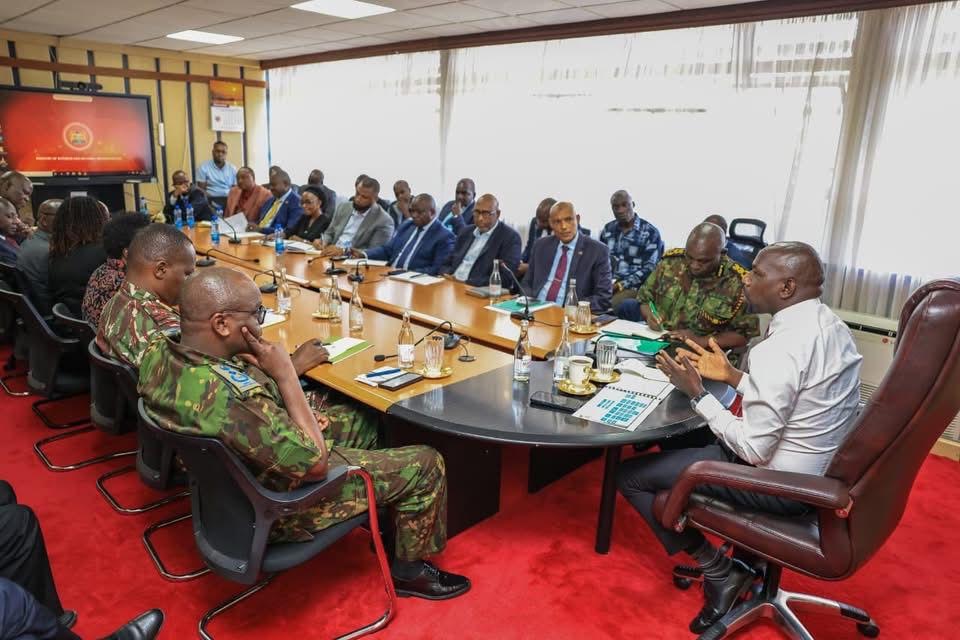
Interior Cabinet Secretary Kipchumba Murkomen convened a high-level multi-agency meeting to intensify the government’s efforts against illicit alcohol and drug trafficking.
The meeting follows a directive from President William Ruto in his New Year's Address.
Murkomen said the prevalence of illicit brews and narcotics had reached “alarming levels,” posing a threat to public health, security, and the country’s future.
He noted that the Ministry of Interior has been tasked with urgently scaling up interventions to address the issue.
As part of the strategy, the government plans to strengthen the Anti-Narcotics Unit (ANU) through the deployment of additional officers, with staffing projected to reach full capacity by the end of the year.
A multi-agency team was established to coordinate a nationwide crackdown on the distribution of illicit ethanol and narcotics.
The operation will include seizure of assets and property acquired through proceeds of these trades, in line with existing laws.
Murkomen also announced enhanced policing along ungazetted border points and major transit routes to disrupt supply chains.
He added that the government will work with county administrations to strengthen rehabilitation and recovery programmes for individuals affected by drug and substance abuse.
The meeting brought together senior officials from key security and regulatory institutions, including Inspector General of Police Douglas Kanja; Chief of Strategy Execution in the Office of the President Adan Mohamed; Deputy Inspectors General Eliud Lagat of the Kenya Police Service and Gilbert Masengeli of the Administration Police Service.
Others were Director of Criminal Investigations Mohamed Amin; Principal Administrative Secretary Beverly Opwora; Secretary for Internal Security Thomas Saka; Kenya Bureau of Standards CEO Dr Esther Ngari; NACADA CEO Dr Anthony Omerikwa; and Assets Recovery Agency Director-General Mark Ogonji.
The Interior Ministry said the multi-agency approach is aimed at delivering a coordinated and sustained response to dismantle networks involved in illicit alcohol and drug trafficking across the country.
Murkomen has called on county governments to establish at least one rehabilitation centre per county to support recovery and reintegration of affected individuals.
He also stated that this year will focus on “liberating our youth from the yoke of drug and substance abuse.”
Plans are underway to strengthen the ANU within the Directorate of Criminal Investigations (DCI), with its personnel expected to increase from 200 to 700 officers.
The unit will be equipped with modern surveillance, intelligence, forensic, and financial investigation tools to target high-level drug and alcohol trafficking networks.
President Ruto said asset tracing, seizure, and forfeiture would play a key role in investigations, with recovered assets redirected toward rehabilitation, prevention, and treatment programmes.
He also warned that any government official or security officer found colluding with traffickers would face prosecution and dismissal.
Ruto declared alcohol and drug abuse a national emergency, citing public health, security, productivity, and social concerns.
He noted that one in six Kenyans aged 15-65 reportedly uses at least one substance of abuse, with initiation often beginning during teenage years.
“This crisis demands decisive national action,” Ruto said, unveiling a comprehensive strategy that emphasises enforcement, prevention, and multi-agency cooperation.
Authorities have conducted operations targeting illicit drugs and alcohol across the country over the past three months.
Several suspects have been arrested, and significant quantities of drugs and illicit alcohol have been seized and destroyed.