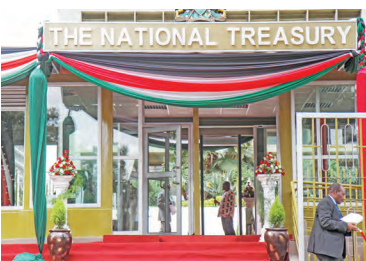
Treasury has sent out an early warning that it may not adequately fund education, health, defence, energy and roads in the 2026-2027 budget.
Fresh disclosures reveal the financial headache President William Ruto’s administration is facing with its own budget projected to be in the red by Sh134 billion.
The government is projected to sustain the significant shortfall in the financial year 2026-27 after allocating constitutionally mandated funds to counties and other obligations.
The revelations in the Draft 2026 Budget Policy Statement expose how the exchequer would be strained, besides the worry of unsustainable debt.
The report shows the government will have a negative balance of Sh134 billion for its own functions after servicing loans and funding counties.
This means planned expenses from ordinary revenue exceed available cash in the budget.
As such, budgets for State House, the army, roads, national hospitals, and every ministry could be on paper but unfunded, unless drastic measures are employed.
“This shortfall impacts the financing of key functions including education, health, defence, roads, and energy, among others,” the draft 2026 BPS reads.
Already, there are grumbles about insufficient capitation for secondary schools, delayed disbursements to counties, and general cash-flow affecting salaries and collective bargaining agreements signed between the government and unions.
According to the policy statement, John Mbadi's Treasury team projects ordinary revenue at Sh2.98 trillion, up from this year’s Sh2.75 trillion.
But debt and other fixed obligations are projected to gobble up more than 85 per cent of the cash before a single shilling can be spent on day-to-day government operations.
As high as Sh1.66 trillion, about 56 per cent of all ordinary revenue, will be channelled to service public debt.
This is followed by Sh877 billion for mandatory obligations like civil service pensions, salaries for judges and MPs, and contractual commitments.
Treasury would thus be left with a paltry Sh293.3 billion to share between the national government and the 47 counties.
With the counties’ entitled share, based on existing formulas, set at Sh427.2 billion, the entire shareable total will be overshot by Sh134 billion.
To comply with the constitution and fund devolution, the shortfall must be recovered from what would have been the national government’s portion.
The result is a negative balance for the national Executive, Parliament, Judiciary, and all other national functions.
“This will occasion additional borrowing which may distort the fiscal framework,” Treasury said in the dossier seen by the Star.
This implies that the national government must increase borrowing beyond current projections, slash expenditures, or introduce new taxes.
Treasury has acknowledged the expenditure pressures and the slow adoption of e-procurement, hinting at inefficiencies and cost overruns.
Following the struggle, counties are projected to miss out on allocations for fertiliser subsidy for which Sh5 billion was provided in the 2023-24 budget.
“The national government has, over the years, provided for additional allocations to county governments from its share of revenues,” Treasury noted.
To illustrate the crisis, the Consolidated Fund Services, which includes public debt interest payments and pensions, has been allocated Sh1.43 trillion.
After mandatory transfers to county governments, the Treasury would be left with Sh1 trillion from ordinary revenue for all national government functions, yet its own projected spending for the Executive, Parliament, and Judiciary remains Sh2.9 trillion.
Of this, Parliament has been allocated Sh48.7 billion, an increase of about Sh900 million, with the Judiciary getting Sh29.9 billion.
In what’s worse, the draft 2026 BPS shows that the core of the crisis lies in the ever widening budget deficit.
Based on the projected revenue and expenditure, the fiscal deficit is expected to hit Sh1.1 trillion (5.3 per cent of GDP) in the 2026-27 financial year.
This is an increase of about Sh205 billion from the current year’s deficit of Sh901 billion – 4.7 per cent of the gross domestic product (GDP).
Treasury intends to borrow Sh1 trillion from domestic sources and Sh99.6 billion from external lenders to seal the gap.
This comes even as revenue targets remain unmet, with Treasury projecting the gap to remain above three per cent of GDP for years to come.
Citing an underperformance of about Sh100 billion as of the end of October 2025, Treasury said it remains uncertain that the projected revenue will be realised.
“Ordinary revenues underperformed [in the period cited]. If this trend continues, it is bound to affect the projected ordinary revenue for FY 2026/27,” the BPS states.
Mbadi’s team further lamented that the national government has continued to solely bear the shortfalls in revenue in any given financial year, save for 2024-25.
To survive, the spending cuts instigated at the onset of Kenya Kwanza's tenure are expected to continue, posing tough times for the already struggling ministries.
Treasury says the challenge has been compounded by underwhelming revenue collection.
Despite ambitious tax administration reforms, ordinary revenue as a percentage to GDP is projected to shrink to 13.9 per cent from 14.5 per cent.
At the same time, the government is ramping up spending, particularly on development projects under its bottom-up economic transformation agenda.
In the latest budget watch, experts who advise MPs warned that the borrowing plan would crowd out private businesses and pile pressure on bank interest rates.
“It may exert upward pressure on interest rates, crowd out private sector credit, and heighten refinancing risks,” the Parliamentary Budget Office said in its 2025-26 Budget Watch report.
The government now faces a dilemma as it has to either increase taxes, or slash the county allocation, or worse, borrow even more.
All the steps portend a clash with citizens, senators, and governors, with more borrowing set to add fuel to the debt fire that created the very crisis.
The government is already having challenges meeting some obligations, evidenced by an allocation of Sh5.6 billion in Equalisation Fund arrears.
With counties failing to realise their own-source revenue targets, the situation is expected to get worse.
The crisis has been deepened by a bloated wage bill, exceeding the set 35 per cent in many counties, squeezing out development.
The findings mirror a worsening situation for the Ruto team.
A recent report by the Controller of Budget, Margaret Nyakang’o, revealed how the Kenya Kwanza administration is living from "hand-to-mouth".
The review for the period to September 2025 revealed government struggling with debt repayment, county disbursements, and pending bills.
“Debt servicing has reduced the resources available for current spending needs,” Nyakang’o said amid revelations that debt repayment gobbled Sh509 billion in three months.
President Ruto has on many occasions lamented that his administration has no room for further borrowing and introducing new taxes.
He said this was the reason his team has resorted to securitisation and PPPs to finance key infrastructure projects tapped for the ‘Singapore dream’.
Ahead of Christmas, the Cabinet approved the formation of the Infrastructure Fund and Sovereign Wealth Fund to better manage projects.