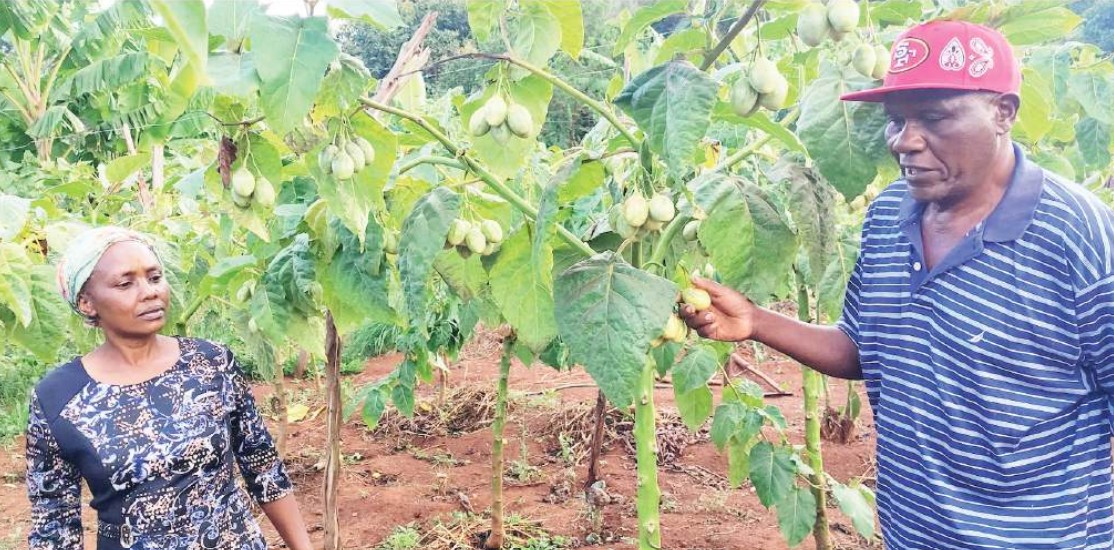
Farmers in Murang’a county are increasingly turning to fruit farming, drawn by the promise of higher yields and better returns compared to the traditional tea and coffee that have long defined the region.
Across the county, fruit cultivation is emerging as a profitable alternative, offering farmers improved incomes and more stable earnings amid fluctuating returns from conventional cash crops.
The shift is largely driven by rising market demand for fruits and a growing need to diversify income sources.
Farmers are now calling for cooperative groups to help them access affordable inputs, receive technical support and collectively penetrate larger markets.
In Kamune, Mathioya constituency, farmers have embraced crops such as tamarillo and passion fruit, locally known as karakara, alongside avocado, mango and macadamia.
Kenya News Agency visited the farm of Fredrick Muya, a retired teacher whose farming journey began in 2003.
Muya said the move into fruit cultivation followed the identification of a market gap and increasing demand locally and beyond the county.
“We realised there was a ready market for these fruits, and the returns are much better compared to what we were getting from tea and coffee,” he said.
Muya grows an impressive variety of crops, from Hass avocados and coriander to passion fruit, hibiscus, rosemary, lemongrass and mint.
He is committed to organic farming, emphasising healthy soils and ecosystems by avoiding synthetic fertilisers.
“I am keen on producing crops that my family can consume while maintaining soil health and protecting the environment,” he said.
Soil testing has been central to his success, helping him understand nutrient requirements and improve both crop quality and yield.
Tamarillo, or tree tomato, thrives in moderate, well-distributed rainfall, temperatures of 15 to 20 degrees Celsius, and a soil pH of five to 8.5.
Muya has planted the Ruby Red variety, chosen for its fast maturity and resistance to pests and diseases.
Other varieties include Ecuadorian Orange, Gold Mine, Inca Gold, Red Oratia, Rothame, Solid Gold and Yellow.
Planting requires digging holes 30 to 45cm deep and 60cm in diameter, with seedlings transplanted when 60 to 70 days old or 20 to 30cm tall to protect them from winds.
Tamarillo fruits can be harvested commercially from one year, yielding 60 to 100kg per tree annually, with local prices around Sh200 per kilo at the nearby Othaya market. Muya has more than 1,000 trees on his five-acre farm.
Regular watering is a challenge, especially with shifting climate and low rainfall patterns. Nonetheless, adopting organic practices has helped reduce production costs and manage pests such as aphids, whiteflies and spider mites.
The Muyas use locally available materials, including Sodom apple, Mexican marigold, tigonia, garlic, rice husks and tobacco, to prepare botanical pesticides.
Cow milk, fresh or fermented, is applied to young whiteflies to prevent infestations.
Muya called on agricultural extension officers to intensify training on modern and sustainable farming techniques.
“Organic farming has helped us manage pests and diseases more effectively, but we need more guidance to fully embrace modern production methods,” he said.
He cautioned against overusing synthetic fertilisers, which can acidify the soil, affect fruit taste and lead to losses.
The transition to fruit farming has also attracted young people, who view it as a viable opportunity for self-employment and stable income.
Moses Mwangi, a young farmer from Kieni village, Kamune, said fruit cultivation has renewed hope and created jobs.
He grows 300 tamarillo stems and more than 200 passion fruit plants. Mwangi emphasised the importance of forming cooperative societies to collectively buy inputs, access expert advice and negotiate better prices in larger markets.
“Working as groups will help us reach bigger markets, reduce input costs and strengthen our bargaining power,” he said.
As demand for fruits rises, farmers in Murang’a are embracing innovation, sustainability and collaboration, positioning fruit farming not just as an alternative to traditional crops but as a pathway to prosperity for the region’s smallholder farmers.