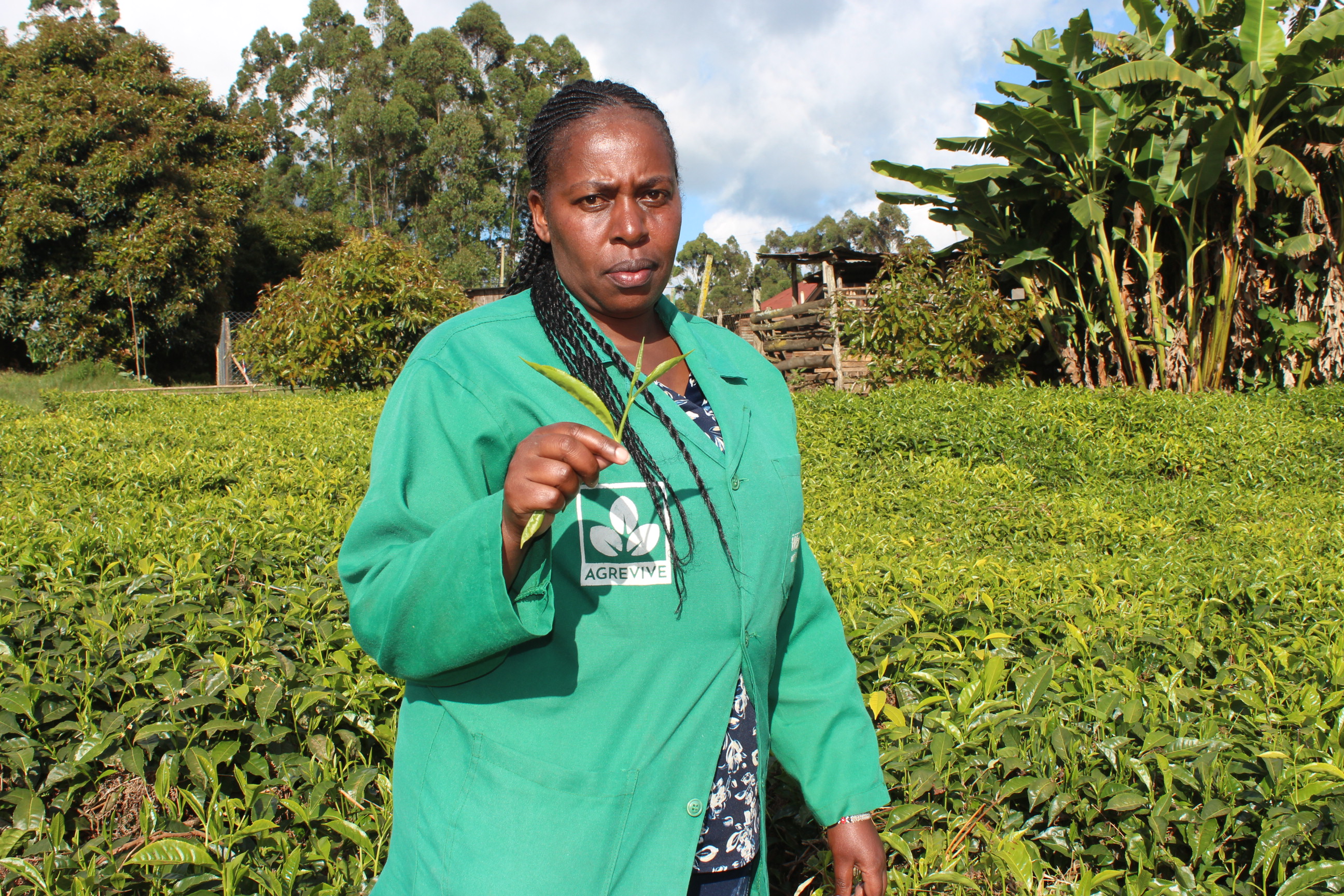
 Peninah Kimani, an extension officer under Ikumbi tea factory, in a tea farm during a farmers field day/ ALICE WAITHERA
The government owes tea factories Sh7.1 billion in fertiliser subsidy arrears, a burden KTDA warns could destabilise the sector if not urgently addressed.
Chairperson Chege Kirundi says the state has pledged to disburse Sh2 billion through a supplementary budget to reduce the arrears.
But if unpaid, the arrears risk collapsing the agency, he said.
Kirundi explained that though the state subsidises the commodity to ensure farmers pay only Sh2,500, factories are forced to pay suppliers up front as they wait for the government to release the funds.
“We have to order the fertiliser as KTDA. When the government delays in issuing the funds, the factories remain in deficit.”
Against this backdrop, KTDA is pushing through wide-ranging reforms aimed at transforming the tea industry to survive a fast-changing environment.
Kirundi said changes have been made to ensure farmers get the fertilisers in time to maximise their production.
Last year, farmers received the commodity in November, which aggravated their production in an industry grappling with climate change.
“This system has been overhauled to ensure farmers get the commodity by July. We will be advertising the tender early enough to ensure the fertilisers get to the farmer on time,” he said, adding that plans are underway to explore local fertiliser production.
While underscoring the need for the tea sector to adapt to changes, Kirundi said KTDA is now shifting towards an export-oriented model and moving away from bulk tea exports to packed and blended teas to cut out middlemen.
New markets are being opened in China, Asia and other regions, with support from the Ministry of Trade and Kenya’s foreign missions.
“Herbal teas market is expanding. We need to conform to the market and shift to products such as instant tea and iced tea,” he said.
This will help local tea to retain its brand and earn more from their produce, as local tea has long been used to make international brands without recognition.
The agency is now working on Geographical Indication and traceability to build a Kenyan tea brand that will require legislative reforms and necessitate changes in KTDA’s structure.
Last year, farmers produced about 340 million kilogrammes of made tea, yet local consumption remained at just five percent.
“The reforms are anchored on a farmer-first principle, focusing on costs across farming, manufacturing, sales and marketing,” Kirundi said.
While black CTC tea remains dominant, particularly in the Middle East, Kirundi said KTDA is expanding orthodox tea production to access new markets.
He said KTDA, now more than 60 years old, is operating in an environment that has dramatically changed with markets evolving and production systems shifting.
“Climate change has intensified and farmer awareness has grown. These circumstances now demand that things be done differently,” he said.
He added that under his leadership, the agency has developed about 72 reform initiatives that it’s seeking to implement gradually to reposition the agency and the industry.
He appealed to farmers from the East of Rift region to put measures in place to raise their earnings, saying factories have no control over auction outcomes that are determined by quality.
He said tea from East of Rift region generally fetches better prices due to superior quality, blaming weak enforcement of the law and tea hawking in the West region for undermining factories, leading to reduced production and rising costs.
Kenya has 34 KTDA-managed factories and 42 private factories, with only three private factories located in the East of Rift region.
“These factories offer easy cash to farmers and take produce that ought to have gone to KTDA managed factories, causing them to operate below capacity and raising their costs,” Kirundi said.
Nonetheless, he said the future of the crop is bright as long as reforms across the sector are sustained.
Tea was first planted in Kenya in 1903 by colonial settlers in Limuru, Kiambu, with commercial production beginning in 1924.
Africans were barred from growing tea until after independence. Today, Kenya stands out as the only major tea-producing country dominated by small-scale farmers, unlike other producing countries that rely on large plantations. The KTDA model itself was, therefore, a new concept.