This year is starting with great expectations that it will be a defining year ahead of the General Election in 2027.
Key factors include economic anxieties that are making the electorate restless, potential political realignments and a stress test for electoral institutions.
The death of former Prime Minister Raila Odinga’s presents both a challenge and an opportunity to ambitious successors and even rivals by creating a sudden political vacuum that will force far-reaching changes.
The polls will be the first since 1997 in which Raila will not be on the campaign trail, though his larger than life shadow will loom over the battle. With elections barely 20 months away, three key camps are emerging.
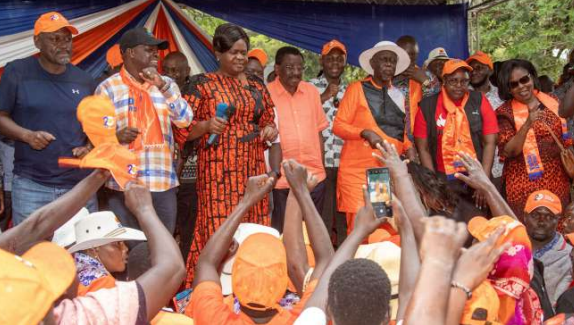
For starters, President William Ruto is working behind the scenes to formalise a pre-election pact with Raila’s Orange Democratic Movement.
The move has triggered the emergence of factions in ODM whose strident noises threaten the stability of the broad-based government.
The noisy younger and defiant faction, the youthful party ideologues and the more reflective centre core cannot seem to agree on the best route to take, which forms a major leadership test for party leader Oburu Oginga. Will he pull them along with a compelling vision?
Raila's key stalwarts in government, among them Energy CS Opiyo Wandayi, his Mining counterpart Hassan Joho, ODM deputy leader Abdulswamad Nassir and ODM chairperson Gladys Wanga believe it is strategic to back Ruto and in the event he wins, spend five years plotting a successful race.
But against this cornerstone, the party secretary general Edwin Sifuna believes an alternative path away from backing Ruto and instead leaning for the opposition makes for a better political strategy.
“We cannot afford another five years of Ruto,” the senator said when he joined former DP and DCP leader Rigathi Gachagua for the burial of Embakasi North MP James Gakuya’s mother.
His appearance at the send-off ceremony in Murang’a, Gachagua’s backyard, has sent tongues wagging over his next move.
Stung by the tensions in the party, Suna East MP Junet Mohamed recently pointed fingers at former President Uhuru Kenyatta, accusing him of rocking their boat through proxies. Uhuru dismissed the claims with a wave of the hand.
And in the face of turmoil, Oginga rushed in to steady the ship, declaring he will run in the event they do not clinch a deal with Ruto's UDA. Securing ODM's support could heavily tilt the polls in Ruto's favour and pave the way to his retaining his seat.
Wandayi, unhappy about the endless squabbles, especially on the varying visions, said, "We have decided as a community to walk the path we were shown by Raila. It was clear that we support Ruto to deliver his agenda and help him secure a second term.
"We are handing him a second term because of the friendship and commitment he has shown us," he said, saying they have tasked Oburu to lead the negotiations with Ruto's UDA party.
In the same vein, the opposition itself faces the critical challenge of unity amid reports of deep divisions among the top players.
The coalition, involving figures like Gachagua and Kalonzo Musyoka, is yet to agree on the timeline for naming its presidential flagbearer.
Fault lines have continued to play out ahead of the anticipated timeline for naming a flag bearer.
Sources aware of the intrigues point to an Uhuru factor in the United Opposition’s future.
They hold that Jubilee is mulling a ticket that would bring former Interior CS Fred Matiang’i and Kalonzo as a pair.
This narrows Gachagua’s options, having himself announced that he, or Kalonzo, is best-placed to carry the opposition’s mantle.
“Our commitment is that we must have one candidate to face Ruto. It can be me, or Kalonzo, or Matiang’i or George Natembeya or even Oburu,” Gachagua said.
Even so, the opposition has been grappling with sideshows, personality contests and disjointed messaging.
While top players in the outfit maintain that the confounding signals are part of their strategy, other quarters disagree.
“Unity is no longer optional, it is a political necessity,” Kitutu Chache MP Anthony Kibagendi said.
Beyond coalition building, 2026 will test key institutions led by the Independent Electoral and Boundaries Commission.
IEBC faces scrutiny over its preparedness, including plans to register 6.3 million new voters.
Its funding, procurement and public trust will be under a microscope long before the 2027 vote.
Furthermore, the political discourse is being complicated by constitutional debates amid a long-drawn quagmire of how to realise changes to the supreme law.
Prime CS Musalia Mudavadi’s recent calls for a referendum conducted alongside the elections posit a constitutional debate.
A push for far-reaching constitutional amendments, proposing offices like the Prime Minister and an entrenched CDF, pose a major political test.
As political risk analyst Dismas Mokua says, “Kenya’s next election may be fought in 2027, but it will be won or lost in 2026."
For Ruto men, the presidency is not for debate. Pokot South MP David Pkosing said the seat is not negotiable.
“We are not saying two-term not just because we are Rift Valley. It is because the President has defied all odds and has delivered.”
He cited gains in economic growth, stable oil prices and expansion of infrastructure. However, Ruto’s legacy plan is threatened by a tight fiscal space.
Besides the national politics, several counties are witnessing early signs of heated competition ahead of the vote.
Significant battlegrounds include Bungoma, Kiambu, Kisumu, Machakos, Meru, Murang’a, Nairobi, Siaya, Tana River and West Pokot.
The influx of new entrants seeking to unseat incumbents guarantees high-stakes personal battles that will both reflect and fuel national rivalries.
The grassroots wars will determine the strength of any national coalition’s ground game and consume vast political and financial capital throughout the year.
While the election is in 2027, the political battle and the result will largely be determined by the critical decisions, deadlines and realignments of 2026.
The tremors of this political tsunami are already being felt and are envisioned to be clearer by December 2026, a time when the political landscape is believed would be more defined.