Kenya is headed into 2026 with a cautiously optimistic economic outlook, buoyed by easing domestic borrowing costs, a firmer export base, strengthening household spending, and improving investor sentiment.
Yet the global environment remains uncertain, shaped by geopolitical realignments, shifting trade regimes, technological change, and volatile financial markets.
How Kenya navigates the interplay between its domestic reforms and rapidly changing global dynamics will determine whether 2026 becomes a year of sustained recovery or one constrained by external factors.
At the centre of Kenya’s improving prospects are projections from the December 2025 Focus Economics Consensus Forecast, which places the country’s GDP growth at 5.0 percent in 2026, slightly above an estimated 4.9 percent in 2025.
This projection positions Kenya above the Sub-Saharan African average of 4.1 percent, reflecting its relatively resilient and diversified economy. Analysts attribute this momentum largely to the Central Bank of Kenya’s (CBK) continued easing of monetary policy.
Since February 2025, the CBK has lowered its base lending rate from 11.25 percent to 9.50 percent, marking seven consecutive rate cuts aimed at stimulating credit expansion, supporting investment, and relieving household financial pressures.
The Economist Intelligence Unit (EIU) notes that this monetary pivot is already influencing investment patterns.
“In 2025, economic growth should strengthen as accelerating fixed investment, buoyed by laxer financing conditions, outweighs softer momentum in exports,” EIU economists state. Lower borrowing costs have encouraged businesses to restart or expand projects delayed by the economic shocks of 2024, while households are gradually regaining confidence as inflation stabilises within the target band.
Yet the easing is not without challenges. A TransUnion Kenya survey conducted in August 2025 shows that despite falling rates, 68 percent of potential borrowers still avoid formal credit due to affordability concerns.
High legacy debts, tighter collateral requirements, and cautious banking practices continue to constrain lending, particularly for small businesses. The CBK has acknowledged these challenges, indicating there remains “scope for further easing” to support private-sector activity if inflation remains subdued.
For Kenya to achieve the projected 5 percent growth in 2026, economists agree that several pillars must align: sustained credit growth, macroeconomic stability, stronger export performance, and disciplined fiscal management.
Should global capital conditions tighten, the shilling come under pressure, or public debt risks rise, the recovery could stall. For now, however, Kenya appears positioned for a modest improvement, with the key test being whether monetary gains translate into job creation, stronger consumption, and durable private-sector confidence.
The World Bank has also adjusted its 2025 growth projection for Kenya from 4.5 percent to 4.9 percent, citing a rebound in construction, a sector affected by disruptions during the 2024 protests.
According to the Bank, construction activity in the first half of 2025 helped offset weaker performance in manufacturing, providing fresh impetus to the wider economy.
The contrast with 2024 is notable: in the first quarter of that year, construction grew by just 0.1 percent, down from 3.0 percent in 2023, amid declines in cement consumption and bitumen imports, key sector indicators.
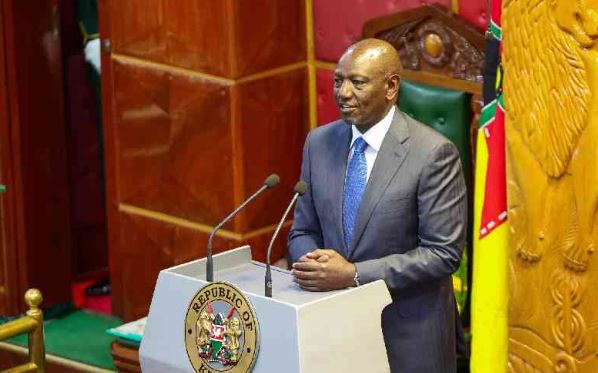
President William Ruto’s administration has maintained that the economy is growing between 5 and 5.8 percent, a projection supported by Treasury Cabinet Secretary John Mbadi, who links the momentum to ongoing fiscal consolidation.
During his State of the Nation Address in November, President Ruto cited projections from “14 of the world’s leading financial institutions, including Citigroup, J.P. Morgan, Standard Chartered, and Goldman Sachs,” all anticipating growth within the 5–5.8 percent band in 2026.
According to the President, this trajectory is supported by stable inflation, lower credit costs, improving export receipts, and a broadly stable macroeconomic environment.
Not all voices are as optimistic. In May, the President’s economic advisor, David Ndii, noted that the construction sector—often a bellwether of economic activity—would slow unless new financing models emerged.
“The construction boom was debt-financed. Party is over,” Ndii said, arguing that reduced borrowing could constrain infrastructure expansion. However, recent data, combined with efforts to scale up affordable housing projects, suggest the sector may gain momentum, albeit under more cautious fiscal parameters.
Fiscal consolidation remains a potential drag on near-term growth, as the World Bank notes. Further uncertainty comes from the expiration of the African Growth and Opportunity Act (AGOA) in September 2025.
Kenya is seeking an extension, but delays could affect textile exports, a key source of foreign exchange. The Bank has urged Nairobi to advance reforms to boost competition, improve the business environment, and attract investment.
Globally, the economic outlook for 2026 is uncertain. The Economist’s annual World Ahead report describes 2026 as a year in which long-standing geopolitical norms will continue to be tested.
Editor Tom Standage highlights the unpredictability: Will escalating trade tensions trigger a slowdown? Will the rapid expansion of artificial intelligence lead to growth or disruption? Analysts are divided on whether the world is entering a new Cold War between U.S. and China-led blocs or whether a tripartite influence system—including the U.S., Russia, and China—will emerge.
China, despite internal challenges, is expected to strengthen ties with the Global South, negotiating new trade and infrastructure agreements.
Meanwhile, concerns over AI investment bubbles and potential job displacement continue. Climate action remains uneven: the goal of limiting global warming to 1.5°C is increasingly seen as unlikely, and political scepticism in some countries complicates emissions-reduction efforts.
Still, global emissions may have peaked, with developing nations driving sustainable technology adoption. Kenya, a global leader in geothermal energy, could benefit from this trend.
The International Monetary Fund (IMF) in its October World Economic Outlook slightly raised the 2026 global growth forecast to 3.2 percent but warned that the outlook remains “dim,” citing U.S. protectionism and trade fragmentation. These factors could weaken global trade, business confidence, and financial markets, affecting export-dependent economies like Kenya.
Despite global turbulence, Africa’s macroeconomic performance is projected to strengthen in 2025 and 2026. According to the African Development Bank (AfDB), the continent is expected to grow by 4.2 percent in 2025 and 4.3 percent in 2026, driven by strong consumption, accommodative monetary policy, and improved global conditions.
Inflation is forecast to fall to an average of 10.3 percent in 2026, though some countries will continue facing double-digit rates due to debt, supply-demand mismatches, conflict, and climate shocks. Fiscal deficits are projected to widen to 5.1 percent of GDP in 2025, reflecting subdued exports, weaker tourism, and sluggish revenue collection.
Commodity-dependent economies have been particularly affected by declining global prices, though current account deficits may narrow due to a weaker U.S. dollar and improved exports.
For Kenya, these continental and global trends present both opportunities and risks. Stronger African and global growth could lift demand for exports and ease debt pressures. Conversely, trade tensions, financial-market corrections, or setbacks in climate financing could have spillover effects.
As 2026 approaches, Kenya’s economic outlook is one of cautious optimism tempered by external uncertainties.
Domestic fundamentals—cheaper credit, recovering construction activity, stable inflation, and ongoing reforms—provide a base for growth, but global forces will test resilience. Whether Kenya can capitalize on emerging opportunities while mitigating external shocks will shape its economic trajectory beyond 2026.
If growth forecasts hold, Kenyans may see modest improvements, including business opportunities, job creation in construction, services, and agribusiness, and gradually rising household incomes.
However, formal employment remains limited and public debt constrains social spending, so gains may be uneven. Structural reforms—enhancing competitiveness, expanding access to credit, supporting SMEs, and improving education and skills—will be critical for ensuring the economy benefits more broadly, particularly for rural and lower-income households.