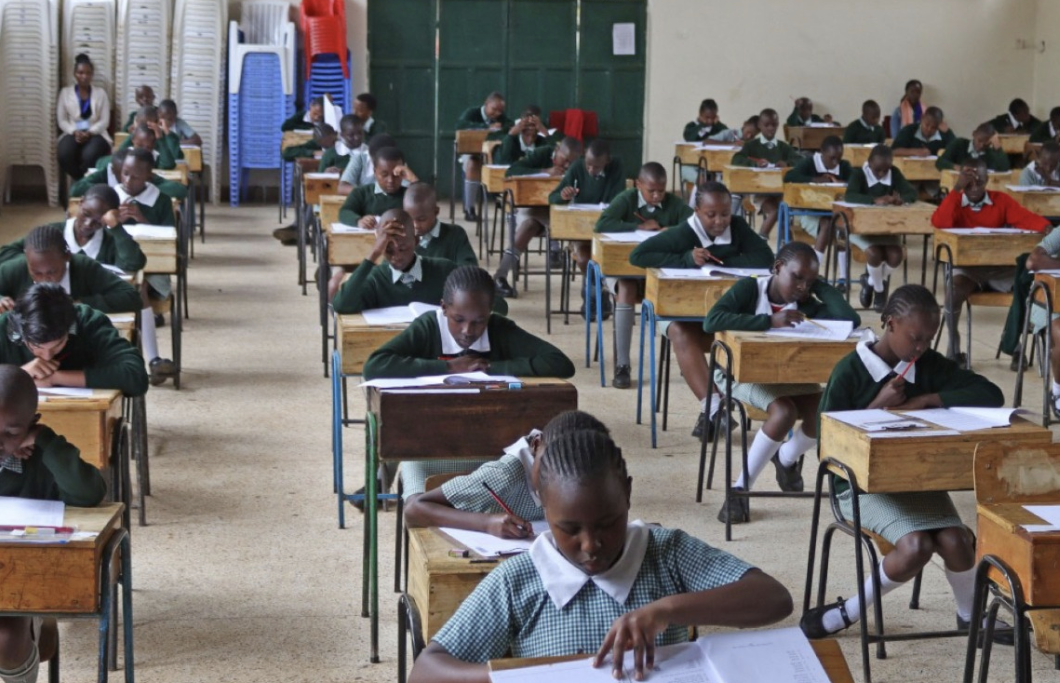
 A total of 1,130,669 learners sat the inaugural Kenya Junior School Education Assessment (KJSEA) marking the end of Junior School in Grade 9.
Kenya’s education system will enter a defining moment in January 2026 when the first cohort of Grade 9 learners transitions to Senior School, marking the start of the fourth and final phase of Basic Education under the Competency-Based Education (CBE) system.
This transition brings the promise of a re-engineered learning experience centred on talent, interest and career pathways—an entirely different journey from the 8-4-4 structure that shaped generations before them.
For the 1,130,669 learners aged between 15 and 17, this will be the beginning of a three-year pre-tertiary, pre-university and pre-career programme that runs from Grades 10 to 12.
It is a stage designed to help them discover who they are, sharpen what they can do, and explore what they may become in the world of work, enterprise and higher learning.
Placement into Senior School
The selection of Senior Schools was conducted between June 9 and June 30 through an online portal managed by the Ministry of Education.
Learners, with guidance from their parents, teachers and career counsellors, selected 12 schools in their order of preference.
The placement system is designed to be fair and interest-based. It considers three criteria:
- Assessment outcomes from the Kenya Junior School Education Assessment (KJSEA)
- Learner interests and talents, and
- Available capacity in preferred schools.
This cohort sat the inaugural KJSEA between October 27 and November 3—a landmark moment that formally closed the Junior School chapter under CBE and paved the way for the transition.
Education Cabinet Secretary Julius Ogamba, speaking on Friday, November 21 at the close of the 2025 national exam season, said the ministry would prioritise speedy and credible processing of results.
“We are entering a new phase where fairness, speed and transparency will define how results are processed and released,” he said, describing the 2025 assessments “a turning point for integrity and efficiency”.
Even though the exams ran smoothly across most centres, the CS confirmed that 418 cases of malpractice were reported.
He reiterated that consequences would strictly follow the Kenya National Examination Council (KNEC) Act 2012.
The law says that a candidate caught committing an irregularity in any paper will have results for the entire subject cancelled.
If widespread cheating occurs in a centre, results for the whole centre can be annulled.
The harshest penalty is reserved for impersonation. Section 31 of the Act states that a culprit shall face up to two years in prison, or a fine not exceeding Sh2 million shillings, or both.
Additionally, the offender is barred from taking any KNEC assessment for three years.
What Senior School Aims to Achieve
The heart of the transition lies in preparing learners for real-world demands.
By the time they finish Grade 12, students are expected to emerge as empowered, ethical and socially responsible citizens ready to contribute to national development, join technical training, or proceed to university.
In line with recommendations from the Presidential Working Party on Education Reforms, every student in Senior School will study seven subjects—four compulsory and three optional—carefully selected to align with their chosen pathway.
Compulsory Learning Areas
A circular issued by the Ministry of Education in August outlined the compulsory subjects: English, Kiswahili (or Kenya Sign Language), Community Service Learning (CSL) and Mathematics.
STEM students will undertake Core Mathematics while Essential Mathematics is for non-STEM learners.
However, non-STEM learners (Arts and Sports Science or Social Sciences) may be allowed to take Core Mathematics if their Junior School results support the decision.
Choosing Optional Subjects
Learners will choose three optional subjects, known under CBE as learning areas, guided by their interests and the requirements of their career pathway.
At least two of the three must come from the learner’s selected pathway.
There are three pathways in Senior School:
- Arts and Sports Science
- Social Sciences
- Technology, Engineering and Mathematics (STEM)
A learner can under exceptional cases be allowed to select subjects across different pathways, but only where career requirements justify the choice—for example, a budding sports journalist combining Languages with Sports Science.
Below is a table showing the Pathway → Track → Optional Subject structure
| Pathway | Track | Optional Subjects |
|---|---|---|
| Arts & Sports Science | Arts | Fine Arts, Music and Dance, Theatre and Film |
| Sports Science | Physical Education, Sports and Recreation | |
| Social Sciences | ||
| Social Sciences | Humanities & Business | Business Studies, History & Citizenship, Geography, CRE, IRE, HRE, CSL |
| Languages & Literature | Literature in English, Fasihi ya Kiswahili, Indigenous Languages, Sign Language, Arabic, French, German, Mandarin | |
| Science, Technology, Engineering & Mathematics (STEM) | ||
| STEM | Pure Sciences | Mathematics, Biology, Chemistry, Physics, General Science |
| Applied Sciences | Agriculture, Computer Science, Home Science | |
| Technical Studies | Aviation, Power Mechanics, Media Technology, Marine & Fisheries Tech, Building Construction, Electricity, Metal Work, Woodwork | |