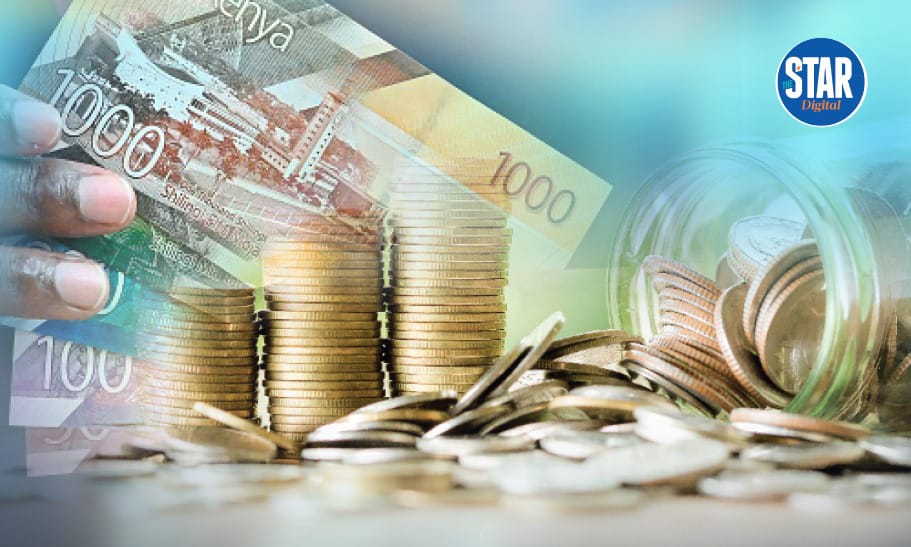
 Economy growth rate/The Star- illustration
Kenya’s economy in 2025 presented a picture of cautious recovery: steady enough to dispel fears of a prolonged downturn, but still fragile because of fiscal strains and structural bottlenecks.
Through the first half of the year, the country recorded a visible pickup in activity — driven by agriculture, a resurgent construction sector and resilient services — even as policymakers juggled the dual tasks of sustaining growth and managing debt.
Official statistics from the Kenya National Bureau of Statistics (KNBS) show that real output held at 4.9 per cent in the first quarter and rose to 5.0 per cent in the second quarter of 2025, signalling a modest but meaningful acceleration from 2024, when growth stood at 5.0 per cent in the first quarter and slowed to 4.6 per cent in the second.
"The recently released Gross Domestic Product (GDP) data for the second quarter of 2025 showed continued resilience of the Kenyan economy, with real GDP growing by 5.0 per cent compared to 4.6 per cent in the second quarter of 2024," a report by the Central Bank committee stated.
The numbers behind the headline
Digging into the numbers clarifies why analysts shifted from caution to guarded optimism.
The KNBS quarterly reports attribute the Q1 and Q2 outcomes to sectoral dynamics: agriculture remained a backbone — contributing roughly a fifth of output — while mining, construction and selected services provided the upside that pushed growth above the 4.5–4.8 per cent range many forecasters had expected.
In Q1, agriculture expanded strongly and mining showed signs of recovery; in Q2, construction rebounded (supported by increased cement consumption and resumed government road works) and services such as transport, finance and ICT continued to support demand.
These sectoral patterns explain why quarterly growth moved from 4.9 per cent in Q1 to 5.0 per cent in Q2, rather than jumping to higher double-digit gains.
Monetary policy and prices: room to ease
A central pillar of the 2025 story was monetary easing.
The Central Bank of Kenya’s Monetary Policy Committee, responding to subdued inflationary pressures and improving exchange-rate stability, systematically lowered the policy rate during the year.
In October 2025, the committee decided to lower the Central Bank Rate (CBR) by 25 basis points to 9.25 per cent, a move that followed earlier cuts intended to revive private-sector lending and investment.
Lower benchmark rates translated into falling commercial lending rates and a gradual rebound in bank credit: by September, private-sector credit growth had turned positive year-on-year after months of contraction.
The CBK also highlighted that overall inflation remained contained, with core measures easing — an environment that gave the central bank space to support growth without compromising price stability.
External buffers and the current account
Kenya’s external position, while tightened in recent years by higher import needs and debt servicing, showed constructive elements in 2025.
The Central Bank reported comfortable foreign exchange reserves — enough for several months of import cover — and noted that services receipts (notably travel/tourism) and diaspora remittances provided steady inflows.
Kenya shilling stability against the US dollar and the recently acquired Eurobond have seen the country ramp up its forex reserves, hitting $12.07 billion (Sh1.56 trillion), the highest ever recorded, as of October 2025.
This marks a major turnaround a year after the country faced pressure from mounting debt repayments and thinning external buffers.
Data from the Central Bank of Kenya (CBK) shows that usable reserves rose to $12.07 billion (Sh1.56 trillion) by October 15, the first time the figure has crossed the $12 billion mark since the Bank began publishing weekly disclosures.
"The foreign exchange reserves remained adequate at USD 12,072 million (5.3 months of import cover) as of October 15. This meets the CBK’s statutory requirement to endeavour to maintain at least 4 months of import cover," read the CBK bulletin.
That helped finance a current-account deficit that, although wider than in 2024, remained manageable and was expected to be largely covered by financial inflows.
The CBK’s data and projections pointed to a net improvement in reserve buffers for the year even as the country navigated global trade uncertainties.
Fiscal realities: growth on a tight budget
If monetary policy was able to be accommodative, fiscal space was more constrained.
The Treasury’s Budget Review and Outlook Paper (BROP) for 2025 acknowledged the growth pickup but stressed that public finances remained under pressure.
The government’s own macro-fiscal framework projects real GDP growth at about "5.3 percent in 2025 and 2026" — a modest upgrade from 2024 — but also flags widening fiscal deficits and rising debt service burdens that limit how much the state can spend to accelerate growth.
The BROP notes that while some spending has been re-oriented to productivity-enhancing projects and clearing pending bills, much of the revenue base remains tight and medium-term consolidation will be necessary to lower risk.
The World Bank and IMF assessments
Multilateral institutions embraced a similar, nuanced reading.
The World Bank revised up its near-term growth projections for Kenya and underlined that momentum was strengthening.
"Kenya’s economy is projected to grow by an average 4.9 per cent between 2025 and 2027, an increase from previous estimate," the projections state.
"However, fiscal pressures are intensifying, with the FY2024/25 deficit widening to 5.9 per cent of GDP—above the original 4.3 per cent target—driven mostly by revenue shortfalls and increasingly rigid expenditure structures. Risks of fiscal slippage persist."
The Bank emphasised that structural reforms to open competition and improve the efficiency of state-owned enterprises could raise sustainable growth and jobs.
Kenya’s public debt rose during the fiscal year and reached 68.8 per cent of GDP, according to the bank.
"The country remains at high risk of debt distress, underscoring the urgency of credible fiscal consolidation. Domestic borrowing has increased, with a notable shift toward short-term treasury bills, heightening rollover risks," World Bank notes.
At the same time, the IMF team that visited Nairobi in late September–early October highlighted progress in macroeconomic stabilisation and constructive dialogue with Kenyan authorities.
The team added that the mission had "made progress in taking stock of the latest macroeconomic and financial sector developments" and that policy priorities would include steps "to enhance fiscal policy credibility, ensure sustainability of public finances and debt, and minimise fiscal, financial, and external sector risks."
What drove the sectors — winners and laggards
A sectoral read shows why growth was resilient but uneven.
Agriculture stayed resilient — benefitting from favourable weather for key crops and stable input availability — and remained the largest contributor to GDP.
Services, particularly transport, financial services and information & communication technology, continued to expand as domestic demand and digital adoption held up.
Construction was the surprising star in the first half of the year: improved cement consumption and renewed public investment in roads and housing projects reversed the prior contraction seen in 2024.
Manufacturing, however, lagged; capacity constraints, energy costs in certain subsectors and weak export demand kept industrial growth moderate.
The net effect was an economy that could grow around 5 percent on the back of services and agriculture gains even without a full industrial revival.
KNBS’s quarterly breakdowns make these patterns clear in the composition of second-quarter growth.
Risks and structural constraints
Three structural risks framed the “but” in the 2025 narrative.
First, public debt remains elevated; the World Bank underlined that the FY2024/25 deficit widened and that public debt approached levels that warrant careful management and credible consolidation to reduce rollover risks.
Second, fiscal rigidities — large wage and interest payments — constrain the government’s ability to redirect spending toward growth-enhancing investments.
Third, external uncertainties, including higher tariffs in key markets, volatile commodity prices, and geopolitical tensions, could dent export demand and capital flows.
Multilateral and domestic analysts emphasised that addressing market distortions, improving competition, and reforming underperforming state-owned enterprises were key to unlocking higher, more inclusive growth over time.
The World Bank’s country team warned that despite recent good indicators, "the fiscal outlook remains subject to downside risks," a short quote that encapsulates the precarious balance policymakers face.
What the numbers imply for ordinary Kenyans
Numbers tell a persuasive macroeconomic story, but how those gains are distributed across households is far more revealing.
World Bank and KNBS data show that even as Kenya’s economy gathered momentum in 2025, the labour market continued to expose a familiar imbalance: formal employment remains a small slice of total jobs, and the pace of high-quality, modern-sector job creation still trails overall GDP growth.
The 2025 Kenya National Bureau of Statistics (KNBS) Economic Survey underscores this reality.
Kenya added 782,300 new jobs in 2024 across the modern and informal sectors (excluding small-scale agriculture). Yet only 78,600 jobs (about 10 percent) were formal, while 703,700, or 90 percent, were generated in the informal economy.
This pushed total employment from 20.0 million in 2023 to 20.8 million in 2024, a significant rise but one dominated by non-wage, insecure work.
Wage data reflects a similar tension.
KNBS shows the nominal wage bill grew 7.2 per cent to Sh2.998 trillion in 2024, with the private sector accounting for 70.6 per cent.
Average annual earnings in the formal sector increased to Sh933,100 in 2024, up from Sh894,200 in 2023.
But after adjusting for inflation, real wage gains remain modest, suggesting that rising pay has not fully matched rising living costs.
Inflation data adds another layer.
KNBS reported annual inflation at 3.6 per cent in March 2025, down sharply from 7.7 per cent in 2023 and 4.5 per cent in 2024, signalling a notable easing of price pressures.
The Central Bank similarly reported a steady disinflation trend through 2024–2025. Yet despite the overall cooling, essential items, particularly food, transport and rent, continue to strain household budgets, muting the benefits of macro-level stability.
This is why the IMF and World Bank have repeatedly urged Kenya to focus not only on faster GDP growth but on reforms that boost job quality, raise real incomes, and broaden inclusion.
Short verbatim markers capture the tone of the year:
KNBS reported that "the economy expanded by 5.0 per cent in the second quarter of 2025," the CBK noted its decision to trim the policy rate to 9.25 percent to support lending, the Treasury projects growth at "5.3 percent in 2025 and 2026," the World Bank cautioned that "the fiscal outlook remains subject to downside risks," and the IMF welcomed the authorities’ engagement while urging steps "to enhance fiscal policy credibility."
Those phrases — taken from the institutions that produce the data and policy judgments — summarise the tidy but fragile verdict: Kenya fared better in 2025 than many feared, but turning this recovery into resilient, inclusive, long-term growth will require disciplined fiscal policy, deeper structural reforms and a sustained revival in private investment.