In a year of shifting alliances, heated reforms, and high-stakes political theatre, 2025 produced a flurry of memorable political quotes that captured the pulse of Kenya’s democracy.
From State House addresses to grassroots rallies, leaders flexed their verbal influence, shaping public mood, defining policy priorities and revealing underlying tensions.
When William Ruto declared during the 62nd Madaraka Day celebrations that:
"Our biggest problem has always been one of implementation and execution: The faith to believe in our plans for change; the courage to execute, and the patience and focus to get it done," the message crystallised his administration’s push for transformation under its Bottom-Up agenda.
It was part rallying cry, part admission of past shortcomings.
On 15 June in Kakamega County, speaking at a church service, Ruto took a tougher tone.
"Hawa watu wengine hawana mpango. We cannot hand over leadership to people who have no plan…You don’t know how our youth will get jobs, you don’t know how agriculture will progress, you don’t know how children will go to school…”
He challenged his opponents directly, arguing that rhetoric without a roadmap would not steer Kenya forward.
Perhaps one of the more unity-oriented remarks came from opposition stalwart Raila Odinga, who addressed delegates at a retreat in Karen, Nairobi in June.
The late former Prime Minister Raila Odinga was present during the event.
“I believe strongly that no matter our disagreements, our visions and disappointments, we have a country first."
His words emphasised national cohesion amid speculation about realignments and political convenience.
On issues of national security and respect for institutions, Ruto’s assertion during a cadet-commissioning parade in April was unambiguous:
"I want to urge all Kenyans, leaders, politicians, and journalists alike that our military men and women are the anchor for our stability.”
This statement underscored his intolerance for politicising the armed forces and reminded the public of service-state relations.
At the heart of many of these utterances is a president keen to project ambition.
In August in Gilgil, he said:
“Let no one tell you that your dreams are too big. There is power in daring great, in raising the bar…Within our lifetime, Kenya will and must rise to the first-world standard.”
It was a moment of vision-casting that sought to shift the national mindset from incrementalism to bold outcomes.
Kindiki - In July, he delivered a call for dialogue over unrest: “I plead with you, my fellow countrymen, we cannot build this country through chaos, incitement and violence.”
Raila - A March 2025 pact between his party and the government drew attention. He said the cooperation was designed to “help build the country” rather than form a new political formation. Kalonzo-“I don’t think I would be a running mate in 2027 … It is too late for any games to be played against me," he said in a past event.
And earlier in March he lamented betrayal in politics: “There is betrayal all over... but very interesting betrayal is that of politicians.”
Kalonzo’s rhetoric captured two themes: self-assertion and ethical critique. He tested the opposition waters, subtly signalling that the traditional number-two role was no longer sufficient.
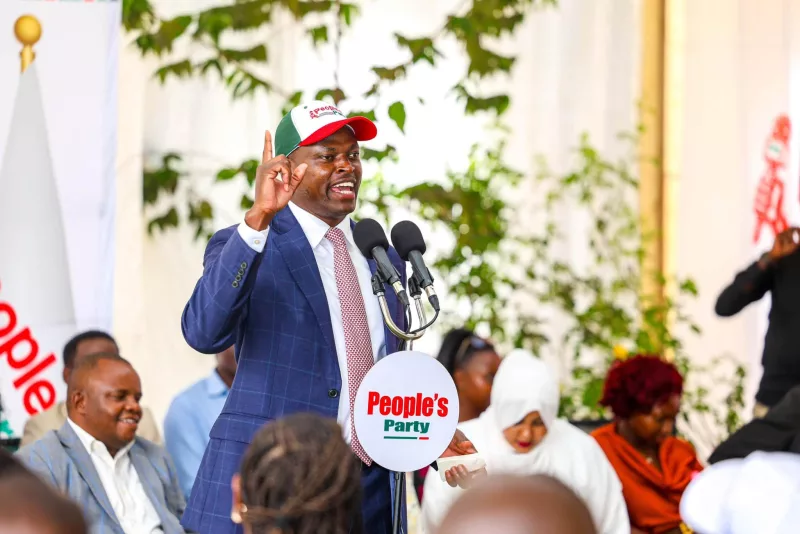
Karua - Leading the People’s Liberation Party, Martha Karua used her rhetoric in 2025 to reframe leadership expectations.
In April she stated: “God willing, I will vie for presidency… A woman would not let her kids go to bed hungry and when there is not enough food; she finds a way to divide it among them. That is what we want for Kenya.”
By September, she emphasised the limited-term promise: “Nobody will ever finish the job of making Kenya prosperous; you lay a foundation and you wait for the next team to come… So I will be seeking one term.”
Karua’s language combined gender equity, leadership ethic and systemic reform, advocating for a motherly approach and rotational political power.
Oburu - This broad-based arrangement is the best we’ve had in all administrations… Our people are very soon going to see the difference in terms of development.”
Gachagua - On January 27, 2025 at the launch of the Democratic Action Party of Kenya (DAP-K) headquarters in Karen, Nairobi, Gachagua declared: “We shall make whatever sacrifices necessary to make sure William Ruto is a one-term president.”
He framed the pledge as part of a coalition of “like-minded Kenyans … who will walk this journey together to liberate this country from bad governance, corruption and dictatorship.”
Osoro - Yet the pledge immediately triggered pushback. On 22 May, MP Sylvanus Osoro rebuked the DAP-K leader: “You are telling people they will serve for one term, yet you served half a term.”
Osoro’s sharp retort marked a turning point in the year’s political discourse, signalling a shift from polite criticism to more open confrontation.
But it also opened the floodgates for a new wave of memorable, and consequential political statements from leaders across the divide.
Minority Leader Junet Mohamed, a long-time ODM stalwart, repeatedly positioned Parliament as a check on executive overreach.
In his May address after a heated budget session, Junet stressed the watchdog role of the House:
“Parliament must never become a rubber stamp. Our duty is to the people, not the convenience of the Executive.”
The statement, reported in televised proceedings, echoed opposition concerns about shrinking legislative independence.
In the Senate, Narok Senator Ledama Olekina continued his crusade for institutional fairness, especially in public finance.
During a Senate committee confrontation over county disbursements, he delivered one of the year’s viral lines:
“We will not allow a situation where some counties are starved and others rewarded politically. Devolution was not a favour, it is a constitutional right.”
His fiery interventions became a staple of Senate clips and political talk shows.
From the Coast, Mombasa Governor Abdulswamad Nassir took a more pragmatic tone as he pushed back against claims that devolved units were mismanaging funds.
Speaking during a national consultative meeting on counties, he insisted:
“Give counties the resources, then hold us accountable. But you cannot demand miracles with starvation budgets.”
The quote, widely shared in regional media, underscored growing tensions between Treasury timelines and county expectations.
In July 2025, Mining Cabinet Secretary Hassan Joho publicly declared his intention to run for the presidency in 2032 while urging Kenyans to re-elect President William Ruto for a second term in 2027.
Speaking during the Likoni Constituency Economic Empowerment Forum on Saturday, Joho, who redefined old loyalties, endorsed President Ruto and called for national unity.
“Mimi nikiangalia siku za usoni, mimi ni siku moja nataka kuwa rais wa Kenya (When I look into the future, I see that one day I want to be the President of Kenya),” Joho said.
From Western Kenya, National Assembly speaker Senator Moses Wetang’ula, while maintaining a Speaker’s institutional neutrality in Parliament, made a notable pitch outside the chambers at a civic event in his home county:
“Kenya’s politics must return to ideas. We cannot continue substituting policy with insults and expect development to happen.”
The remark aligned with his broader theme of reining in political excess and fostering more disciplined public debate.
In the Rift Valley, Nandi Senator Samson Cherargei became a headline-maker with his typically uncompromising defence of the administration. In July, amid criticism of the Finance Bill, he declared:
“Kenya cannot be built on protest economics. If you want change, bring proposals, not stones.”
The line, reported across nightly news bulletins, inflamed critics but cemented his role as one of the government’s most outspoken defenders.
Meanwhile, Nairobi politics delivered its usual share of dramatic soundbites.
Governor Johnson Sakaja, speaking during a confrontation with city MCAs over market demolitions, offered a more reflective tone:
“We must decide whether we want a city of order or a city of chaos. Leadership is not about popularity; it is about doing what is necessary.”
His comments highlighted ongoing friction between City Hall, traders and the county assembly over redevelopment plans.
Nairobi Senator Edwin Sifuna, an unwavering critic of the Kenya Kwanza administration, delivered one of the sharpest opposition lines during a TV debate on national taxation.
“This government behaves as if Kenyans are an ATM. You cannot keep withdrawing without depositing goodwill, honesty and lawful governance.”
The quote instantly trended, feeding into broader public anger over the cost of living.
Within Mount Kenya, former MP offered a more measured critique at a public lecture in Nyeri:
“Our politics suffers from short-termism. We promise five-year miracles in a country whose problems are 50 years old. We must be honest about timelines and capacity,," said the the lawmaker.
His intervention was praised across think-tank and academic circles for reframing political expectations.
Prime Cabinet Secretary Musalia Mudavadi also blended diplomatic language with internal reflection.
At a regional investment forum he argued:
“Kenya’s strongest asset is stability. We must guard it jealously, even as we contest vigorously.”
The statement was interpreted as a gentle pushback against both opposition unrest and government hardliners.
In the North, Mandera Governor Mohamed Khalif issued one of the clearest warnings about security frustrations during a press briefing after a series of attacks:
“Our people cannot continue living between fear and neglect. Security is not charity, it is a constitutional obligation.”
His comments reignited debate about national security resource allocation in frontier counties.
This was after allegations were made of the presence of Jubaland forces in his county.
From the youth front, Embakasi East MP Babu Owino, known for his unfiltered style, struck an unexpectedly sober note during an education stakeholders’ forum.
“We cannot keep politicising education. Every lost year for a student is a lost decade for the country," he said.
The remark received bipartisan praise, with commentators noting his growing influence in youth-focused debates.
Even within the Kenya Kwanza coalition, internal competition produced quotable moments.
Kiharu MP Ndindi Nyoro, widely mentioned in succession discussions, projected fiscal discipline during a televised budget interview.
“We must cut wastage ruthlessly. Kenya can grow, but not with leakages that are treated as normal," he said.
The line bolstered his reputation as a leading economic voice within the ruling side.
Speaking during an event in Garissa in June, Health CS Aden Duale reiterated the need for the country to remain united and shun leaders he says are hell-bent on fueling tribalism, hate, and violence among Kenyans.
"We don’t want retrogressive political leaders who want to divide this country along tribal lines. We want one Kenya where both Muslims, Christians, and people of all faiths are treated equally and the country’s development is distributed fairly across the country," he stated.
Together, these additional quotes, varied in tone, origin and intention, added depth to the national conversation, showing a political class wrestling with delivery, accountability, ambition and uncertainty.