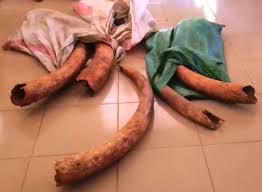
A rider was arrested on Saturday evening in Wamba, Samburu County, while transporting approximately 39.9 kilograms of elephant tusks, valued at about Sh4 million.
Authorities said the suspect told police he was taking the tusks to a potential buyer when he was intercepted.
He has been detained ahead of a planned arraignment, while investigations into the source of the tusks continue.
The seizure forms part of ongoing operations targeting the trafficking of elephant and rhino trophies.
On December 24, two suspected traffickers were arrested in Migori Town with 16 kilograms of elephant tusks valued at Sh2.1 million.
The suspects, who were identified as Tanzanian nationals, were intercepted at Bande Centre in the Masara area. They reportedly informed police that they had a potential buyer for the tusks.
Elsewhere, in Ichichl shopping centre, Othaya, Nyeri County, three suspects were arrested with four pieces of elephant tusks weighing 18 kilograms, valued at Sh2.6 million.
They were transporting the tusks on a motorcycle when intercepted.
These operations were jointly conducted by the Kenya Police Service and Kenya Wildlife Service (KWS) personnel.
The suspects are also detained pending possible arraignment.
Police said the suspects will be charged with being in possession of wildlife trophies of endangered species, contrary to Section 92(4) of the Wildlife Conservation and Management Act, 2013.
Kenya has recorded several such seizures in recent months, reflecting ongoing efforts to combat wildlife trafficking.
Elephant tusks remain highly valued in the illegal market, particularly in East Asia, fueling poaching across Africa.
Despite an international ban on the ivory trade, officials report that African elephants continue to face poaching threats.
In response, Kenya has implemented high-tech surveillance measures, including the use of drones, to monitor wildlife and track poachers.
The Kenya Wildlife Service, alongside other stakeholders, has introduced initiatives to curb wildlife crime.
These include community education, interagency collaboration, and intelligence-led operations.
These measures contributed to Kenya recording zero rhino poaching in 2020, the first time in approximately two decades.
Regionally, Kenya is known as a key transit route for ivory moving from eastern and central Africa to Asian markets.
The demand for ivory and rhino horn, particularly for ornaments and traditional medicines in Asia and the Middle East, continues to drive the illicit trade.