By the time 2024 came to a close, Kenya was a country in mourning and in motion. The year had ended with some of the largest public demonstrations against gender-based violence (GBV) in recent memory.
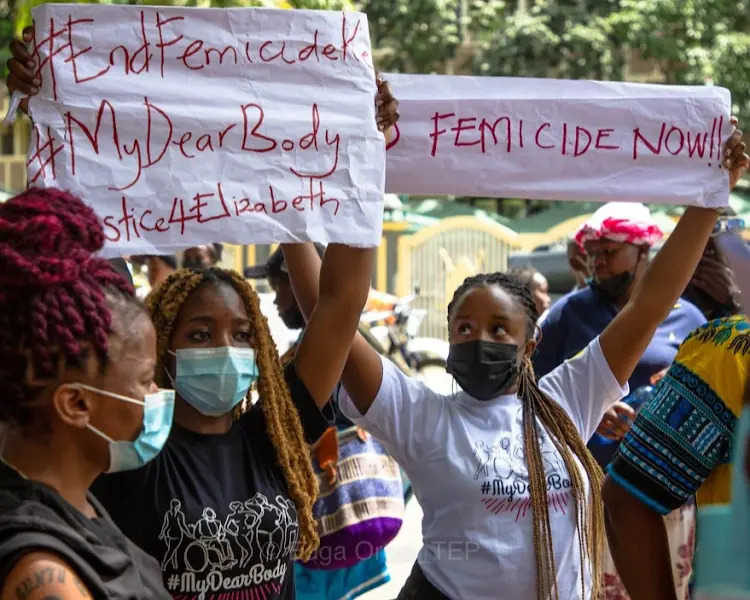
Women, men, and young people poured into the streets of Nairobi, Nakuru, Eldoret, Kisumu, and Mombasa in December 2024, carrying placards with the names of women written in bold strokes.
Protesters chanted, “Stop killing women,” as police fired teargas in attempts to disperse crowds in the capital. Images of young people running from plumes of smoke on Moi Avenue circulated widely online, sparking fresh anger and intensifying calls for accountability.
The outrage had been building for months as stories of women killed by partners, ex-boyfriends, strangers, and even service providers dominated national news.
Many of the cases trended on social media, galvanising a generation that refused to look away. What pushed the public further was the repeated perception that institutions were failing survivors.
Delays in investigations, missing evidence, collapsed prosecutions, and lenient sentences fueled a belief that the justice system had not kept pace with the scale and complexity of the crisis.
Activists framed the moment as a breaking point. They insisted that 2024 could not end without structural change, with many calling for the country to confront it as a national emergency.
As 2025 began, the pressure was undeniable. Cabinet offices, legislators, courts, police, and county governments were forced to respond.
The year would go on to become transformative in the country’s legal and policy approach to gender-based violence.
Some decisions were long overdue, others controversial, and many still face implementation hurdles. But taken together, they marked a defining shift in Kenya’s handling of GBV.
Gender Cabinet Secretary Hannah Cheptumo announced that the state is implementing “significant systemic reforms” aimed at drastically reducing GBV incidents. These reforms span legal, judicial, and institutional frameworks.
Between August and October last year alone, 97 women were murdered in cases linked to GBV.
“These efforts are aimed at addressing systemic challenges and ensuring justice for survivors,” Cheptumo said while appearing before the Senate plenary in May.
Key components of the reforms include the establishment of dedicated GBV courts, the development of a Gender Information Management System (GIMS), and the creation of a specialised unit within the Office of the Director of Public Prosecutions.
Her ministry, in collaboration with the National Gender and Equality Commission, is developing GIMS, which she described as transformative in the fight against GBV.
“GIMS is a critical tool for advancing gender equality and tackling GBV and related issues in Kenya,” she said.
The system will serve as a centralised platform for collecting, storing, analysing, and disseminating gender-related data from both national and county levels.
This will eliminate data fragmentation and enhance coordination in decision-making and programme development tailored to the needs of women, men, boys, and girls.
Furthermore, GIMS will support the monitoring and evaluation of national, regional, and international commitments such as the Constitution, Vision 2030, and the Sustainable Development Goals (SDGs).
A Presidential Working Group on Femicide was formed, and Standard Operating Procedures for GBV case handling were introduced.
The government also pushed for strengthening existing legislation through various amendments to curb the vice.
“The manual outlines proper procedures for reporting, meticulous evidence recording, and effective prosecution, aiming to ensure victims receive prompt and effective justice,” Cheptumo explained.
She noted that GBV is driven by a complex mix of social, economic, cultural, legal, and institutional factors, requiring a coordinated, multi-agency response.
These include patriarchal norms, gender inequality, harmful traditional practices, poverty, unemployment, weak law enforcement, inadequate protection mechanisms, and a slow justice system.
To accelerate justice for victims, the government established 11 specialised GBV courts across the country, located in Siaya, Mombasa, Kiambu, Meru, Nakuru, Machakos, Kisii, Kibera, Kitale, and Makadara.
In addition, 97 protection centres, also known as safe shelters, were set up across 21 counties to provide refuge and essential services to GBV survivors.
“These shelters play a vital role in ensuring safety and providing services such as physical care, vocational training, business start-up support, financial assistance, and reintegration into society,” Cheptumo noted.
The government’s shelter initiative is part of a broader multi-agency approach, including the one-stop GBV recovery centres established in all Level 5 hospitals across Kenya’s 47 counties.
The ministry developed guidelines for the establishment and management of these centres, opening the door for private sector involvement to support and supplement government efforts.
National action plan
This year, the government unveiled a comprehensive strategy to tackle gender-based violence over the next five years, marking a major step in Kenya’s commitment to protecting women and children.
The initiative, outlined under the Kenya National Action Plan 2025–2029 (KNAP), was spearheaded by the State Department for Gender and Affirmative Action (SDGAA).
The plan sets out a multi-layered approach, combining legal reform, survivor-centred support, community engagement, data-driven monitoring, and integration with peace and security frameworks.
According to the Directorate of Gender-Based Violence Mitigation, these measures aim to reduce GBV prevalence and ensure accessible, quality services for survivors across the country.
Central to the plan is the strengthening of legal and policy frameworks. The government intends to review existing GBV laws and establish regulatory frameworks for protection centres and toll-free helplines, ensuring survivors have standardised and reliable access to support services.
“The legal reforms under KNAP will help streamline referrals, improve evidence management, and facilitate effective prosecution of GBV cases,” the framework noted.
The plan emphasises one-stop centres and shelters for survivors, providing integrated medical, psychosocial, and legal services.
It also proposes a survivor’s fund to support economic and social recovery, alongside distribution of dignity kits for those affected.
“Survivors will no longer have to navigate multiple agencies alone. The plan creates a coordinated pathway for care, protection, and justice.”
KNAP recognised the role of social norms in driving GBV and includes targeted community engagement initiatives. These efforts involve working with men and boys, promoting awareness campaigns, and leveraging national and county Gender Sector Working Groups to address harmful practices and prevent violence before it occurs.
Recognising the vulnerability of women and children in conflict and crisis situations, the plan integrates GBV prevention and response into broader peace and security frameworks, ensuring continued protection even in humanitarian emergencies.
The initiative aligns with global commitments under the Generation Equality Forum, reinforcing Kenya’s determination to uphold constitutional and human rights obligations.
With KNAP, the government aims to create a holistic, survivor-centred system, providing both protection and justice for victims while fostering societal change to prevent GBV.
County-level action plans, operational protection centres, and helplines are expected to be rolled out.
Legislative pressure
Female lawmakers gave a major boost to the fight against femicide and gender-based violence when they launched a nationwide campaign in January 2025 aimed at raising awareness, supporting survivors, and ensuring justice.
The initiative, named Komesha Dhuluma, was officially unveiled on January 16 at the Parliament Buildings.
The campaign was spearheaded by KEWOPA (Kenya Women Parliamentary Association) and led by all 102 female legislators from both the National Assembly and Senate, who rolled out the initiative within their respective constituencies.
KEWOPA Chairperson Leah Sankaire announced that the campaign engaged communities directly, bringing critical messages on femicide and GBV to the grassroots level.
President William Ruto committed Sh100 million to support the initiative, signalling high-level government backing.
Sankaire said that each female legislator would localise the campaign through community sensitisation forums, designed to address the specific challenges and needs of their constituencies.
“All KEWOPA members will spearhead the campaign by engaging directly with their communities at the constituency level,” she said at the launch.
The campaign aimed to directly engage 100,000 individuals, including women, men, youth, and persons living with disabilities, while targeted media campaigns were expected to reach over 10 million Kenyans.
The initiative went beyond awareness-raising, linking advocacy to justice and survivor support through collaboration with stakeholders such as women’s rights organisations, the judiciary, and law enforcement agencies.
Hon. Sankaire emphasised the holistic nature of the campaign, noting that Komesha Dhuluma focused on both prevention and response.
“This initiative goes beyond raising awareness on femicide. We are working with stakeholders to ensure survivors receive justice and support,” she said.
The campaign used multiple approaches, including community dialogue, grassroots mobilisation, media outreach, and stakeholder partnerships, to ensure its message reached all corners of the country.
KEWOPA hoped that the initiative would foster a culture of zero tolerance for violence, strengthen survivor protection, and enhance accountability for perpetrators.
By combining political leadership, government support, and active community engagement, Komesha Dhuluma represented a landmark effort to curb femicide and gender-based violence in Kenya.
The initiative demonstrated the united front female lawmakers took in championing human rights, promoting justice, and protecting vulnerable populations at the start of 2025.
Although institutional reforms accelerated, the lived experience of survivors remained uneven. More survivors reported receiving respectful treatment at specialised SGBV desks.
Courtrooms adapted to allow vulnerable witnesses to testify behind screens or via video link. Some counties expanded survivor psychosocial support, reducing the emotional burden of lengthy trials.
But gaps remain large. Where shelters were overwhelmed, many survivors could not afford transport to health facilities within the required 72-hour forensic window.
Others abandoned cases because of lengthy court processes or fear of retaliation. In rural areas, cultural stigma continued to silence victims.
In 2025, for the first time in many years, Kenya treated GBV as a collective crisis rather than an issue for activists alone.
Public fury forced institutions to confront their failures. Courts tightened procedures, policymakers updated frameworks, police officers underwent training, and county governments adopted new models.
The conversation changed from whispers to headlines.
By the end of 2025, survivors still faced many obstacles. But they faced them in a country that was moving slowly, inconsistently, often chaotically, but moving nonetheless.
“The fight against GBV is not won by one judgment or one policy. It is won by the willingness of a country to change,” GBV officer Ann Wamakori said.