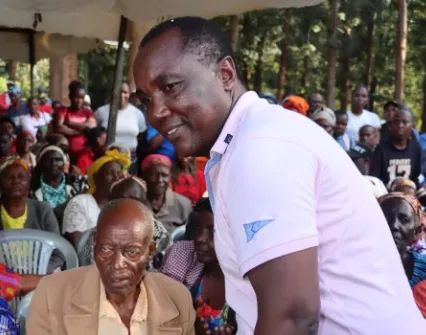
 Eva Karimi of Share the Love Centre in Murang’a during the annual Women of Love and Prayer gala/ ALICE WAITHERA
As the fight against Gender-Based Violence (GBV) intensifies, the church has been challenged to take a firmer stand against the menace.
This follows revelations that many churchgoers are grappling with GBV, an issue that has left thousands nursing mental wounds and children deeply traumatised.
According to the Technical Working Group on GBV, the country loses between Sh41 billion and Sh46 billion annually to femicide and gender-based violence through lost productivity.
The high number of GBV cases within the church prompted Eva Karimi, the wife to Bishop John Waweru of Share the Love Centre in Murang’a, to start an initiative aimed at supporting affected women.
Karimi founded Women of Love and Prayer (WOLAP) as a platform to bring together women suffering from GBV and offer them support.
She explained that in her work as a church leader, she often encountered desperate women enduring violence in their homes who couldn’t to speak out due to their positions and responsibilities within the church.
“Religion teaches that a woman should persevere, and this has caused many women to remain in abusive relationships and suffer immensely. We are here to tell them that even as we pray, we must take steps to empower ourselves and leave if the violence persists,” she said.
Karimi noted that many women end up suffering mental illness, while others lose their lives as they wait for their abusive partners to change.
“We realised that most women stay because of lack of financial empowerment. Through WOLAP, we bring these women together and connect them with others who have been in similar situations and overcome,” she said.
Started five years ago, WOLAP offers survivors psychological support through the Love Basket Foundation, after which they are equipped with skills that can help them secure employment.
Speaking during the annual WOLAP gala held at the church’s premises, Karimi pointed out that women who suffer mental instability while undergoing GBV in their marriages are often unable to adequately protect their children as they struggle to survive.
This, she said, exposes children to trauma and dangers such as molestation, further compromising their well-being.
“Through this initiative, we are able to restore spiritual, mental and psychological balance to church women and help those in dangerous situations to get out,” she said.
Karimi said many cases of girls who lose their lives through femicide come from poor households, where desperation pushes them into relationships with predatory men as they try to meet their daily needs.
The Love Basket Foundation, she noted, equips women with digital skills, enabling them to work online and support themselves.
“We identify their abilities and help them develop their skills into viable ideas that can sustain them financially. Some are also provided with capital to start small businesses such as groceries,” she said.
This approach, she explained, was adopted after it emerged that women who are counselled after domestic violence often return to their abusers due to lack of financial independence, allowing the violence to persist.
WOLAP, which started with about three women, has since grown into a sacco, providing a platform for women to save and access capital to start and expand businesses.
Karimi called for concerted efforts to fight GBV, which she said is producing a generation of traumatised children and significantly contributing to mental illness.
“Every so often, we see reports of women being gang-raped or killed. It has become normalised. We need protests similar to those organised by the youth against the high cost of living to fight this menace and create awareness,” she said.
She also called for full utilisation of gender desks established in police stations, noting that many victims still fail to receive proper assistance after reporting GBV cases.
“Many women come to us after visiting police stations and failing to get any help,” she said.
Bishop John CW, on his part, said stern action should be taken against men found guilty of battering or assaulting their partners to stem the trend.
The bishop confirmed that domestic wrangles are rife among church members and challenged the clergy to be decisive when handling such cases.
“It is important to pray, but when matters get out of control, the church must be the first to protect women. No religion is above humanity,” he said.
“As clergy, when we receive cases of violence within families, we must protect the victims, whether men or women, even as we pray.”
According to the Kenya Demographic and Health Survey 2022, 34 per cent of Kenyan women aged between 15 and 49 years have experienced physical violence, while about 13 per cent have experienced physical or sexual violence from an intimate partner.