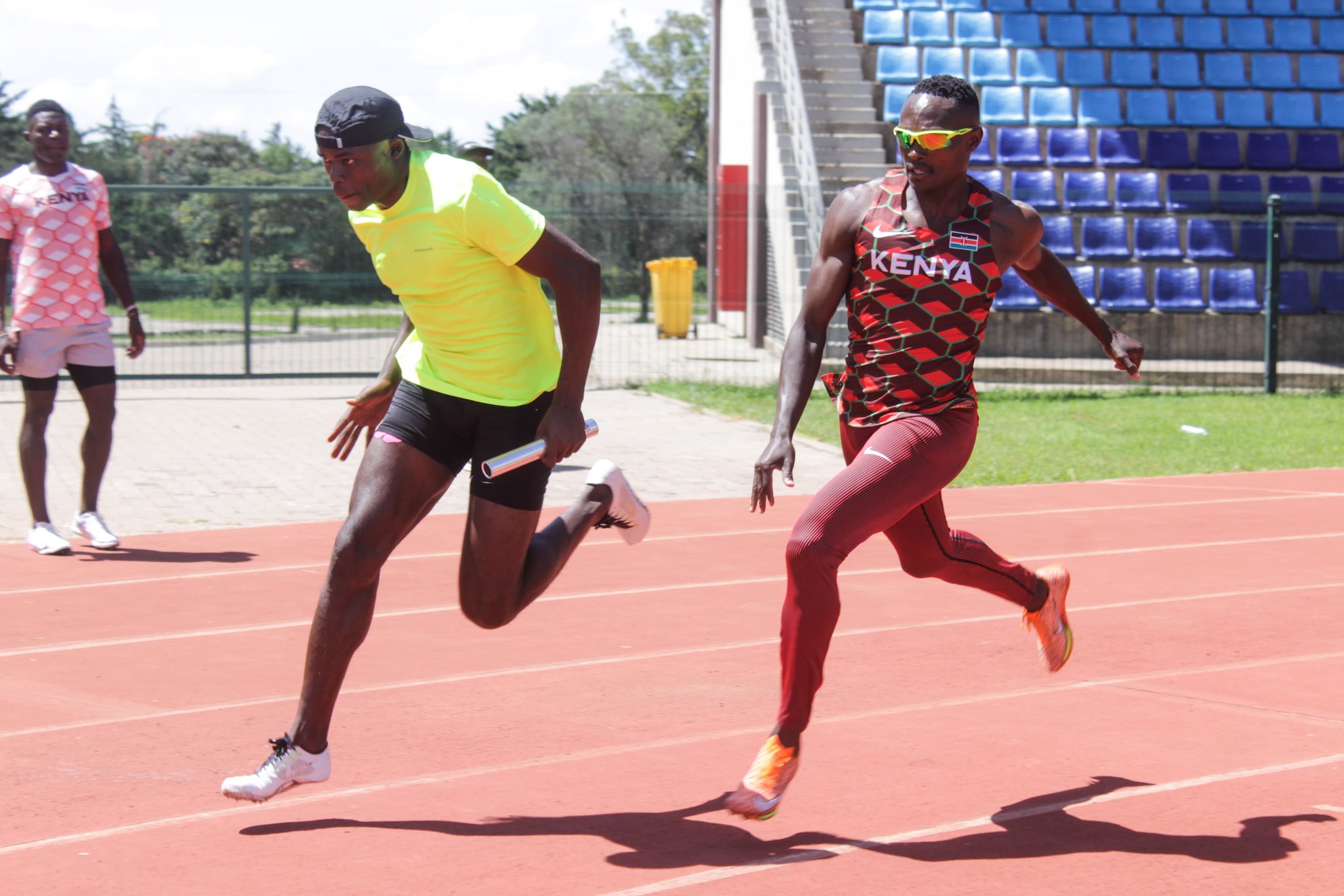
 Sprinters Boniface Mweresa (R) and Steve Odhiambo exchange the baton during a previous training session/ TEDDY MULEI
National sprints coach Stephen Mwaniki says assembling a competitive 4x100m mixed relay team for the 2026 World Relays Championships in Gaborone, Botswana, will be one of the top priorities for Kenya’s sprint coaches.
The mixed relay is the newest addition to the global athletics programme, having been officially introduced by World Athletics in May this year before making its championship debut at the Tokyo World Championships in September.
Canada stamped their authority on the inaugural event in Tokyo, storming to gold in 40.30 seconds ahead of Jamaica (40.44) and Great Britain (40.88), to set the benchmark for the rest of the world.
Read Also
With the spotlight now firmly shifting to Botswana for the World Relays, Mwaniki says Kenya will channel maximum effort into building a formidable mixed 4x100m squad capable of competing at the highest level.
“World Athletics has introduced a new event, the 4x100m mixed relay, and that is our main focus for next year as sprint coaches,” Mwaniki said.
He underlined the strategic importance of the discipline, insisting Kenya must seize the opportunity presented by the new event.
“We can't afford to miss out on having representation in the 4x100m mixed relay. It’s important that we start the work immediately because I believe it’s an event we can do very well in,” he added.
According to the tactician, success in Gaborone will hinge on assembling the right blend of speed and balance between the men and women.
“We need to ensure we have two good female sprinters who can run around 11.2 seconds and two male sprinters capable of clocking 10.2 seconds,” Mwaniki explained.
“If we can achieve that, then we will be in pole position at the World Relays in Botswana,” he said.
While the mixed 4x100m relay remains the headline focus, Mwaniki was quick to note that Kenya will not neglect the other relay disciplines.
“However, we will also be putting effort into the other relay events so that we can post solid performances across the board,” he said.
A major pillar of that broader plan, Mwaniki believes, is the continued uplift of women’s sprinting at the national level.
At present, he admits the women’s 4x100m relay is not a primary target for the Gaborone showdown due to the high-speed demands required to field a competitive quartet.
“The women’s 4x100m is not really a big target for us because getting four female sprinters running sub-11.4 seconds is very challenging,” Mwaniki said. “Currently, we only have two, or at most three, who can run those times.”
Even so, he insists the door remains open as development continues. “That does not mean we are ruling out anything,” he said.
Mwaniki pointed to encouraging signs of growth in women’s sprinting, noting that the talent pool is steadily deepening.
“The female sprinters are coming up nicely. We have some strong athletes at the moment, and that shows a lot of promise for the future of the country,” he observed.
One of the key drivers behind that surge, he believes, is the recruitment of female athletes into the uniformed forces, citing three-time national 100m champion Esther Mbagari, who recently joined Kenya Prisons.
“Female athletes being recruited into the forces is a big step because they now get a proper and conducive environment to train,” Mwaniki said.
“We have top athletes like Mbagari, who has joined Kenya Prisons, and that makes a big difference.”
Another major boost has been the steady rise of female coaches within the system.
“Women coaches are also coming up strongly. They have shown great initiative in coaching young female athletes,” he said.
“Just recently, Athletics Kenya held a training programme where over 40 female coaches graduated with World Athletics certification. That clearly shows their commitment and resolve.”