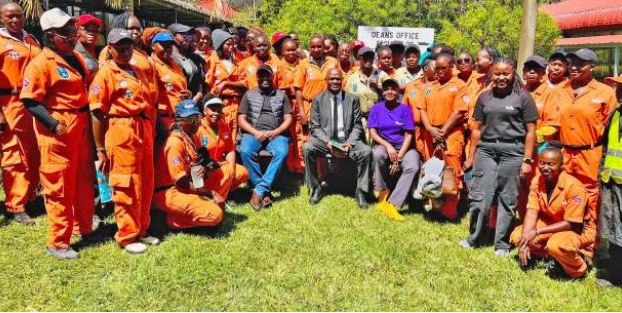
 The eighth
cohort of
women who
were trained
in mechanised
farming at
Egerton
University with
Prof Japheth
Onyando, dean
of the Faculty
of Engineering
and Technology
/KNA
The eighth
cohort of
women who
were trained
in mechanised
farming at
Egerton
University with
Prof Japheth
Onyando, dean
of the Faculty
of Engineering
and Technology
/KNA
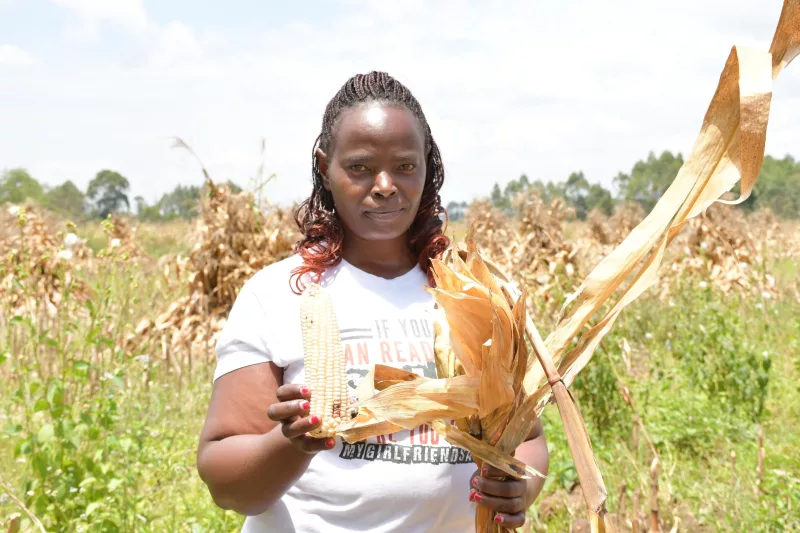
This portrays strenuous farming, as official statistics indicate that 70 per cent of food is grown by women who are smallholder farmers.
Experts at Egerton University, in conjunction with various stakeholders, say it is time smallholder women farmers ditched the hoe in favour of modern technology, particularly mechanised farming, which will complete the same tasks faster and far more efficiently.
It is against this background that the dean of the Faculty of Engineering and Technology Prof Japheth Onyando instituted a programme to encourage adoption of technology and mechanised farming among women smallholder farmers to improve production and quality.
The initiative lays emphasis on intensive tractor operation and servicing training programmes for women.
Prof Onyando indicated that the university was supporting various initiatives towards crafting public-private partnerships to encourage setting up of mechanisation hubs which will also link providers of mechanised farm services with smallholder women farmers who do not have agricultural machinery.
The university has in the past three years overseen training of over 300 women on mechanised farming from the counties of Kisumu, Bomet, Nakuru, Kericho, Kisii, Nyamira, Laikipia, Uasin Gishu and Elgeyo Marakwet to gain essential skills and help secure food supply and enhance their support to overcome barriers and improve food systems.
"We are delighted that the eighth cohort of women has successfully completed an intensive tractor operation and servicing training programme. This demonstrates Egerton University and its partners’ commitment to advancing inclusive agricultural transformation,” he said. The seventh cohort of over 50 women completed similar training in November 2024.
Speaking during the closing of the week-long training for the eighth cohort at the institution’s Njoro main campus, Prof Onyando stated that the participants were taken through tractor handling, field operations, preventive maintenance, troubleshooting and essential safety procedures—knowledge crucial for modern agriculture.
“We will continue equipping Kenyan smallholder women farmers with practical mechanisation skills traditionally dominated by men. The move is aimed at giving women farmers opportunities to embrace better mechanised food production to increase yields in addition to making farming attractive to the younger generation,” he said.
“We envision a situation where smallholder female farmers have access to subsidised mechanisation. This will help reduce over reliance on human labor which is not economical. Farmers will enjoy increased yields in their farm produce.”
He added that the initiative supports the government of Bottom-Up Economic Transformation Agenda by commitment to increasing agricultural productivity and expanding economic opportunities for grassroots communities.
By empowering women in small-scale farming with access to mechanised farming techniques, Egerton University is working to bolster Kenya’s food security and stimulate rural economies through practical skills development.
The training programme has received support from Hello Tractors, One Acre Fund, Kenya Investment Mechanism, John Deere, CFAO Kenya, Kubota, Massey Ferguson, Heifer International Kenya, CIWaB, and Egerton University’s Faculty of Engineering and Technology.
Onyando said technological advancements have enabled the manufacture of light and cheaper machines that can help women smallholder farmers revolutionise agriculture both in terms of quantity and quality of products grown and processed.
He said the notion that mechanisation is only for those in large-scale farming was misguided and a threat to Kenya’s food security. “The need to boost crop yields to feed Kenyans is becoming a priority. Technological advancements and innovations can help women small-scale farmers improve productivity thus making agriculture more profitable. The university is seeking ways of enhancing food security through mechanised farming, irrigation, and use of quality seeds and appropriate fertilizers,” he said.
Onyando said mechanised farming contributes to timely preparation of land, efficient land use and increased production. It also reduced the cost of production.
Mechanised farming improves harvesting of the crop, lowering costs and reducing post-harvest losses by 20 per cent with fewer damaged crops compared to manual harvesting.
Training coordinator Dr Patrick Wamalwa explained that the course is designed to provide a solid foundation in tractor operation. "This training empowers women with the practical skills they need to become proficient tractor operators,” he said, adding that the programme also aims to connect participants to broader opportunities in Kenya’s agricultural mechanisation value chain.
According to the Food and Agriculture Organization (FAO), a UN specialised agency that champions efforts to defeat hunger, Africa overall has less than two tractors per 1,000 hectares of cropland. In comparison, there are 10 tractors per 1,000 hectares in South Asia and Latin America.
Wamalwa stated that without mechanised agriculture, productivity suffers drastically, lowering farmers’ earnings. “The need to boost crop yields to feed Kenyans is becoming a priority. Technological advancements and innovations have helped small-scale farmers improve productivity thus making agriculture more profitable. We hope to get more farm machinery so that we can broaden the scope of our practical sessions and allow even more women to benefit from this training.”
A World Bank report on agribusiness indicators notes that the degree of mechanisation in Kenya is about three tractors per 1,000 hectares or 26.9 tractors per 100 square kilometers.
The report indicates that despite the potential that mechanisation has in transforming agriculture by helping farmers to intensify their businesses, mechanisation levels remain very low in Kenya and across the continent.
In 2019, Africa Renewal reported that Africa had an average of about one to two tractors per every square kilometer compared to developed countries, where India had 128 tractors while Brazil registered 116 tractors both per square kilometer.
The World Bank attributed the low level to the fact that mechanisation is capital intensive, requiring special financial products such as long-term capital, credits, or leasing arrangements, which is beyond small holder farmers and Micro, Small and Medium Enterprises.
“Nevertheless, where the small holder farmers access mechanisation, they are required to go an extra mile to maximise the potential of the agricultural machines which if not maximised, compromises repayment plans and becomes a threat to profitability of the machines,” the report said.
Wamalwa indicated that the training was a step towards gender inclusion in the field of mechanised agriculture and a forum for allowing women to play an active role in mechanising Kenya’s agricultural sector.
The training curriculum blends practical and theoretical knowledge, covering areas such as tractor maintenance, handling, field operations, and advanced farming techniques.
“In Kenya there are only 2 tractors for every 2500 acres. Kenyan youth need to keep their eyes and innovative prowess around the agriculture sector. At the moment mechanisation levels on farms across Africa are very low, with the number of tractors in Sub-Saharan Africa ranging from 1.3 per square kilometer in Rwanda to 43 per square kilometres in South Africa, compared with 128 per square kilometres in India and 116 per square kilometres in Brazil,” Wamalwa said.
Nakuru county executive) for gender, sports and youth programmes Elga Riaga who represented Governor Susan Kihika highlighted the transformative potential of equipping women with technical skills: "When women gain the confidence to operate and service farm machinery, we are not just empowering individuals, we are reshaping communities and unlocking new economic opportunities,” she said.
Riaga stated that mechanised agriculture is not a gendered space but a space for skill, innovation, and determination. She regretted that despite women constituting approximately 75 per cent of Kenya's agricultural labour force, they face significant challenges, including limited access to agri-food value chains dominated by men.
Kenya’s low level of mechanisation is attributed to inadequate training, research and technology development, weak local manufacturing and distribution, insufficient agricultural mechanisation quality assurance, low level of investments in mechanisation services, poor extension and technology adoption as well as weak institutional and legal framework.
Amidst these challenges, the country is in great need of agricultural mechanisation due to the decreasing availability of farm labour, lack of interest by the youth in farming activities and adverse climate change, a Draft Policy document notes.
Sub-Saharan Africa has the lowest uptake of agricultural mechanisation in the world and is heavily dependent on manual labour. Several interventions have been made to address this to varying degrees of success.
Half a decade ago, many countries in the continent established public sector-operated machinery hire services to make it easy for smallholder farmers to get hold of these machines for optimal production.
Despite these efforts, farm power availability per area of agricultural land has declined or stagnated in many sub-Saharan African countries over the past decades, leading to increasing reliance on human muscle power, the Draft Agricultural Mechanisation Policy notes.
The number of tractors in the region declined from 235,000 in 1970 to 222,000 in 2000. Africa and the Middle East have only three per cent of the global market of agricultural machinery by geographical area.
Research shows that Kenya, Uganda and Tanzania had more tractors than India 40 years ago. However, by 2005, India had a hundred times more tractors in use than the three East African countries combined.