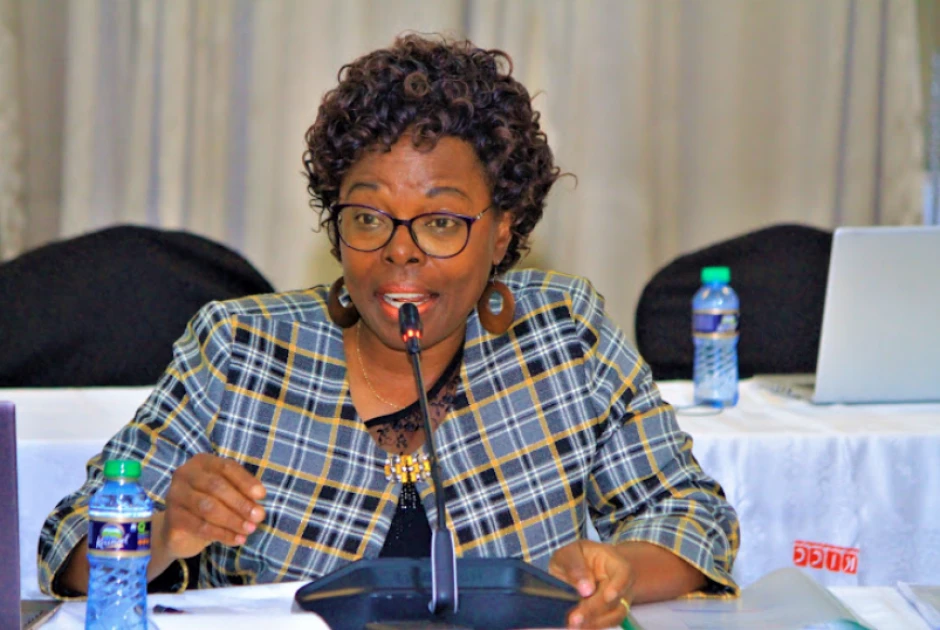
 Controller of Budget Margaret Nyakang’o
A new report by Controller of Budget Margaret Nyakang’o for July-September shows the penalties are drawn largely from the infrastructure sector.
The extra charges have nearly doubled this year, compared to the same period last year when they stood at Sh14.5 billion.
The amount keeps rising as the penalties remained unpaid as of September 30, 2025, in what point's to the exchequer's liquidity handicap.
Of the amount, highways agency Kenha was slapped with a Sh7.9 billion bill after it failed to settle road contracts on time.
The charges went up by Sh3 billion in under a year, considering the Sh4.9 billion balance posted in a similar period last year.
The interest penalty remained unpaid during the review period, pushing the highway agency’s debt to Sh62 billion.
Kenya Rural Roads Authority was charged Sh13.4 billion, pushing its total debt to Sh59 billion.
Nairobi Metropolitan Area Transport Authority was penalised Sh1.8 billion as state oil company National Oil took a hit of Sh1 billion over delayed payments.
Kemri was also penalised Sh1.5 billion, pushing its total outstanding debt to Sh2 billion, which remained unpaid.
Urban roads agency Kura had penalties of Sh324 million as the Water Resources Authority grappled with a Sh90 million bill.
The Pyrethrum Processing Company of Kenya had penalties of Sh777 million at the time of the review.
The government appears strained by the burden of settling debts, which totaled Sh702 billion as of the review period.
Bills in respect of national government ministries increased to Sh118 billion from last year’s Sh117 billion.
State corporations owed Sh406 billion, including the penalties, from the previous year’s Sh410 billion.
Despite paying contractors Sh54 billion, the bills have outpaced revenues, even as county governments owed Sh177 billion.
Behind these numbers are people whose lives have taken another turn after running into cash-flow problems over unpaid bills.
Stories are told people losing their homes used as collateral for loans to execute government tenders.
There are tales of suicides, auctioned properties and broken marriages, with the human toll soaring as the bills remain unpaid.
Association of Suppliers secretary general Simon Gichuki says many genuine state suppliers are borrowing to repay loans, sinking deeper into debt.
He argues that as new administrations take over with each regime change, historical debts are shelved.
This, he says, ends up trapping genuine suppliers in a cycle of debt and despair.
Cars, houses, and property are taken away to salvage yards after suppliers fail to get paid by government.
The numbers have stagnated in some cases, with little being heard from the pending bills verification committee.
The committee, tasked with the job of auditing and validating these old debts, was granted a third extension, expiring on December 31.
As Kenyans wait for their verdict, or possibly another request for extension, the debts keep piling.
For instance, bills in respect of Nairobi Metropolitan Services of Sh13.5 billion, which are Uhuru Kenyatta-era bills, are yet to be paid.
The Executive Office of the President owed Sh147 million as of September 30, with that of the Deputy President yet to pay Sh1.6 billion.
The National Police Service is among those with huge debts at Sh13.7 billion, Sh14 billion at Medical Services Department, and Sh6 billion at the State Department of Transport.
The Agriculture department had pending bills of Sh9 billion, Sh1.7 billion at the Wildlife Department, a similar amount at the National Land Commission, and Sh1 billion at Public Works.
Several other ministries owed hundreds of millions. The State Department of Energy, as per the latest report, had no pending bills.
Polls agency IEBC was also yet to pay Sh5.4 billion, mostly legal claims, as at the time of the review.
The Parliamentary Joint Services also owed Sh2.5 billion. Ministries, commissions, and independent offices owed recurrent suppliers a total of Sh76 billion, and Sh42 billion in respect of development projects.
The situation perhaps is worse at state corporations. It is emerging that they had outstanding salary areas of Sh37 billion.
In what points to inconveniences the agencies’ staff face, state corporations owe KRA Sh25 billion in Pay as You Earn deductions.
The agencies had also not remitted Sh898 million to the National Social Security Fund.
Pending payments to hospital insurance fund SHA were Sh39 billion while Sh24.7 million in Helb deductions remained unsettled.
The corporations had also not remitted Sh10.9 billion to Saccos despite deducting the same from employees.
It was a significant rise, considering last year’s amount of Sh2.6 billion for the similar period.
Unremitted staff loan deductions stood at ShSh2.4 billion while pension arrears hit an all-time low of Sh2.6 billion.
The entities owed pension funds Sh35 billion in the previous reporting period, the current balance being a significant drop of 93 per cent.
Bills described as ‘others’ were at Sh54 billion, while suppliers of consumables and general goods were still owed Sh36 billion, a marginal drop of Sh3 billion from last year.
Balances owed to contractors of development projects stood at Sh195 billion, from Sh249 billion last year.
Universities bills have also increased tremendously, hitting Sh83.5 billion as of September 30. The University of Nairobi owed Sh15 billion, Kenyatta University (Sh14 billion), and Sh10 billion at JKUAT.
Experts have underscored the adverse effects of pending bills. The Institute of Economic Affairs, in an October 2025 article, painted a sad picture.
“Legally, they contravene statutory and constitutional mandates for prudence, equity, and transparency in public finance,” IEA said.
“The central insight is that pending bills are not merely delayed payments, they are an implicit form of high-cost borrowing shifted onto weaker private actors.”
INSTANT ANALYSIS
The prolonged delays point to the hidden cost of doing business with the government and the devastation of pursuing payment. The outstanding payables persist at a time several audits have red-flagged the practice of carrying forward bills into a new financial year.