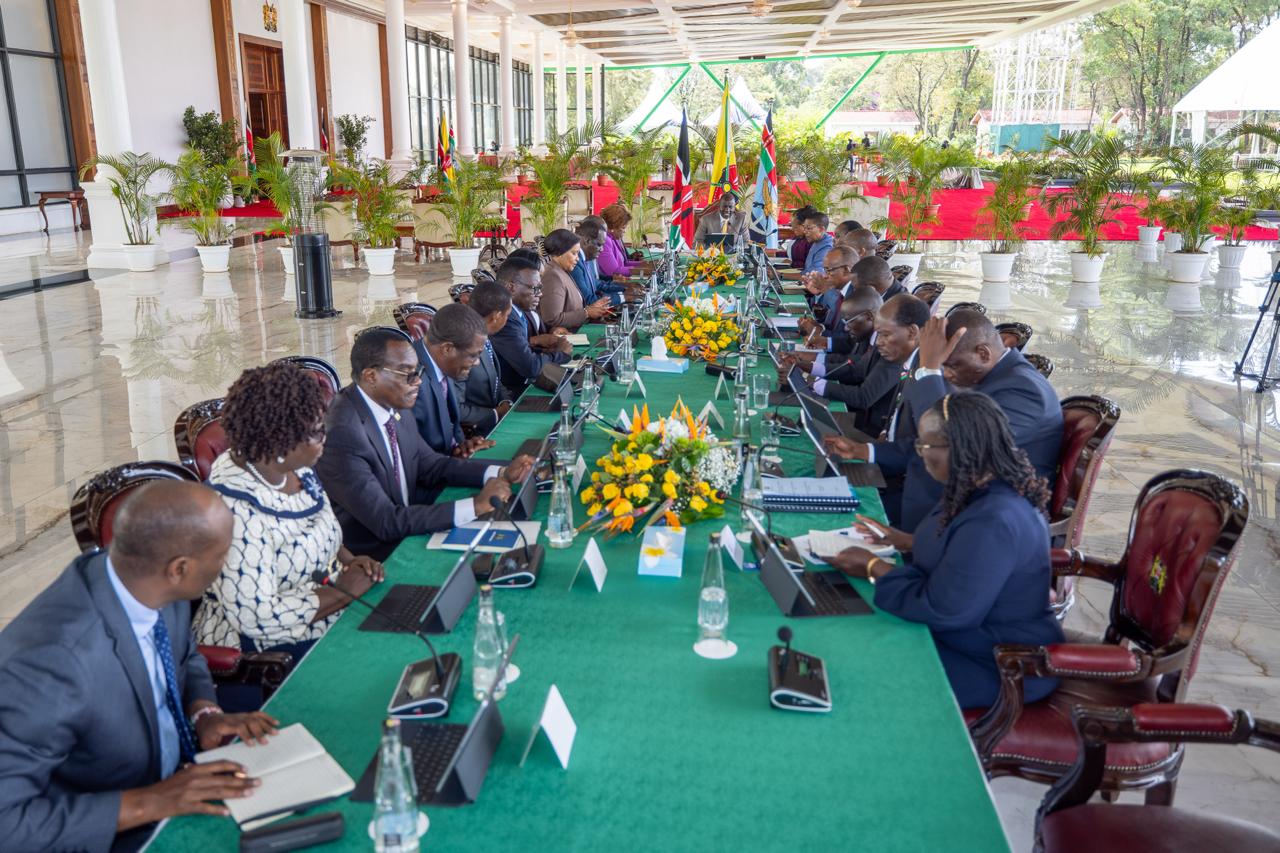
 President William Ruto chairs cabinet meeting on December 15, 2025 / PCS
The Controller of Budget’s review of the first three months of the 2025-26 financial year shows the exchequer is being stretched thin by debt repayments, pending bills and recurrent spending, leaving little for long-term public investment.
CoB Margaret Nyakang’o reveals that the Kenya Kwanza team is living from hand to mouth, a situation that threatens to crowd out development and deepen economic woes.
It reveals the struggles with public debt repayments, disbursement to counties, pending bills, development spending, and spending delays in critical sectors.
The report reveals that nearly half of the Sh1.1 trillion spent between July and September 2025 went to servicing public debt.
About Sh509 billion was spent on debt repayment alone, representing a 27 per cent jump from the same period last year.
Principal repayments alone rose to Sh251.80 billion, the surge showing the burden of a public debt stock that has ballooned to Sh12.04 trillion.
The expenditure highlights the continued pressure of debt servicing on the national budget.
“Debt servicing has reduced the resources available for current spending needs,” Nyakang’o said.
She noted that, “A significant portion of the government’s budget is allocated to debt servicing, leaving less money for other development expenditures.”
The report details that Consolidated Fund Services, the mandatory first-charge items on the national budget, consumed Sh545.48 billion in total.
This means that for every shilling spent, a significant portion is immediately redirected to creditors and mandatory expenditures, leaving less for development.
In what indicates the extent to which the engine of development is slowed, only Sh132 billion, which is 18 per cent of the allocated Sh744 billion, was spent in the review period.
The economy is being managed on a cash-flow basis, addressing the most urgent claims while longer-term capital projects are deferred.
The Controller of Budget’s warnings about procurement delays and the slow transition to accrual accounting are symptoms of the deeper crisis.
The investments meant to build roads, schools, hospitals and drive long-term economic transformation suffered cash constraints.
Critical sectors performed extremely dismally in terms of development spending, with the health sector spending a mere three per cent of its development budget.
The energy sector managed only four per cent, and six per cent for the General Economic and Commercial Affairs.
The report highlights procurement delays, bureaucracy in approvals, and no provisions for government's share of donor-backed projects.
County governments received only Sh66 billion in the first quarter, which translates to a paltry 16 per cent of their annual share.
In what further highlights the government’s liquidity challenges, pending bills remained stubbornly high at Sh525 billion as of September 30, 2025.
State corporations' debt accounted for 77 per cent of the amount, with details showing unremitted statutory deductions, unpaid contractors, and NHIF arrears.
Unremitted Sacco deductions grew to Sh10 billion from Sh3 billion last year, as pension arrears dropped significantly from Sh35 billion to Sh2.6 billion.
Fresh details show that state corporations had unpaid salaries to the tune of Sh37 billion as of the period under review.
While contractors' debts reduced by Sh55 billion, the debt owed to NHIF (now Social Health Authority, SHA) increased to Sh39 billion.
President William Ruto has on many recent occasions spoken to the cash crisis that his administration is facing, with no room for further borrowing and staging new taxes.
The President explained that the cash flow crisis is the reason his team has resorted to Public Private Partnerships as among avenues to realise the dream of a first-world country.
The Cabinet on Monday approved the formation of the Infrastructure Fund and Sovereign Wealth Fund to better manage projects.
“The funds will finance the country’s transformation agenda focused on strengthening food security, expanding modern transport, scaling up energy generation, and the digital economy,” the Cabinet brief reads.
“Under the new framework, all privatisation proceeds will be ring-fenced and invested strictly in public infrastructure projects that generate and preserve long-term value,” the brief adds.
As the crisis persists, the report highlights that the government remains on a spending spree, with Nyakang’o flagging wasteful spending in hospitality, travel, and allowances.
She noted that the government was yet to contain recurrent expenditure, calling for more rationalisation and efficiency, and stronger management controls.
The report shows that agencies burned Sh4 billion in local travel, Sh872 million on foreign trips, Sh2.2 billion on hospitality, and Sh17 billion on unspecified items.
Top spenders on hospitality were the National Land Commission (Sh567 million), State House (Sh199 million), Interior (Sh630 million), Judiciary (Sh55 million), OP (Sh40 million), and DP’s office (Sh44 million).
Government agencies spent Sh1.2 billion on rent, Sh781 million on training, Sh123 million on printing and advertising, Sh3.6 billion on purchase of specialised materials, Sh272 million on vehicle maintenance, and Sh261 million on insurance.
Constrained, the report shows the government has mostly resorted to Article 223 of the constitution, which allows for spending outside the approved budget to meet shortfalls.
In just three months, the state spent Sh43.50 billion under the special approvals, with security taking up Sh16 billion while Sh896 million went to settling Covid-19 pending bills.
The education sector, with the largest allocation of Sh703.07 billion, saw massive recurrent spending on teacher and university funding, but its development absorption was only 25 per cent.
Teacher salaries and university funding dominated recurrent spending, while infrastructure projects such as classrooms, laboratories for senior schools, and dormitories, lagged.
The social protection sector also saw high absorption rates, driven by cash transfer programmes.
The review highlights a recurrent-heavy budget structure where salaries, debt, and transfers leave no fiscal space for public investment.
Furthermore, the creation of seven new state departments has increased the number of MDAs to 87, raising the risks of higher public wage bill.
Nyakang’o concluded that the path forward requires “more rationalisation and efficiency, and stronger management controls” to balance immediate obligations with future prosperity.
INSTANT ANALYSIS
The report indicates that while the government is studious in settling debt, pensions, and a portion of salaries, it is at the cost of delayed development and accumulated arrears.The survivalist approach keeps the state functioning but sacrifices the investments needed for sustainable growth and job creation.